
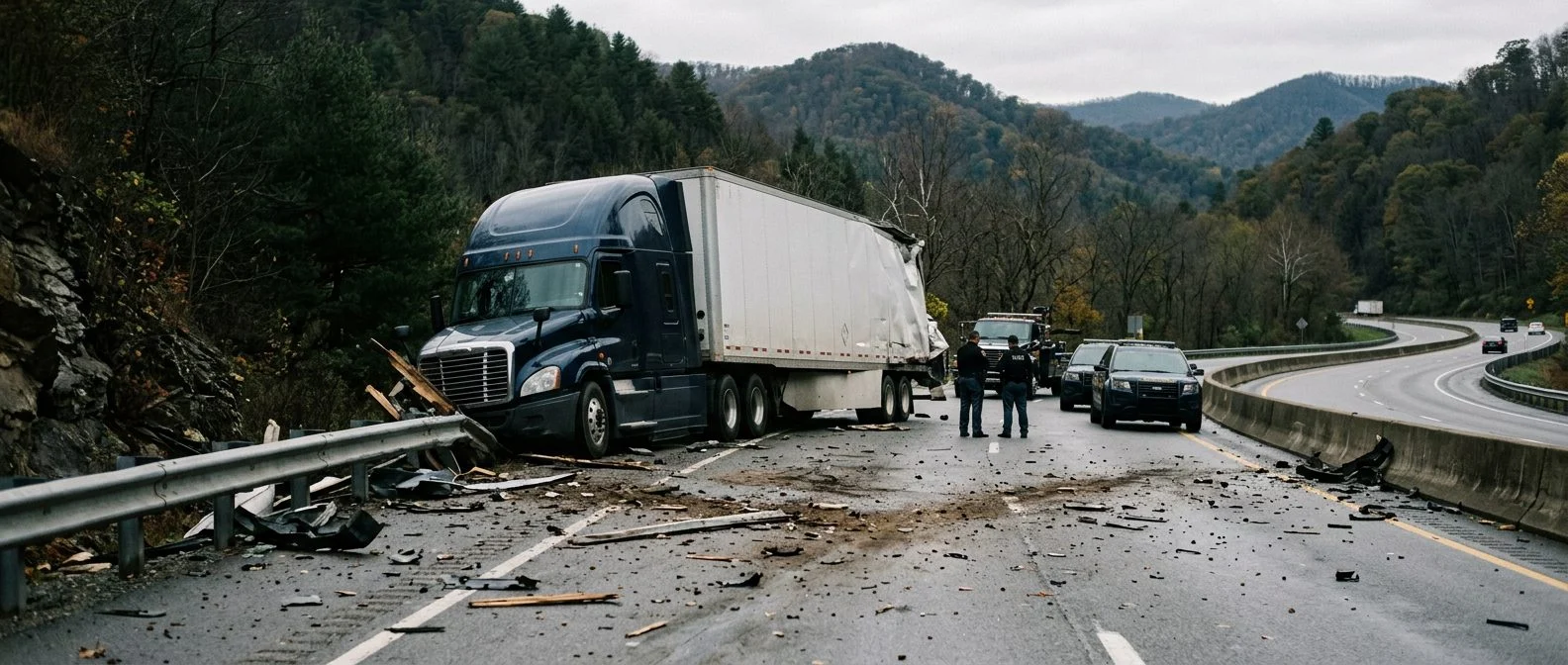
Truck Accidents | West Virginia
Can You Sue a Trucking Company After a West Virginia Crash?
Often, yes. Commercial truck crashes can involve more than one company and driver. Here is how these claims work and how the firm can help you understand your options.
Published October 28, 2026
Can you sue a trucking company if their truck hits you?
Often, yes. In many West Virginia crashes with a commercial truck, the trucking company can be named in a lawsuit along with the driver. Whether it can depends on the facts, especially whether the driver was working for that company when the crash happened.
A truck crash claim is usually more involved than a typical car crash claim. More people and more records are often part of the picture. There may be a driver, an employer, a company that leased the truck, a broker who arranged the load, and sometimes a maintenance shop. Each one may hold its own files and carry its own insurance.
The rest of this page walks through who can be named, how employer responsibility works, the federal rules that often matter, the deadlines, and the evidence that can disappear fast.
Does the trucking company always get named?
No. Naming the company depends on what it did, who controlled the driver, and what the records show.
If a commercial truck left you or someone you love badly hurt, you don't have to work out who is responsible alone. Request a free case review and talk through what happened. Talk it through with Big Bubba — the first case review is free, confidential, and carries no obligation.
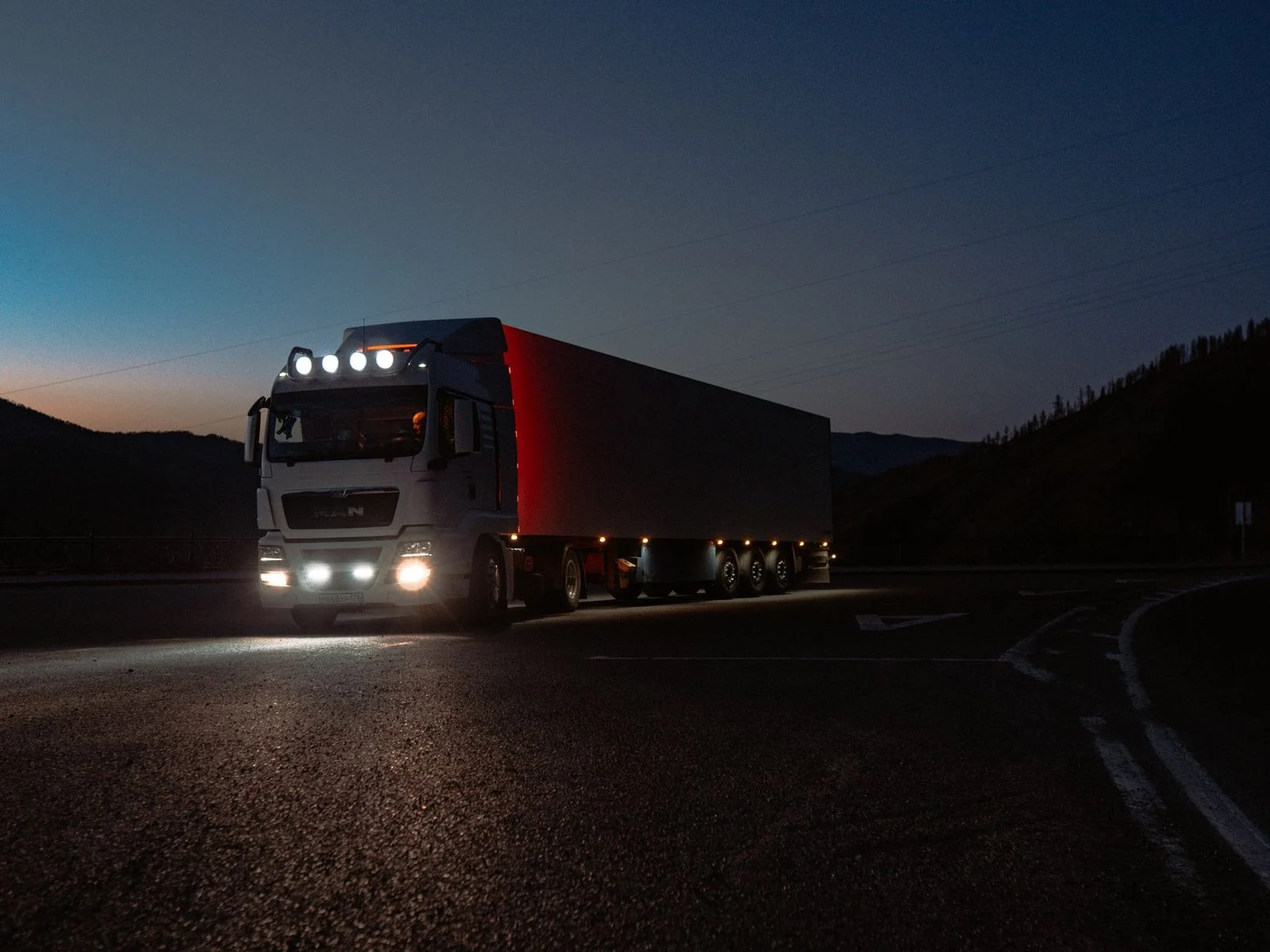
Who can be named in a West Virginia truck crash lawsuit
The driver whose negligence caused the crash can be named. Many injured people sue the driver and the company at the same time.
The motor carrier is the business that operates the truck. It includes the owner of a commercial motor vehicle, the employer of the person driving it, and anyone else who owns, leases, rents, or holds legal control over the vehicle or driver.
Other parties may share responsibility, depending on the facts. Examples include a vehicle owner, a company that loaded cargo unsafely, or a repair shop whose work failed. Naming every responsible party early matters. Each one may hold its own records and carry its own insurance.
This also affects how damages are divided. Under W. Va. Code § 55-7-13c, each defendant’s share of compensatory damages is generally several. That means each one answers for its own percentage of fault. Some exceptions apply, so the details of each case matter.
How a trucking company can be responsible for its driver’s actions
A trucking company can be responsible for a driver’s negligence when the driver was doing the company’s work. The company answers for an employee’s negligent act, not only for its own decisions.
West Virginia follows this rule. The key question is usually whether the driver was working for the company at the time of the crash. A delivery or route the company assigned is a common example.
Facts that often answer this include dispatch messages, load assignments, pay records, driver logs, and who owned the truck. Companies sometimes dispute employment status. That’s one reason the facts of the job matter so much.
Is the company’s name on the truck enough?
A name on the door helps, but it doesn’t settle the question by itself. The whole relationship between the driver and the business is what gets examined.
Direct liability: when the company’s own decisions are at issue
A company can also be responsible for its own decisions, separate from the driver’s actions. These claims ask whether the company acted reasonably in how it chose, trained, supervised, and equipped the driver.
Checking a driver means looking at the driving record, qualifications, and past work history.
Other claims look at training, supervision, and whether the company kept a driver it should have known was unfit. A company may also face questions about whether maintenance was kept up. Dispatch schedules that pushed a driver to keep going can be part of the story too.
These questions often rely on the company’s own files. That’s why records matter. People who wait to ask for them may find the answers harder to reconstruct later.
Leased trucks and independent contractors
Many drivers don’t work for the company whose name is on the truck. They may drive a leased truck, or they may be labeled independent contractors. Paperwork alone doesn’t always decide who is responsible.
Federal law addresses leased trucks. Under 49 U.S.C. § 14102, federal regulators may require a motor carrier that uses vehicles it doesn’t own to transport property under an arrangement with another party to put the arrangement in writing. Under 49 U.S.C. § 14102, the Secretary may require a motor carrier providing transportation subject to jurisdiction under subchapter I of chapter 135 that uses motor vehicles not owned by it to transport property under an arrangement with another party to do four things. It may require the carrier to make the arrangement in writing, signed by the parties and specifying its duration and the compensation to be paid by the motor carrier. It may require the carrier to carry a copy of the arrangement in each motor vehicle to which it applies during the period the arrangement is in effect. It may require the carrier to inspect the motor vehicles and obtain liability and cargo insurance on them. And it may require the carrier to have control of and be responsible for operating those motor vehicles in compliance with requirements prescribed by the Secretary on safety of operations and equipment, and with other applicable law as if the motor vehicles were owned by the motor carrier.
Courts look at practical facts, not just labels. When the relationship is disputed, both the driver and the company are often named. Federal rules also tell carriers to make drivers follow the duties placed on them. Under 49 C.F.R. § 390.11, whenever part 325 of subchapter A or this subchapter prescribes a duty for a driver or imposes a prohibition upon the driver, it is the motor carrier’s duty to require observance of that duty or prohibition.
Federal trucking safety rules that may support a claim
Federal trucking rules set limits that can matter after a crash. A rule violation can help show what went wrong. It is one part of the bigger picture, not the whole case.
Hours-of-service limits are a common focus. Under 49 C.F.R. § 395.3, a driver may not drive after 14 consecutive hours on duty that follow 10 consecutive hours off duty. A driver may drive 11 hours in that period. Weekly limits apply too.
Testing rules also matter. Under 49 C.F.R. § 382.303, an employer must test surviving drivers for alcohol and drugs after certain crashes. Those include crashes involving a death, where the driver was performing safety-sensitive functions, and crashes with an injury needing immediate treatment away from the scene or a tow-away, where the driver is issued a citation under State or local law for a moving traffic violation arising from the accident. Under 49 C.F.R. § 382.303, after an occurrence involving a commercial motor vehicle operating on a public road in commerce, each employer shall test for alcohol each surviving driver who receives a citation within 8 hours of the occurrence under State or local law for a moving traffic violation arising from the accident, and shall test for controlled substances each surviving driver who receives such a citation within thirty-two hours of the occurrence, in each case where the accident involved the conditions the regulation lists. Alcohol tests not given within two hours must be documented with reasons.
Driver qualification files and maintenance records are also key.
Not sure what your next step is?
Talk it through with Big Bubba — the first case review is free, confidential, and carries no obligation.
Can you sue a trucking company based in another state?
Yes, it’s often possible. Many trucking companies are based outside West Virginia but still run trucks on West Virginia roads. An out-of-state company is not automatically out of reach of a West Virginia claim.
Where a case can be filed depends on the crash location, where the parties are based, and the court rules that apply. The details shape the answer.
That means a reader’s options can reach beyond the driver and the local company. The details of who arranged the trip, who hired the carrier, and where the crash happened all matter.
Filing deadlines for truck crash claims in West Virginia
For most personal injury claims, West Virginia generally allows two years to file. Under W. Va. Code § 55-2-12, a personal action for injuries for which no other limitation is prescribed must be brought within two years after the right to bring it has accrued.
Wrongful death claims have their own rule. Under W. Va. Code § 55-7-6, the action must be brought by the personal representative of the deceased person’s estate. It must be commenced within two years after the death, subject to the provisions of section eighteen, article two, chapter fifty-five. W. Va. Code § 55-7-6 reads: “The provisions of this section shall not apply to actions brought for the death of any person occurring prior to July 1, 1988.”
Specific facts can affect deadlines, so waiting can narrow options. Shared fault can also matter. Under W. Va. Code § 55-7-13c, a plaintiff’s fault does not bar recovery unless it is greater than the combined fault of all other persons. Otherwise, the recovery is reduced in proportion to the plaintiff’s fault.
How long does a truck crash lawsuit take?
It varies widely and depends on the case. Timing depends on the parties involved, the records, and how the case develops.
Evidence that can disappear after a truck crash
Some of the most important proof sits in a company’s systems or on the truck itself. Electronic logging device data, dashcam video, and the truck’s event data recorder can be overwritten or lost. The company may keep these records only for a limited time.
Other key items include maintenance and inspection records, driver qualification files, dispatch messages, cargo records, and bills of lading. Photos of the scene and vehicle damage matter too. So do names and phone numbers of witnesses.
Early requests to preserve records help protect evidence the company controls. Insurers often call soon after a crash. West Virginia law limits some contact in the first days.
Who the claim may cover: the reader’s situation
An injury claim may address losses such as medical care, lost income, and how a serious injury changes daily life. A wrongful death claim has its own list. Under W. Va. Code § 55-7-6, a jury’s verdict shall include, but may not be limited to, damages for sorrow, mental anguish, and solace. It may also include lost income and services, care and hospital expenses, and reasonable funeral expenses.
The losses that apply depend on the injury, the family’s situation, and the evidence. Serious injuries can bring long-term needs. That’s one reason the full picture often takes time to build.
No one can predict how a particular claim will turn out. Each case depends on its own facts, its own records, and the law that applies to it.
Where you stand now, and talking with the firm
You may be reading this while caring for someone hurt in a truck crash. You may be coping with the loss of a family member. You may not have decided what to do next, and that’s a normal place to be.
The decision in front of you is often this: whether the trucking company, its insurer, and the driver can be held responsible. It also includes whether to act before records and deadlines pass. The points above are a starting map, not a verdict.
If you want to talk through the crash details and your legal options, you can request a free case review with the firm. The review is confidential.
We serve injury victims across West Virginia, including Charleston, Huntington, Morgantown, Wheeling, Martinsburg, Parkersburg, Beckley, Clarksburg, Fairmont, and Weirton.