
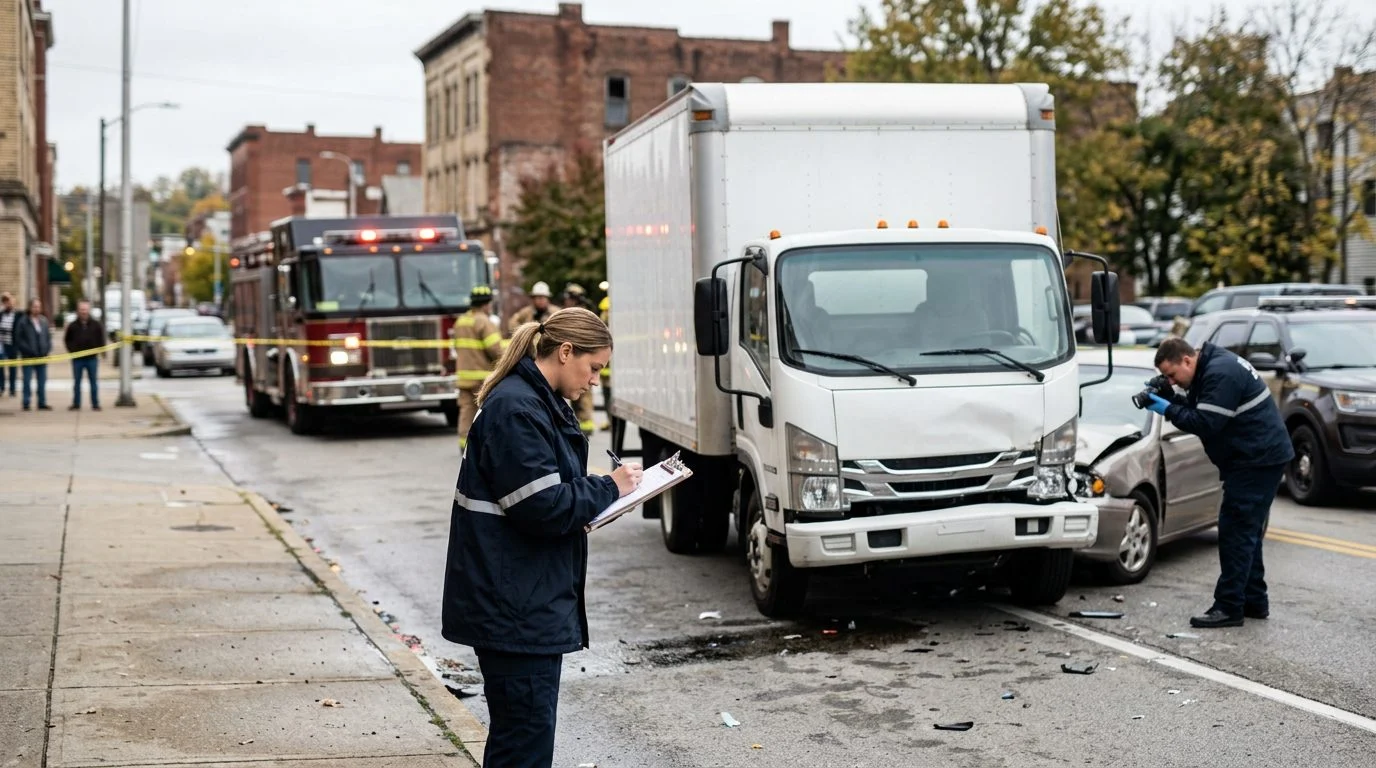
West Virginia | Company Vehicle Crashes
Employer Liability in Company Vehicle Crashes in West Virginia
When a crash involves a vehicle a company owns or assigns to a worker, questions about who may be answerable can get complicated. This page offers a plain-language starting point.
Published November 4, 2026
Why This Question Comes Up After a Company Vehicle Crash
An employer can sometimes be answerable for a crash involving a company vehicle in West Virginia. Whether it is depends on the facts of each crash.
You may have been hurt yourself. You may be caring for someone who was, or grieving a family member who died. Some readers are asking on someone else’s behalf. Each of these situations is stressful, and the paperwork can feel unfamiliar.
A crash with a company car, van, or truck raises two separate questions. The first is who was driving and what that driver was doing. The second is whether the business that owns the vehicle, employs the driver, or directs the driver’s work can also be answerable.
Those questions are often answered with different evidence. The crash report and witnesses may show what the driver did. Work schedules, dispatch records, and driver files may show the company’s role.
Each crash has its own facts, and the same kind of crash can raise different questions under West Virginia law.
If a company vehicle was part of the crash that hurt you or someone you love, you don't have to work out the answer alone. You can request a free case review. Talk it through with Big Bubba — the first case review is free, confidential, and carries no obligation.
How an Employer Can Be Answerable for an Employee’s Driving
An employer may generally be held responsible for harm caused by an employee’s negligence when the employee was acting within the scope of employment.
“Vicarious” means one party answers for the act of another. The starting point is the driver’s own negligence, such as speeding, distracted driving, or failing to yield. The next question is whether that negligence can also be tied to the company.
Ownership of the vehicle is one fact, but it is not the whole answer. The W. Va. Code § 55-7-32 defines an “employer defendant.” That includes the vehicle’s owner, the driver’s employer, and any entity with legal control over the vehicle or driver.
The statute applies only to commercial motor vehicles that fit its definitions, so the vehicle type matters.
The link between the driving and the job is usually what gets examined.
Federal rules also place duties on the company. Under federal motor carrier rules, when a rule in part 325 of subchapter A or in that subchapter puts a duty on a driver, the motor carrier must require the driver to follow it.
What Scope of Employment Means on the Road
A driver on a delivery route, headed to a job site, or carrying out an assigned task is a common example.
Personal errands and detours may be treated differently. The timing, purpose, and route of the trip can all matter. A short personal stop during a work trip may look different from a trip the employer never approved.
Useful facts include start and end times, planned stops, and who assigned the load or route. Phone messages, dispatch texts, and GPS data may show where the driver was going and why.
Write down what the driver was supposed to be doing that day. Note the start time, the planned stops, and who gave the assignment. If you know the driver’s name or the company’s name, write those down too.
Notes made soon after the crash may be useful later, while memories are fresh. Keep them factual. Write what you saw, heard, and were told, and leave out guesses.
Direct Claims Against the Company: Hiring, Supervision, and Vehicle Entrustment
A claim may also focus on the company’s own choices, not only the driver’s actions. These claims look at what the company knew or should have known.
Facts that may be relevant, depending on the case, include ignored safety complaints, skipped driver checks, and maintenance problems. Federal rules require motor carriers to keep a driver qualification file for each driver they employ. Those files may show what the company checked before putting someone behind the wheel.
These company-focused claims can run alongside a claim based on the driver’s own negligence. Each one has its own facts and its own proof.
A common mistake is assuming the driver is the only possible target. The company’s own decisions can be part of the question.
When Independent Contractor Labels and Vehicle Ownership Are Disputed
A company may describe a driver as an independent contractor.
Courts and insurers may look at how the work actually operated. Useful questions include who controlled the work, who set the schedule and routes, who supplied the vehicle, and who could assign or refuse loads.
Ownership, leasing, and insurance arrangements can bring more companies into the picture. Under the West Virginia statute, a party that leases, rents, or holds legal control over a commercial vehicle may fall within the definition of an employer defendant.
Insurance matters here too. The West Virginia Division of Motor Vehicles explains state auto insurance requirements and proof of coverage. Lease agreements and insurance cards may show who owned the vehicle and who insured it.
Keep any contract, pay record, or text message that describes the work arrangement. These documents may explain the relationship better than a label does.
Workers’ Compensation and Claims Against Another Driver
Workers’ compensation generally works differently from a negligence lawsuit.
Benefits, forms, and deadlines depend on the job and the claim. The rules differ from those for a lawsuit against a driver.
Whether that claim exists can vary by case.
Keep records of benefit forms, deadlines, and letters from the employer and any insurer. Write down the dates of phone calls and who you spoke with. These details may matter later, especially if more than one claim is open.
Not sure what your next step is?
Talk it through with Big Bubba — the first case review is free, confidential, and carries no obligation.
Evidence That May Matter in a Company Vehicle Crash Claim
Common starting points include the police crash report, photos of the scene and vehicles, witness names, and medical records. These show what happened and what injuries followed.
Company records may also be relevant.
Driver vehicle inspection reports are kept for only three months from the date they were prepared, but these rules do not apply to a private motor carrier of passengers (nonbusiness), a driveaway-towaway operation, or any motor carrier operating only one commercial motor vehicle. Because that period is short, asking early matters.
After certain crashes on public roads, federal rules may require alcohol and drug testing of surviving drivers, usually within set hours. When a test is not given in time, the employer must keep a record of the reasons.
Federal hours-of-service rules set driving limits and required breaks for many drivers. Logs and dispatch records may show whether those limits were followed.
Electronic data, phone records, and dash camera footage can be overwritten or lost over time. Asking for preservation early may help. You don’t need to gather all of this alone. Our firm can help identify what to request when you contact us for a free case review.
Time Limits to Keep in Mind
West Virginia generally allows two years to bring a personal injury action. Exceptions may apply, so the exact deadline in a given case should be checked early.
For a wrongful death case, West Virginia generally requires the action to be brought within two years after the death, subject to other provisions of state law. The action is brought by the personal representative of the deceased person.
Under W. Va. Code § 55-7-13a, recovery in a personal injury or wrongful death action is generally based on principles of comparative fault, with liability allocated to each person who proximately caused the damages, including the injured person, in direct proportion to that person’s percentage of fault.
Claims against employers, drivers, and insurers can involve different steps and different records. Waiting to look into the question may narrow your options.
Early review helps you see which deadlines may apply to your situation.
Talking Through Your Company Vehicle Crash
If a company vehicle was part of the crash, the next step is to look at the facts together. The core questions are who was driving, what the driver was doing, and what the company knew and did.
Start with the driver’s role, the trip, and the company’s involvement. Then consider which records and deadlines may apply. The facts of your own crash will shape the answer.
Quick Answers
Can a company be answerable if its driver caused a crash in a company vehicle?
It may be, especially if the driver was doing work for the company at the time.
Does calling a driver an independent contractor end the question?
Not always. The label is one fact among others, including who controlled the work.
How long do you generally have to file?
West Virginia generally allows two years for many injury and wrongful death claims, and exceptions may apply.
If a company vehicle was involved in the crash that hurt you or someone you love, you may still be sorting out what happened. You don’t have to decide who may be responsible on your own. You can request a free case review, where the driver’s role and the company’s involvement can be discussed in your own words.