
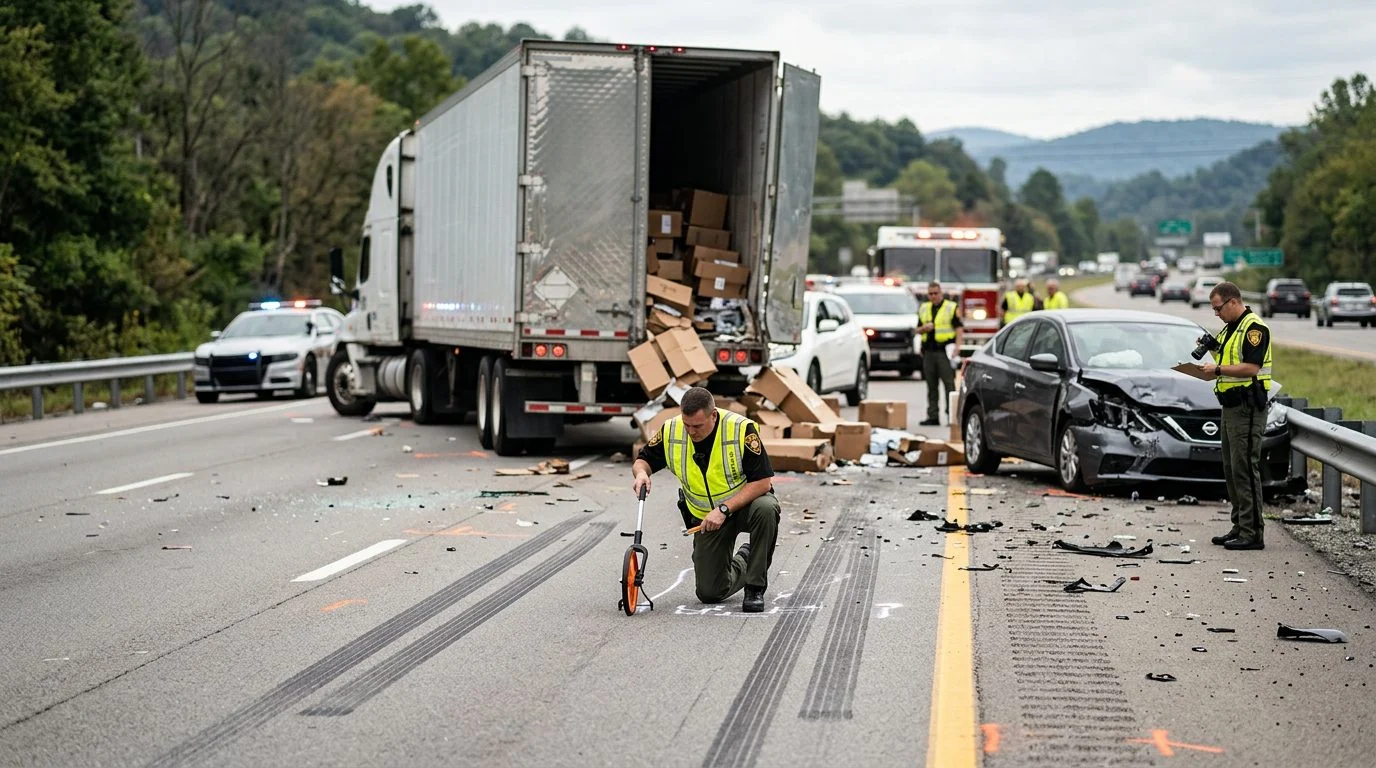
Truck Accidents | West Virginia
Truck Accident Settlement Timeline in West Virginia: What Shapes How Long a Claim Takes
Big Bubba helps people hurt in car and commercial truck crashes, and families in wrongful death cases, across West Virginia. Here is what affects the pace of a truck accident claim.
Published October 27, 2026
The Short Answer: Truck Accident Settlements Vary in Length
How long do truck accidents take to settle? There is no single answer, but many truck claims take several months or longer. Truck claims often run longer than car accident claims.
A claim with minor injuries and clear fault may move in a few months. A claim involving serious injuries or a death usually takes longer, because the full harm must be understood first. This page explains the general process. It does not predict how long any one claim will take.
Four factors shape the pace: how serious the injuries are, how many parties are involved, how quickly evidence is gathered, and whether the insurer negotiates in good faith. If talks stall, the case may need to be filed in court, which adds more time.
If you're reading this while caring for an injured family member, you don't have to sort out the timeline alone. Talk it through with Big Bubba — the first case review is free, confidential, and carries no obligation.

Why Truck Accident Claims Often Take Longer Than Car Accident Claims
Truck claims take longer because more companies, rules and records are involved in one crash. A typical car accident often involves two drivers and two insurance policies. A commercial truck crash can involve the driver, the trucking company and several insurers.
Commercial trucks are usually operated by drivers employed by a carrier. The carrier’s insurance is often larger and layered.
Federal rules also govern commercial trucks. These cover driving hours, inspections, maintenance and driver hiring. Reviewing compliance takes time.
Trucking insurers also rely on claims staff, adjusters and outside investigators. That can stretch out communication and review. If a company or insurer contacts you early, read about trucking company calls after a crash.
The Stages of a Truck Accident Claim
A truck accident claim usually moves through four stages, though the order and timing vary.
- Early evidence. Police reports, photos, vehicle damage and witness names are gathered first.
- Investigation. The crash is examined, including the driver’s records, the carrier’s hiring and safety files, and maintenance history.
- Treatment and documentation. Medical care continues, and records are gathered into a demand for compensation.
- Negotiation, then possible lawsuit. The insurer responds. The claim may settle, or it may stall and move toward a court filing.
These stages often overlap. Knowing them helps you see where your own claim may sit. The time a claim takes is tied to how far it has moved through these steps.
Lengthy Investigations and Why Evidence Takes Time
Investigations take time because much of the key evidence sits with the trucking company. Getting it can take weeks or months.
Many trucks record data automatically. Under federal rules, an electronic logging device (ELD) records the date, time, location, engine hours, vehicle miles, driver and vehicle identification, and motor carrier identification. The federal ELD recording rule lists these data elements. Engine control module information and dispatch messages may also matter.
Timing matters because records are not kept forever. Prompt requests help make sure the data is preserved.
Driver files matter too. Under the federal driver investigation rule, replies to a carrier’s safety investigation of a driver must be placed in the driver investigation history file within 30 days of the driver’s start date.
Reconstructing the crash and inspecting the truck can also take months, especially with complex mechanical or road conditions. Your own records help. Photos, notes, texts and copies of insurer letters give the investigation a starting point.
How Medical Treatment Affects the Settlement Timeline
A claim is usually easier to value once medical treatment shows how the injury will affect the person over time. Settling too early can leave important effects unknown.
Catastrophic injuries often need long treatment. A traumatic brain injury can cause changes in thinking, mood and movement that take time to measure. A spinal cord injury may require surgery, rehabilitation and equipment changes.
Doctors may need several visits, tests and therapy sessions before they can describe the long-term picture. A claim often cannot be fully valued until the injured person’s condition is clear enough for doctors to assess. This is one reason serious claims often run longer.
Your part matters too. Follow medical advice, keep appointment records, and save bills and notes about daily limits. These records are a central part of the claim. Gaps in care can make the medical record harder to review.
Complex Liability and Multiple Parties
More than one party can share fault in a truck crash, and each one can add time.
Possible parties include the driver, the trucking company, a vehicle owner or lessor, a company that loaded the cargo, a maintenance contractor, or a parts maker. Each may have its own insurer, lawyer and investigation. Each new party can extend talks.
West Virginia uses a modified comparative fault rule. Under W. Va. Code § 55-7-13c, fault chargeable to the injured person does not bar recovery unless that person’s fault is greater than the combined fault of all others. W. Va. Code § 55-7-13c reads: “(c) Any fault chargeable to the plaintiff shall not bar recovery by the plaintiff unless the plaintiff’s fault is greater than the combined fault of all other persons responsible for the total amount of damages, if any, to be awarded.” Otherwise, recovery is reduced in proportion to that person’s fault.
Fault can also be assigned to a nonparty. Under W. Va. Code § 55-7-13d, a defending party may give notice that a nonparty was wholly or partially at fault, no later than one hundred eighty days after service of process upon that defendant. The notice must be filed with the court and served upon all parties to the action, designating the nonparty and setting forth the nonparty’s name and last known address, or the best identification of the nonparty which is possible under the circumstances, together with a brief statement of the basis for believing such nonparty to be at fault. That notice can start a new round of investigation.
If your crash involved a truck’s rear or side underride guard, read about truck underride crashes.
Not sure what your next step is?
Talk it through with Big Bubba — the first case review is free, confidential, and carries no obligation.
Settlement Negotiations, Litigation, and Filing Deadlines
Most truck claims are resolved through negotiation, but a claim can move toward a lawsuit if talks stall.
Negotiation usually follows a pattern. A demand is sent, the insurer responds with a counteroffer, and both sides exchange documents. Rounds of back-and-forth can take months.
West Virginia also limits early talks. Under W. Va. Code § 55-7-11a, during the first twenty days after a personal injury, no one may negotiate a settlement while the injured person is an inpatient in any hospital or partially or totally unable to engage in his or her usual trade, profession or occupation. Under W. Va. Code § 55-7-11a, an injured person may disavow a settlement, release or statement obtained in violation of this section within one hundred eighty days from the date of the injury, by signing a written statement of disavowal and sending a copy to the person who violated the section; the settlement, release or statement then cannot be used as evidence if any money paid for it is repaid or returned.
A claim may move toward a lawsuit when the insurer does not respond fairly, or when the sides cannot agree on fault or the value of the harm. Then court schedules, discovery (the exchange of evidence before trial) and trial dates extend the timeline.
The filing deadline is a separate clock. West Virginia generally allows two years for personal injury actions under W. Va. Code § 55-2-12. Some rules can change these dates, so timing matters early.
How long do truck accidents take to settle in West Virginia?
Timing turns on the injuries, the parties, the evidence and whether a lawsuit is needed. There is no fixed number of months.
What is the deadline to file a truck accident claim in West Virginia?
For most personal injury claims, West Virginia generally allows two years under W. Va. Code § 55-2-12. A wrongful death action must be commenced within two years after the death under W. Va. Code § 55-7-6, subject to the provisions of section eighteen, article two, chapter fifty-five. W. Va. Code § 55-7-6 reads: “The provisions of this section shall not apply to actions brought for the death of any person occurring prior to July 1, 1988.”
Can an insurer settle a truck crash claim in the first 20 days?
West Virginia law restricts settlement talks during the first twenty days after an injury, while the injured person is in the hospital or unable to work. The rule is found in W. Va. Code § 55-7-11a.
What Affects the Value of Pain and Suffering and Other Losses
Non-economic losses are documented over time, and that documentation often shapes how quickly a claim can be evaluated.
Non-economic losses include pain and suffering, loss of enjoyment of life and emotional distress. They are harder to measure than bills. Doctor records and notes about daily life help show how the injury has changed someone’s routine.
Economic losses include medical bills, lost income and future care needs. These are documented through bills, pay records and care plans. Gathering them can take time.
In a wrongful death case, W. Va. Code § 55-7-6 lists the losses a jury may consider. These include sorrow, mental anguish and solace, lost income and services the decedent would have provided, care and hospital expenses, and reasonable funeral expenses. Families build this picture over time.
For certain commercial vehicle crashes, W. Va. Code § 55-7-32 sets a limit of $5 million for each occurrence on noneconomic damages against an employer defendant, and beginning January 1, 2026, that limit increases to account for inflation under the Consumer Price Index, but not to more than 150 percent of the $5 million amount. The cap is available only if the employer carries commercial motor vehicle insurance in the aggregate amount of at least $3 million for each occurrence covering the personal injury. It does not apply when a driver was found to have operated the vehicle loaded in excess of the maximum gross vehicle weight rating established under state or federal regulations, not including when an operator or driver is legally operating the vehicle according to a permit issued under § 17C-17-11, among other exceptions. This is a legal limit, not an estimate of what any claim is worth.
After an Agreement: Paperwork, Liens, and Receiving Payment
After an agreement, the final paperwork and any reimbursement claims usually must be resolved before money is paid.
Under W. Va. Code § 55-7-11a, if a person sustains a personal injury, no person shall, within twenty days from the date of the injury, while the injured person is an inpatient in any hospital or is partially or totally unable to engage in his or her usual trade, profession or occupation: negotiate or attempt to negotiate a settlement of the claim for that injury with or on behalf of the injured person; obtain or attempt to obtain from the injured person a partial or general release of liability for that injury; or obtain or attempt to obtain any statement from the injured person for use in negotiating a settlement or obtaining a release, except that a person acting or intending to act on behalf of the injured person may obtain a statement upon the injured person’s express request. Health insurers and other payers may have reimbursement claims for care they paid for. Those claims must be resolved in the paperwork.
Payment timing varies with how quickly the insurer and payers finish their steps. Funds are usually issued after the paperwork is complete.
Wrongful death settlements may need court approval. Under W. Va. Code § 55-7-7, the personal representative may compromise a wrongful death claim before or after a lawsuit is filed. Once the court approves the compromise, it apportions and distributes the damages. That extra step adds time.
Key Dates in a Truck Crash Timeline
If you’re reading this while caring for an injured family member, you don’t have to sort out the timeline alone. Someone researching this may be in a hospital bed, missing work, or fielding insurer calls.
You can reach out to the firm to request a case review. In that conversation, the firm can talk through the facts of your truck crash and how they may affect timing.
The firm serves Charleston, Huntington, Morgantown, Wheeling, Martinsburg, Parkersburg, Beckley, Clarksburg, Fairmont, Weirton and communities across West Virginia. To request a free case review, reach out whenever you’re ready.