
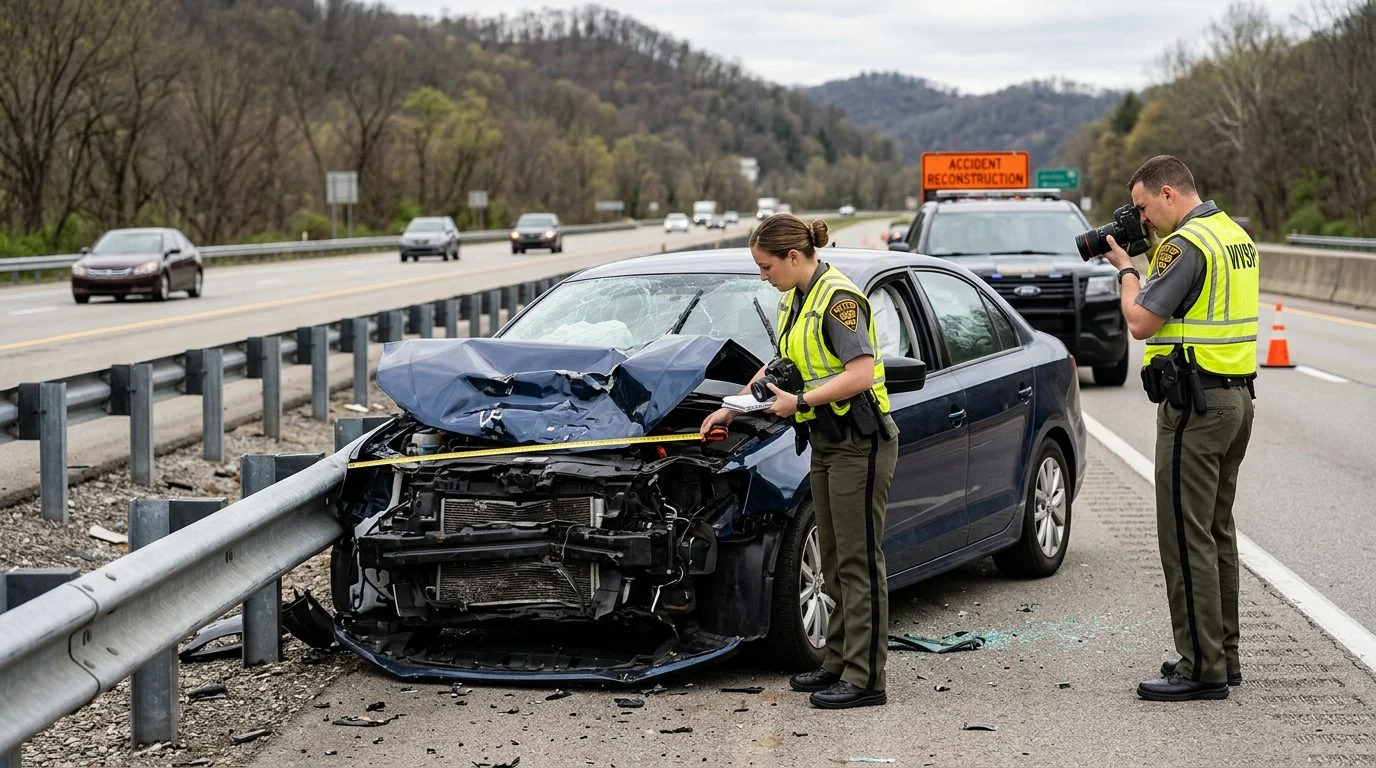
Serving West Virginia crash victims
Asked for a Recorded Statement? Talk to Us First.
After a serious crash, an insurance adjuster may ask to record your account. Learn what the request means, what to watch for, and how the firm can help you decide how to respond.
Published October 24, 2026
If an insurance adjuster asks for a recorded statement after a serious crash, you can pause before you answer. A recorded statement is an audio interview the insurer uses to build its claim file. This guide explains what the request means in West Virginia, what to say, what to avoid, and how to decline or delay. Many people face this call while they are hurt, in the hospital, or answering for a family member. The steps below apply to any recorded statement after a catastrophic crash in West Virginia.
Why an Insurance Adjuster Asks for a Recorded Statement
An adjuster asks for a recorded statement to collect your account of the crash for the insurer’s file. The request often comes within days of the crash. At that point, the injured person may still be in the hospital, taking strong medication, or unsure how badly they are hurt.
West Virginia limits some early contact. W. Va. Code § 55-7-11a says that for twenty days after an injury, no one may try to negotiate a settlement or obtain a statement for that purpose. This applies while the injured person is an inpatient in a hospital or partially or totally unable to engage in their usual trade, profession or occupation. The statute also does not bar a person acting for the injured person from obtaining a statement if the injured person expressly asks for one.
You may not have chosen this call. Maybe you are a spouse, adult child, or sibling answering for someone who cannot talk yet. That is a hard position, and it is common after a serious crash.
Your own insurer and the other driver’s insurer are different companies. The other driver’s insurer looks at its own driver’s share of fault. Your own policy has its own terms, so the rules can differ. Ask before you assume.
If you want to talk through the crash, the injuries, and this adjuster's request, you can reach out to Big Bubba Injury Law and ask for a free case review. Talk it through with Big Bubba — the first case review is free, confidential, and carries no obligation.

A Recorded Statement Is Not a Casual Conversation
A recorded statement is a formal record, even when the call feels friendly. Anything you say can be quoted later in a claim review, a denial letter, or a court filing.
Small words matter. “I think,” “maybe,” and “I didn’t see it” can be heard as firm facts. A guess about speed or distance can later be presented as your certain answer. Once it is on the recording, you cannot take it back on the call.
Keep in mind who the adjuster works for. The adjuster is paid by the insurance company, and the job is to evaluate the claim for that company. The call can sound kind and still serve the insurer’s interests.
Auto Negligence and Why West Virginia’s At-Fault System Makes Your Words Matter
After a crash, questions often come up about what each driver did before and during the collision, and a case review with the firm can help you sort through them. In a claim, the central question is often who was at fault and by how much.
West Virginia uses comparative fault. Under W. Va. Code § 55-7-13a, recovery is based on each person’s percentage of fault. Under W. Va. Code § 55-7-13c, fault chargeable to the injured person does not bar recovery unless it is greater than the combined fault of others. W. Va. Code § 55-7-13c reads: “(c) Any fault chargeable to the plaintiff shall not bar recovery by the plaintiff unless the plaintiff’s fault is greater than the combined fault of all other persons responsible for the total amount of damages, if any, to be awarded.” If it is less, recovery is reduced in proportion to that person’s fault.
That is why a few words can matter. Suppose you say the light was yellow, or that you were “going a little over.” An adjuster can use those words to argue that you share some of the blame. Whether and how that matters depends on all the facts of your crash.
Questions That Deserve Careful Answers
Answer basic identity and vehicle questions briefly and accurately. Your name, address, vehicle make, and insurer are usually simple to confirm.
For the crash itself, describe only what you clearly remember. Say “I don’t remember” when that is true. Do not fill gaps with a likely story.
A traumatic brain injury can affect memory, attention, and the sense of time. A person may feel pressure to answer quickly and get details wrong. A normal scan does not mean the injury is not real. Read more about proving a brain injury caused by a crash, even with normal scans.
Be accurate and complete about prior injuries, medical history, and medications. Gaps can later look like hiding something. Complete answers help keep your account consistent with your records.
What Not to Say to the Insurance Adjuster
Avoid guessing about speed, distance, or the time of day. Do not present an estimate as a fact.
Avoid apologizing. People often say “I’m sorry” out of politeness. On a recording, it can be heard as an admission of fault.
Avoid calling your injuries minor or saying “I’m fine.” Recovery from a catastrophic injury often unfolds over weeks or months. Early statements may not reflect how you will feel later.
Avoid discussing the value of the claim, agreeing to any number, or signing a release on the call.
Avoid speculating about what the other driver was doing or why the crash happened. Stick to what you saw and heard yourself.
How to Decline, Delay, or Offer a Written Statement
You can say you are not ready to give a statement. You can also ask that the request be made in writing.
Before you answer any question, ask for the adjuster’s name, company, claim number, and the purpose of the statement. Write these down with the date and time of the call.
If a recording is made, ask for a copy or transcript. Keep your own notes of every contact.
A written statement can be prepared with more care than a live call. You can review it, correct it, and decide what to include.
Early settlement offers can arrive before the full extent of an injury is known. Read more about why speed is not always in your interest.
If someone obtained a statement in violation of § 55-7-11a, the statute lets you disavow it. You may do so at any time within one hundred eighty days from the date of the injury by executing a written statement of disavowal and forwarding a copy of it to the person who violated this section, as described in W. Va. Code § 55-7-11a. After the written disavowal is forwarded, the settlement, release or statement may not be admissible in evidence for any purpose in any court or other proceeding relating to the injury, so long as any consideration paid for the settlement or general release is repaid or returned to whoever paid it at the time the copy of the disavowal is forwarded.
Not sure what your next step is?
Talk it through with Big Bubba — the first case review is free, confidential, and carries no obligation.
When a Commercial Truck Is Involved
Truck crashes can involve more than one insurer. The trucking company’s insurer, the driver’s employer, and other coverage may all be part of the picture.
Adjusters may ask about the trip, the driver’s schedule, or the load. Federal rules require motor carriers to make drivers record their duty status for each 24-hour period, as described in 49 C.F.R. § 395.8. Electronic logging devices automatically record data such as date, time, vehicle location, engine hours, and vehicle miles, as described in 49 C.F.R. § 395.26. These records may matter to what happened.
On a recorded call, do not answer questions about the company’s records or the driver’s hours. Ask for those questions in writing. You can also read more about truck driver logs and black box data after a crash in West Virginia.
Talking Through Your Situation Before You Answer Another Call
You may be caring for a seriously hurt family member, managing medical appointments, and facing a call you did not expect. That is a lot to carry at once.
Here are the steps to remember. Pause before you answer. Ask for the request in writing. Answer only what you clearly remember. Keep a written record of every contact.
If you want to talk through the crash, the injuries, and this adjuster’s request, you can reach out to Big Bubba Injury Law and ask for a free case review. The review is confidential, and it carries no obligation to continue. Request your free case review.
For more on the claim process after a serious injury, visit the catastrophic injuries resource page.