
West Virginia Injury Claims
Hurt in a Crash Despite Your Seat Belt? Talk to Big Bubba Injury Law
We represent West Virginia families dealing with serious injuries from car and truck crashes, including seat belt related claims, brain and spinal cord injuries, and wrongful death.
Published October 27, 2026
Short Answer: Does Not Wearing a Seat Belt End a Claim?
Short answer: a missing belt does not automatically end a seat belt catastrophic injury claim West Virginia families bring. It can change how fault and damages get argued. How much it matters depends on the crash facts, the injuries, and the evidence.
State law limits how a belt question can be used. Where a person making a claim for damages in a civil action was the driver of a passenger vehicle involved in the collision, evidence that the claimant driver was not wearing a safety belt at the time of the collision is not admissible to show his or her negligence. See W. Va. Code § 17C-15-49a. Whether a missing belt can be used to argue that injuries were made worse depends on the facts, and the statute sets different rules depending on who was in the vehicle. That argument has its own rules, covered below. No one can predict how a specific case will turn out.
Not sure what your next step is?
Talk it through with Big Bubba — the first case review is free, confidential, and carries no obligation.
Why Seat Belt Use Comes Up in Crash Claims
Insurers and defendants raise seat belt use to argue that the hurt person added to their own harm. That argument is the main reason the question comes up in serious crash cases.
West Virginia requires drivers and front-seat passengers to wear a safety belt. Back-seat passengers under 18 must wear one too. W. Va. Code § 17C-15-49 sets that rule. Keep two questions apart. The first is whether a belt was worn. The second is whether not wearing one caused or worsened a specific injury. Courts treat those questions differently.
In a catastrophic injury case, the second question usually carries the most weight. A single crash can cause several injuries from different forces. Sorting out which force caused which injury takes medical records and careful review. Early in a case, that sorting often matters more than the belt itself.
How West Virginia Fault Rules Apply
West Virginia uses modified comparative fault. Your share of fault can reduce your recovery, but it does not always cancel it. W. Va. Code § 55-7-13c says the injured person’s fault bars recovery only when it is greater than the combined fault of everyone else responsible. If it is less, the recovery shrinks by the injured person’s share.
Most serious crashes involve more than two people or companies. The jury must consider everyone who contributed to the harm. That includes people who were never named in the lawsuit. In commercial vehicle cases, this matters a great deal. An employer may be held liable for fault assigned to an agent or servant, such as a driver.
Each defendant’s share of compensatory damages is generally several only. That means each pays its own share, in proportion to its fault, with exceptions set by statute. Every claim turns on its own facts. The split between parties is decided case by case.
Separating Crash Injuries From Injuries a Belt Could Have Changed
Causation is the real question in most of these claims. The issue is which injuries came from the impact itself. The second issue is which injuries, if any, might have been different with a belt worn.
West Virginia limits how that argument can be used. If the claimant was the driver of a passenger vehicle and was not wearing a safety belt, that evidence may be admissible to show that the missing belt exacerbated or contributed to the claimant driver’s damages. The defendant’s burden of proof must be supported by testimony that meets the threshold requirements of Rule 702 of the West Virginia Rules of Evidence. The defense must support that point with testimony that meets Rule 702 of the West Virginia Rules of Evidence. W. Va. Code § 17C-15-49a governs the admissibility of evidence of the failure of an occupant of a passenger vehicle to use a safety belt in any civil action. Under W. Va. Code § 17C-15-49a(f), the court, in its discretion, may upon request of a party bifurcate the trial if it determines that it is necessary to prevent prejudice or avoid confusion of the jury. If the court grants bifurcation, the questions of liability are tried first and the question of damages is presented separately thereafter.
The rule for children is different. For an unbelted child passenger, the statute bars using the missing belt to show the child’s negligence. It may still be admissible, subject to the West Virginia Rules of Evidence, to show the driver’s negligence.
In plain terms, the medical question is where the body moved during the crash. Striking the steering wheel or dashboard can cause different injuries than being held in place. Medical records and imaging help show these details. Doctors’ notes help connect them to the crash.
When the Seat Belt Itself Failed
A seat belt, buckle, retractor, or anchor that fails may support a separate claim. That claim is different from a claim about nonuse. The focus shifts from what the injured person did to how the equipment performed.
West Virginia’s product liability statute covers actions against a manufacturer or seller. These actions are based in whole or in part on strict liability in tort. They can include a failure to warn. W. Va. Code § 55-7-31 sets out those terms.
Federal rules also set standards for truck seat belts. Under 49 C.F.R. § 393.93, trucks and truck tractors manufactured on or after July 1, 1971 must conform to the requirements of Federal Motor Vehicle Safety Standard No. 208, except a truck or truck tractor being transported in driveaway-towaway operation and having an incomplete vehicle seating and cab configuration. Those standards cover belt installation and anchorages. See 49 C.F.R. § 393.93.
Preserving evidence matters here. Before a vehicle is repaired, sold, or scrapped, its belt parts and interior may be important evidence. If you can, keep the vehicle and any removed parts. Restraint failures also sit alongside other equipment questions, such as tire and brake failures.
Evidence That Shapes the Question
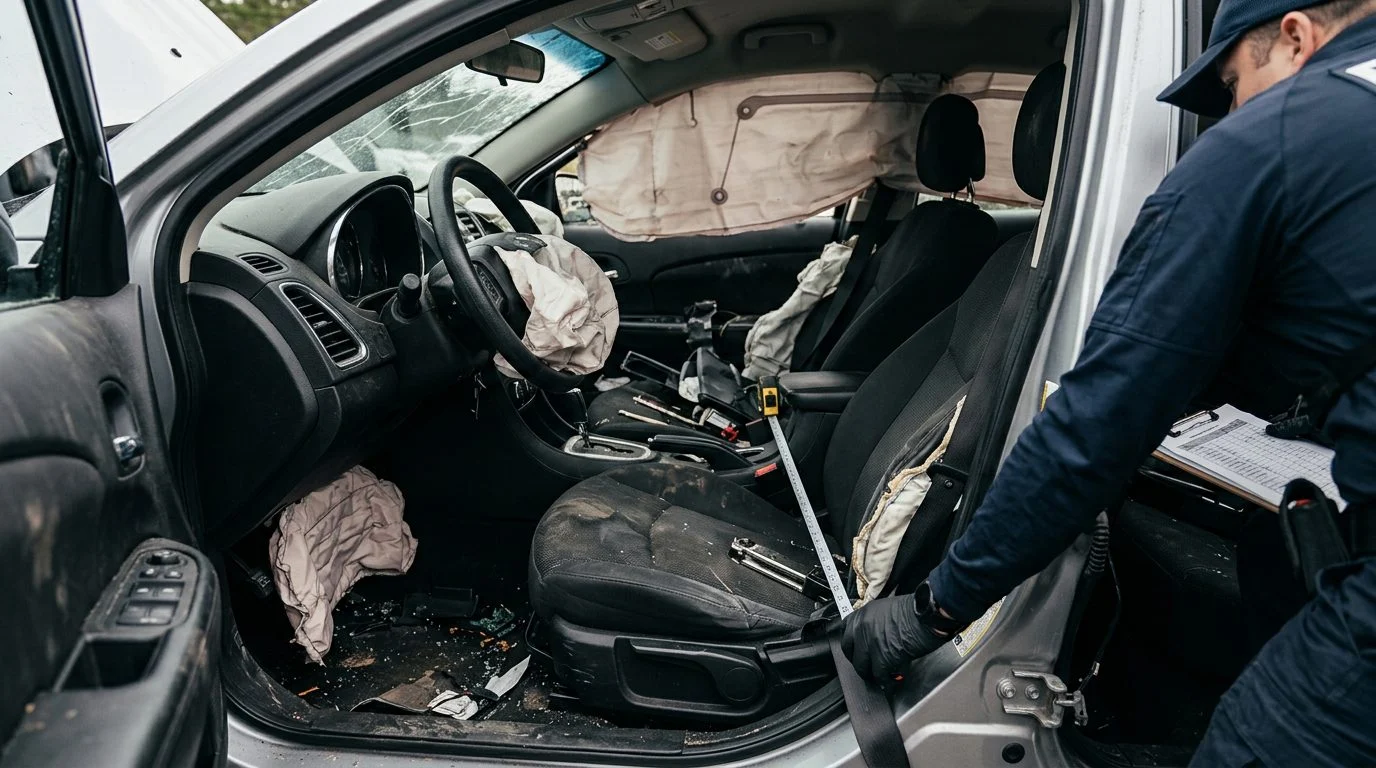
The most useful records show how the crash happened and what injuries followed. Start with the crash report. Then gather photos of the vehicle interior, the seat, the belt, the buckle, and the anchor points.
Other records help too. Vehicle event data may be available in some vehicles. Witness statements can describe whether the belt was in use before the crash. Names and contact details for anyone who saw the scene are worth writing down.
EMS and emergency room notes often describe how the person was found and how they were moved. These details help explain the injury mechanism. Follow-up medical records, imaging results, and rehabilitation notes also matter. They show how injuries developed over time.
Write down what the injured person remembers, as soon as they can. If they cannot recall the crash, family members can record what they saw and heard at the scene. Early notes often stay clearer than memories pieced together months later.
Not sure what your next step is?
Talk it through with Big Bubba — the first case review is free, confidential, and carries no obligation.
Catastrophic Injuries and How the Question Arises
Seat belt questions come up most often in traumatic brain injury and spinal cord injury claims. These injuries usually come from high-force impacts. The defense looks closely at how the body moved during the crash.
Spinal cord injuries can be caused by motor vehicle accidents. They may result in weakness, paralysis, and loss of sensation. MedlinePlus on spinal cord injury describes these effects. In brain injury claims, early records from the scene and the hospital often matter most.
Commercial vehicles add federal rules. Commercial drivers must be properly restrained when a belt is installed. Drivers of property-carrying trucks must also make sure other occupants with installed belts are restrained. See 49 C.F.R. § 392.16.
Cargo can raise another question. Unsecured loads can cause serious crashes. See West Virginia DMV cargo securement guidance.
When a crash causes a death, a wrongful death claim follows the same fault framework. West Virginia’s damages definition includes damages recoverable in a wrongful death action. See W. Va. Code § 55-7-13d.
Talking With the Firm About Your Situation
You may be sitting beside someone in a hospital bed. You may be handling paperwork for a parent or spouse. Hearing that a seat belt could be used against them adds weight to an already hard time.
The firm handles car accident and truck accident claims. It also handles commercial vehicle crashes, catastrophic injuries, traumatic brain injury, spinal cord injury, and wrongful death cases. We serve injury victims across all 55 West Virginia counties, including Charleston, Huntington, Morgantown, Wheeling, Parkersburg, Beckley, Clarksburg, Fairmont, and Weirton.
Common Questions
Can I still file a claim if I wasn’t wearing a seat belt?
Yes. Not wearing a belt does not by itself end a seat belt catastrophic injury claim West Virginia courts hear.
Can a failed seat belt support a claim?
It may support a separate product claim under West Virginia’s product liability statute.
Do federal seat belt rules apply to truck drivers?
Yes. Commercial drivers must be properly restrained when a belt is installed.
If you are weighing a seat belt catastrophic injury claim while someone you love recovers, the firm invites you to request a free case review. We can talk through the crash facts, the injuries, and the records you already have.