
Truck Crash Claims | West Virginia
Spinal Cord Injuries From Truck Crashes: Clear Answers for West Virginia Families
Big Bubba Injury Law focuses on people seriously hurt in commercial truck crashes, including spinal cord injuries, across West Virginia. Your free case review is confidential, with no obligation to continue.
Published October 30, 2026
People with a spinal cord injury from a truck crash in West Virginia may have claims against those responsible. This guide explains the injury, how these crashes happen, who may be responsible, what a claim can cover, and the deadlines to know.
We handle car accidents, truck accidents, commercial vehicle accidents, catastrophic injuries, traumatic brain injury, spinal cord injury, and wrongful death claims. We serve injured people across West Virginia, including Charleston, Huntington, Morgantown, Wheeling, Martinsburg, Parkersburg, Beckley, Clarksburg, Fairmont, and Weirton.
What a Spinal Cord Injury Means After a Truck Crash
A spinal cord injury damages the nerves that carry signals between the brain and the body. When those signals slow or stop, movement, feeling, and bodily functions can change, including bladder and bowel control.
Doctors describe spinal cord injuries by where they happen. A cervical injury affects the neck. A thoracic injury affects the upper and middle back. A lumbar injury affects the lower back. Higher injuries usually reach more of the body, so location shapes daily life.
Doctors also sort these injuries as complete or incomplete. A complete injury means no movement or feeling below the injury site. An incomplete injury means some signals still pass through. Early on, it’s often hard to know how much function will return.
This page is written for the injured person. It is also written for a spouse, parent, or adult child making decisions, managing bills, or caring for someone after a crash.
Not sure what your next step is?
Talk it through with Big Bubba — the first case review is free, confidential, and carries no obligation.

How Truck Crashes Cause Severe Spinal Cord Injuries
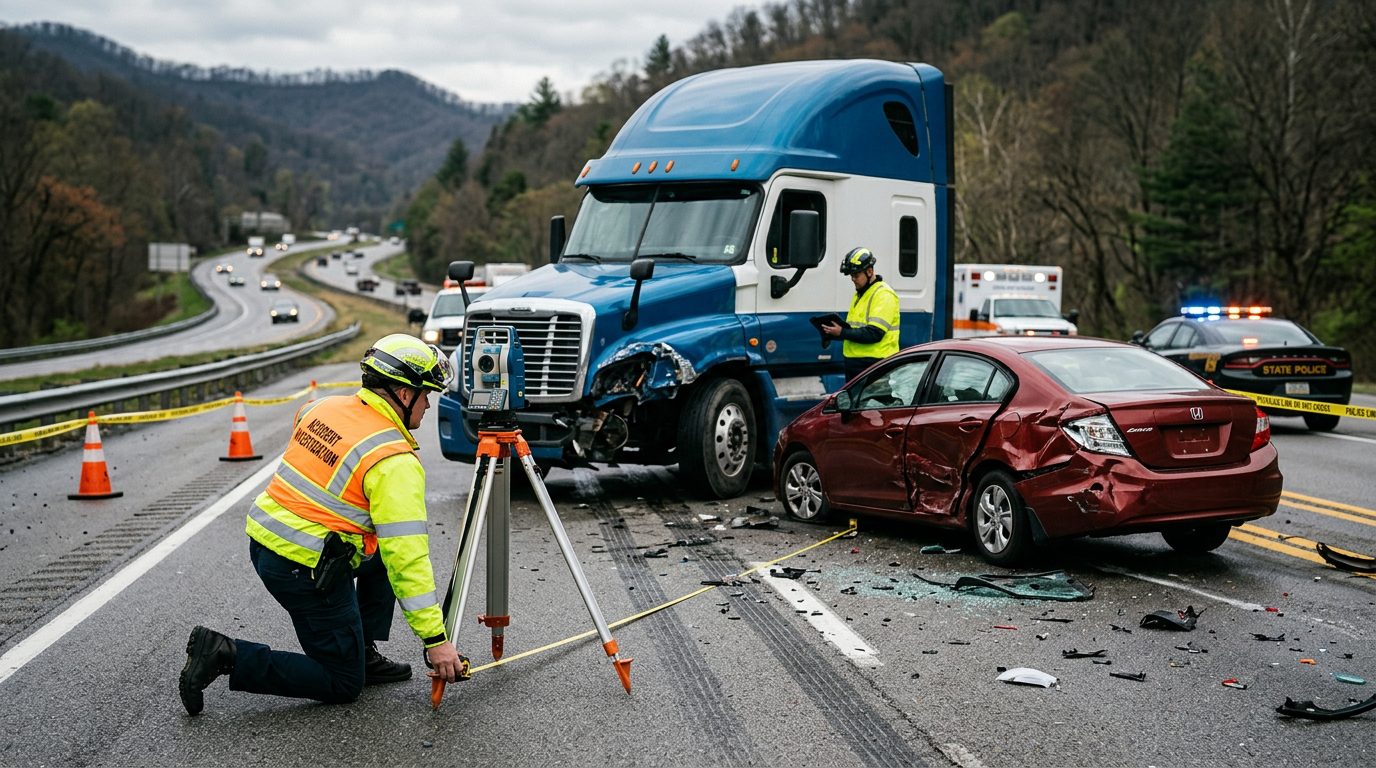
Truck crashes cause spinal cord injuries through the force of impact and the way large trucks tip, jackknife, or lose their loads. Common crash types include:
- Rear-end impacts into cars or slowed traffic
- Jackknifing, when the trailer swings out of line with the cab
- Rollovers, including on curves and ramps
- Underride crashes, where a car slides under a trailer
- Crashes where cargo shifts, spills, or falls
A loaded semi-truck weighs far more than a passenger car. That size gap means people in the smaller vehicle often absorb much more force.
Spinal injuries often come with other damage. Broken vertebrae, crushed bone, and swelling around the spinal cord can make harm grow in the hours and days after a crash.
Motor-vehicle crashes are a serious problem in the state. The Insurance Institute for Highway Safety reports 256 motor-vehicle crash deaths in West Virginia in 2024, a rate of 14.5 per 100,000 people.
Records help build the claim. Ambulance reports, emergency notes, imaging, surgery notes, and therapy records show how the injury happened and what it has changed. Keep copies of everything, and write down symptoms and dates as they happen.
Who May Be Responsible in a West Virginia Truck Crash
Responsibility turns on what caused the crash, and more than one party can be responsible.
The driver may be responsible if negligence, such as distraction, speeding, or fatigue, caused the crash.
The trucking company may also be responsible.
Parties tied to maintenance, loading, or equipment may also matter. Under W. Va. Code § 55-7-13d, fault of a nonparty shall be considered if the plaintiff entered into a settlement agreement with the nonparty or if a defending party gives notice no later than one hundred eighty days after service of process upon said defendant that a nonparty was wholly or partially at fault. See W. Va. Code § 55-7-13d.
Under W. Va. Code § 55-7-13a, comparative fault is the degree to which a person’s fault was a proximate cause of an alleged personal injury, death or property damage, expressed as a percentage, and liability is allocated to each person in direct proportion to that person’s percentage of fault. See W. Va. Code § 55-7-13c.
Truck claims also differ from car claims. They often involve more parties and federal trucking rules.
What a Spinal Cord Injury Claim Can Include
A spinal cord injury claim can seek payment for medical costs, lost income, future care, and the everyday harm the injury causes.
- Past and future medical bills, including emergency care, surgery, rehabilitation, and ongoing treatment
- Lost wages and lost ability to earn in the future
- Future care such as attendant care, medical equipment, and medication
- Home or vehicle changes, such as ramps, wider doorways, or accessible vehicles
- Pain, suffering, and loss of enjoyment of life
That cap isn’t available to an employer defendant without at least $3 million in commercial motor vehicle insurance for the occurrence. It also does not apply in listed situations, such as impaired driving or exceeding federal or state hours-of-operation limits. See W. Va. Code § 55-7-32.
The verdict may include sorrow, mental anguish, and solace, lost income and services, medical and hospital expenses, and reasonable funeral expenses. See W. Va. Code § 55-7-6.
Evidence, Insurance Contact, and Filing Deadlines
Two early steps matter most: preserving evidence and knowing the filing deadline.
Evidence to keep or request:
- Driver logs and electronic logging device data
- Maintenance and inspection records
- Dashcam or onboard video
- Crash reports and photographs
See FMCSA log retention rules.
After certain crashes, federal rules require employers to test surviving drivers for alcohol and controlled substances as soon as practicable following an occurrence involving a commercial motor vehicle operating on a public road in commerce, and employers must keep a record explaining any test not given within the set time limits. Employers must keep a record explaining any test that isn’t done on time. See federal post-accident testing rule.
Insurance contact has its own timing. One exception allows a person acting or intending to act for and on behalf of the injured person to obtain a statement from you, and only at your express request. See W. Va. Code § 55-7-11a. Under W. Va. Code § 55-7-11a, a settlement, release of liability or statement obtained or made in violation of that section may be disavowed by the injured person at any time within one hundred eighty days from the date of the personal injury, by executing a written statement of disavowal and forwarding a copy to the person violating the section, and it then may not be admissible in evidence if any consideration paid is repaid or returned to the person who paid it. Talk with the firm before you give any recorded statement to an insurer.
Personal injury claims generally have a two-year limit under W. Va. Code § 55-2-12. Wrongful death claims must start within two years after death, subject to the provisions of section eighteen, article two, chapter fifty-five, under W. Va. Code § 55-7-6. W. Va. Code § 55-7-6 reads: “The provisions of this section shall not apply to actions brought for the death of any person occurring prior to July 1, 1988.”
How the Claim Process Works, Step by Step
A truck injury claim usually moves through five steps, from the first review to a lawsuit if one is needed.
- Free case review. You talk through the crash, your injuries, and your medical situation with the firm. The review is confidential.
- Preserve evidence. The firm can send preservation requests to the trucking company and insurers.
- Gather medical records. Records help show current and future care needs.
- Present the claim. The claim goes to insurers, and the firm negotiates where appropriate.
- File suit if needed. If a fair resolution is not reached, the claim can be filed in the proper West Virginia court.
Timelines vary with how the injury heals and how complex the case is. Evidence is also time-sensitive, so early steps often come first.
Not sure what your next step is?
Talk it through with Big Bubba — the first case review is free, confidential, and carries no obligation.
Common Questions About Spinal Cord Injury Truck Claims
Shared fault can reduce a claim in West Virginia, but it doesn’t always bar one.
Can I still have a claim if I was partly at fault?
Yes. Your recovery is barred only if your fault is greater than everyone else’s combined, and otherwise it is reduced. See W. Va. Code § 55-7-13c.
Can the trucking company be sued along with the driver?
West Virginia law defines an employer defendant to include the owner and the employer of a commercial vehicle. See W. Va. Code § 55-7-32.
Can my family file if the injury leads to death?
Yes. West Virginia law lets the personal representative bring a wrongful death action.
Can a spinal cord injury cause paralysis?
Yes. Where the spinal cord is damaged and how severely both matter for how much movement is affected.
If someone you love is living with spinal cord damage after a semi-truck crash, the firm can review the crash facts and medical records with you in a free case review. Contact the firm to get started.