
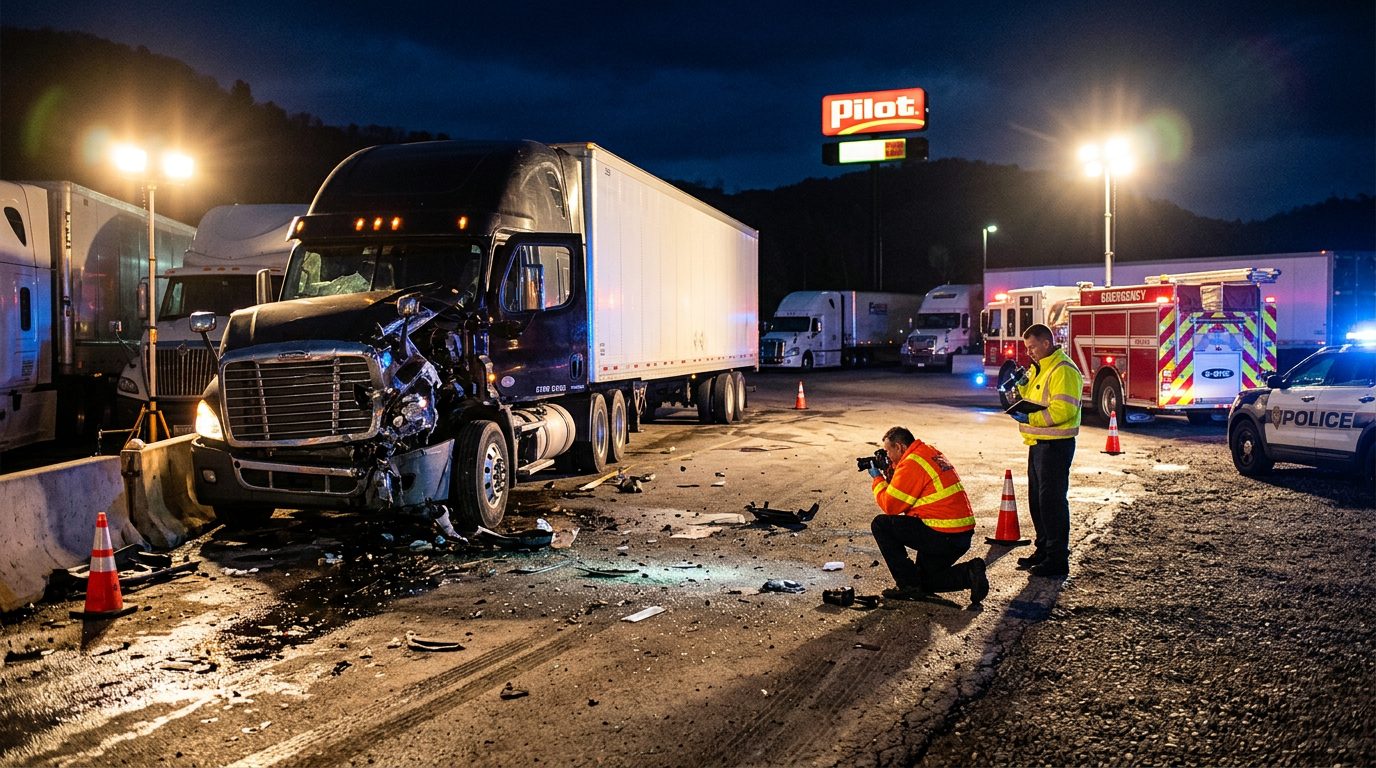
Truck Crash Evidence | West Virginia
Truck Black Box Data Can Be Lost. Act Early After a Crash.
Big Bubba Injury Law helps people seriously hurt in commercial truck crashes across West Virginia understand what recorded truck data may show and how to request it in time.
Published October 27, 2026
Introduction: Why Truck Crash Records Matter in West Virginia
Truck black box data after crash West Virginia cases can show what happened in the moments before impact. That data can also disappear if no one asks for it early.
A crash with a big rig is sudden and frightening. You may be asking questions for an injured family member. You may be trying to understand a death in your family. Either way, the details can feel urgent and confusing.
A commercial truck creates more electronic records than a passenger car. Many of those records are kept by the trucking company. That means the company controls how long they stay. The Federal Motor Carrier Safety Administration publishes national statistics on large-truck crashes. The Insurance Institute for Highway Safety publishes state-by-state motor-vehicle crash fatality statistics.
This page explains what the black box and logs are, what they can show, and how they fit into a claim. If your case involves a serious brain or spinal injury, our catastrophic injuries guide gives broader context.
If a truck crash has hurt someone you love, you don't have to sort out the records alone. You can request a free case review with the firm. Talk it through with Big Bubba — the first case review is free, confidential, and carries no obligation.

What Is a Truck’s Black Box?
A truck’s black box is a recording system that stores vehicle data. Many heavy trucks have one built into the engine control module (ECM). Others use a separate event data recorder (EDR).
The system watches for a trigger, such as a sudden hard brake or a collision. It saves data from the period around that event. Older data is overwritten over time, so the record can be lost if no one preserves it.
The exact system depends on the truck’s make, model, and year. Recording settings can also vary from one truck to another. A records request should name the truck’s specific system.
The black box is separate from the driver’s logs. Each one tells a different part of the story. Together, they can help show the timeline of a crash.
What Kinds of Data Can a Truck Record?
A truck’s recorder can capture how the vehicle moved in the seconds before impact. The exact list depends on the system. Commonly recorded items include:
- Vehicle speed before and at the time of the crash.
- Brake use and throttle (accelerator) position, which can show how quickly the driver reacted.
- Engine speed, gear selection, and cruise control status, where the system records them.
- The timing of events, which helps build a sequence of what happened.
Raw data is only a set of numbers until someone reads it in context. A speed reading means more when it’s compared with the crash report, scene photos, and witness accounts. Trained technicians with proper equipment usually retrieve the data. That helps keep it reliable for later review.
How Driver Logs and Electronic Logging Devices Work
Federal rules require most commercial drivers to record their duty status. An electronic logging device (ELD) usually does this. Under 49 C.F.R. § 395.8, a motor carrier subject to the requirements of this part, except a private motor carrier of passengers (nonbusiness), must require each driver to record duty status for each 24-hour period. The method is an ELD unless a listed exception applies.
An ELD records data on its own. Under 49 C.F.R. § 395.26, it automatically records the date, time, location, engine hours, vehicle miles, driver and vehicle identification, and motor carrier identification. When the truck is moving and there has been no duty status change or other intermediate recording in the previous 1 hour, it creates an intermediate record.
Logs can show whether recorded driving time matches the time the truck was actually moving. That comparison is a key reason these records matter.
Sometimes an ELD fails. Under 49 C.F.R. § 395.34, the driver must note the malfunction. The driver must give written notice to the carrier within 24 hours. The driver must also reconstruct the record of duty status for the current day and the previous 7 consecutive days on graph-grid paper logs, unless the driver already possesses the records or they are retrievable from the ELD. Paper logs can therefore exist alongside the electronic data.
How Black Box and Log Data Can Support a Claim
Black box and log data can help show the timeline of a crash. They can also show whether a driver’s account matches the recorded speed and braking.
Hours-of-service limits matter here. Under 49 C.F.R. § 395.3, except as otherwise provided in § 395.1, a driver of a property-carrying commercial motor vehicle may not drive without first taking 10 consecutive hours off duty. Under 49 C.F.R. § 395.3, a driver may drive a total of 11 hours during the period specified in paragraph (a)(2) of this section, which is a period of 14 consecutive hours after coming on duty following 10 consecutive hours off duty. If logs show driving past those limits, that may matter to the case.
Fatigue is another issue. Under 49 C.F.R. § 392.3, no driver may operate a commercial motor vehicle while fatigue, illness, or another cause makes it unsafe to do so.
In a wrongful death case, the company’s own decisions can matter too. Families may also face funeral and burial expenses. See funeral and burial expenses after a fatal crash.
Data supports a claim, but it does not decide one alone. Police reports, photos, witness statements, medical records, and driver vehicle inspection reports all work together with it.
Why Preserving Truck Data Right After a Crash Matters
Early written requests help keep truck data from being lost. Companies have duties to protect their records, but those duties have limits and timing.
Under 49 C.F.R. § 379.5, a regulated company must protect records from destruction, deterioration, and unauthorized access. Under 49 C.F.R. § 379.3, companies keep records for minimum retention periods. Under 49 C.F.R. § 379.3, companies must retain records for the minimum retention periods provided in appendix A to that part, and after the required periods the records may be destroyed at the discretion of each company’s management. The rule states that it shall not be construed as excusing compliance with the lawful requirements of any other governmental body prescribing longer retention periods for any category of records. Under 49 C.F.R. § 395.22, a carrier must keep a back-up copy of ELD records for 6 months on a device separate from that on which the original data are stored.
Timing matters for the truck, too. A truck may be repaired or returned to service quickly. Under 49 C.F.R. § 396.11, a motor carrier must repair listed defects likely to affect safety before the vehicle runs again.
A preservation request is a written notice. It goes to the trucking company and its insurer. It asks them to keep the truck, its black box data, and its logs intact.
Be careful with recorded statements. Know your rights before you speak with an insurer. You can read more in our guide on talking to an insurance adjuster.
Not sure what your next step is?
Talk it through with Big Bubba — the first case review is free, confidential, and carries no obligation.
Limits and Challenges With Truck Data in a West Virginia Case
Truck data helps, but it isn’t complete. It may not cover the whole trip. It may need technical reading before others can make sense of it.
Multi-vehicle crashes and several carriers make the timeline harder. Each company may hold different records. Gathering them takes time, and delay can complicate a claim.
West Virginia uses modified comparative fault (shared fault). Under W. Va. Code § 55-7-13c, a plaintiff is barred only if their fault is greater than the combined fault of all others. Otherwise, damages are reduced by the plaintiff’s percentage of fault. Records about who did what in the crash matter for this reason.
The state also sets a two-year limitation period for personal injury actions. See W. Va. Code § 55-2-12. Records take time to gather, so that deadline matters early. For broader context, see our West Virginia catastrophic injury overview.

Talking Through a Truck Crash Records Question With the Firm
If you’re gathering facts for someone you love, you don’t have to decide anything today. The question in front of you is simple. Are the truck’s black box and driver logs being kept, and who should ask for them now?
We serve injury victims and families across West Virginia. That includes Charleston, Huntington, Morgantown, Wheeling, Martinsburg, Parkersburg, Beckley, Clarksburg, Fairmont, and Weirton.
Does every truck have a black box?
Many heavy trucks have a recording system. The exact system varies by make, model, and year.
How long does truck black box data after crash West Virginia records last?
Black box data can be overwritten over time. Early written requests help keep it from being lost.
Can driver logs show hours-of-service problems?
ELD records show driving time and duty status. Those entries can be compared with federal hours-of-service limits.
How long do I have to file a West Virginia injury claim?
West Virginia sets a two-year limitation period for personal injury actions. The exact timing depends on your situation.
If a truck crash has hurt someone you love, or you’re grieving a death, you may be the one deciding whether these records get requested. You can request a free case review with the firm and tell us what happened.