
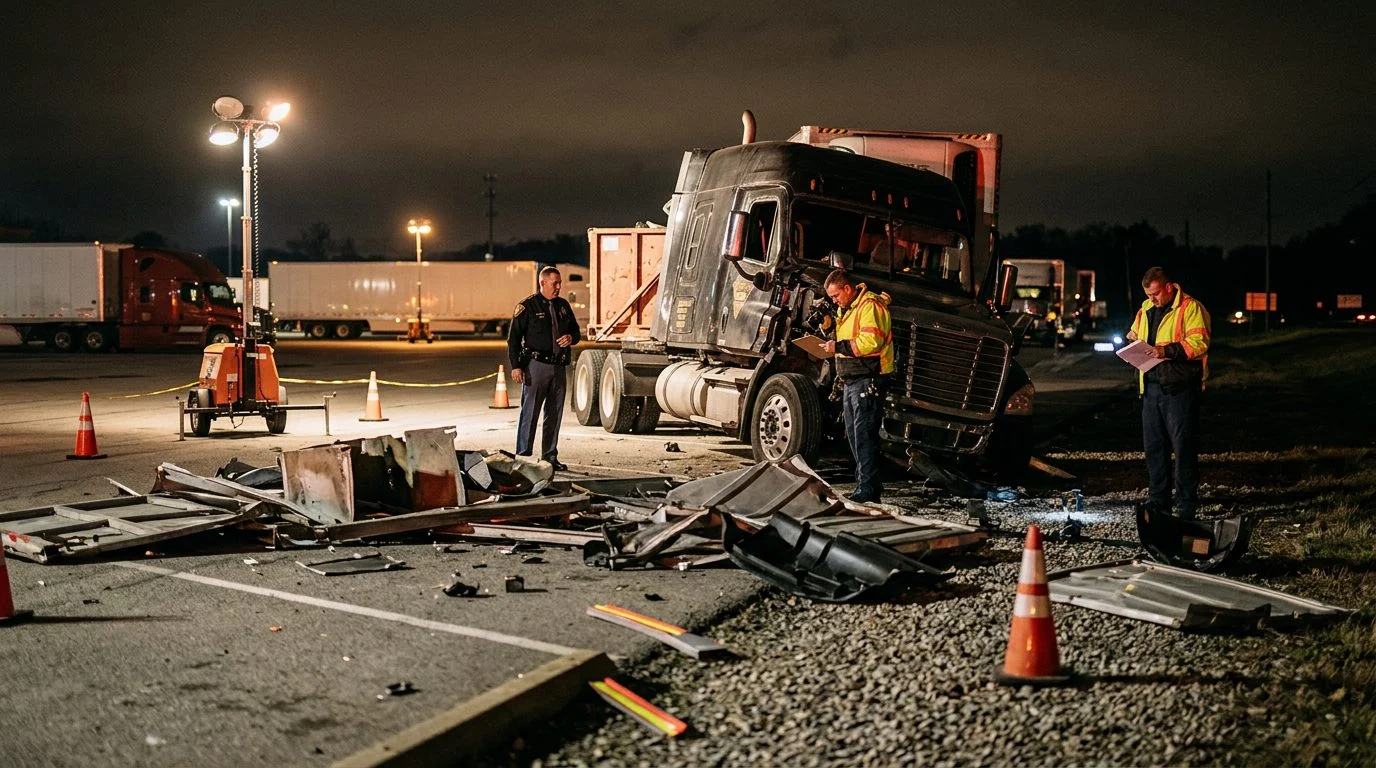
West Virginia Truck Accident Claims
Truck Driver Logbook Violations and Your Crash Claim
Hours-of-service rules and driver logs can matter after a commercial truck crash. Talk with the firm about what happened and what records may show.
Published October 27, 2026
Truck driver logbook violations crash West Virginia cases often turn on one question: what did the driver’s records show? The short answer is that federal hours-of-service rules limit how long a commercial driver may drive and when the driver must rest. Logbooks and electronic logging devices record that duty status, and those records can be compared with what happened on the road.
This page explains those rules in plain language. It also covers why the records can disappear if no one asks for them early, and how they fit with other crash evidence.
What Hours-of-Service Rules Require of Truck Drivers
Federal hours-of-service rules set how long a commercial truck driver may drive and how much rest the driver must take. A driver may not drive without first taking 10 consecutive hours off duty. A driver also may not drive after 14 consecutive hours following that 10-hour rest. (49 C.F.R. § 395.3)
Under 49 C.F.R. § 395.3, a driver may drive a total of 11 hours during the period specified in paragraph (a)(2) of this section. There is also a break rule. Except for drivers who qualify for either of the short-haul exceptions in § 395.1(e)(1) or (2), driving is not permitted if more than 8 hours of driving time have passed without at least a consecutive 30-minute interruption in driving status. That break can be off duty, in the sleeper berth, or on duty but not driving. (49 C.F.R. § 395.3)
Weekly limits add another layer. A driver may not drive after 60 hours on duty in 7 consecutive days, or 70 hours in 8 consecutive days, depending on whether the carrier runs every day of the week. A period can end with 34 or more consecutive hours off duty. (49 C.F.R. § 395.3)
Federal law lets the Secretary of Transportation set maximum hours of service for drivers of motor carriers. Federal law allows the Secretary of Transportation to prescribe maximum hours of service for motor carrier employees under 49 U.S.C. § 31502.
Not sure what your next step is?
Talk it through with Big Bubba — the first case review is free, confidential, and carries no obligation.

How Logbooks and Electronic Logging Devices Record a Driver’s Hours
Logbooks and electronic logging devices (ELDs) both record when a driver is driving, on duty but not driving, in the sleeper berth, or off duty. (49 C.F.R. § 395.8)
An ELD records data on its own. It captures the date, time, vehicle location, engine hours, vehicle miles, and driver, vehicle, and carrier identification. (49 C.F.R. § 395.26) When the truck is moving and no status change or other intermediate recording has been logged in the past hour, the device adds an intermediate record. (49 C.F.R. § 395.26)
This matters because the device data is not just the driver’s word. Investigators can compare it with the driver’s written account, dispatch records, and other information from the same day. A gap between the written story and the device data is a question worth asking.
Common Ways Hours-of-Service Problems Show Up After a Crash
Hours problems usually appear as a gap between the log and the clock. The most common examples involve driving past a limit, starting a new shift too soon, or taking a break that is too short.
A log can show driving beyond the 11-hour limit, or driving after the 14-hour window has closed. It can show more than 8 hours of driving without a 30-minute break. It can also show a 10-hour rest that was cut short, which means the next shift began too early.
Fatigue is the link many people miss. A driver who has been on the road too long may react more slowly and judge traffic less well. Federal law bars driving when fatigue makes it unsafe, even when a log looks technically correct.
Falsified logs are a separate problem. No one may tamper with an ELD so that it does not accurately record data. (49 C.F.R. § 395.8) A fraudulent or intentionally false entry on a required record is also prohibited. (49 C.F.R. § 390.35)
A log violation does not prove who caused a crash. Whether it played a role depends on the facts, the timing, and what the other evidence shows.
Why Trucking Records Need to Be Preserved Quickly
Trucking records can be lost, so early requests matter. Companies covered by this federal records rule must keep records for the minimum retention periods it sets. After those periods, records may be destroyed at the discretion of each company’s management, but this does not excuse compliance with the lawful requirements of any other governmental body prescribing longer retention periods. (49 C.F.R. § 379.3)
Supporting documents help show on-duty time. These include dispatch and trip records and expense receipts. Except drivers for a private motor carrier of passengers (nonbusiness), drivers must submit them to the employer within 13 days of either the 24-hour period to which the documents pertain or the day the document comes into the driver’s possession, whichever is later. (49 C.F.R. § 395.11) A carrier need not keep more than eight supporting documents per driver for a 24-hour period. If it has more, it must keep the ones with the earliest and latest times. (49 C.F.R. § 395.11)
No motor carrier or driver may obscure, destroy, or alter existing information in a supporting document. (49 C.F.R. § 395.11) That rule matters when records look changed or incomplete.
Records to ask about include ELD data, dispatch and trip records, expense receipts, and maintenance information. If equipment failure may also be involved, the firm’s page on defective tire and brake failure covers that issue.
How Logbook Evidence Fits With Other Crash Evidence
Logbook data is most useful when it is compared with other evidence. Investigators often review the crash report, witness statements, vehicle data, roadside inspection reports, and medical records together. Each piece can confirm or challenge the others.
A trucking company’s own records can also matter. A claim may look at how the company hired, trained, and supervised the driver, and how its scheduling may have pushed the driver toward long hours.
West Virginia uses comparative fault, so each person’s share of fault is set as a percentage. (W. Va. Code § 55-7-13a) Fault can be allocated among drivers, companies, and other nonparties who contributed to the harm. That is why a complete picture of the evidence matters.
The strength of a log-based claim comes from how the logs line up with everything else. Matching times and consistent accounts count, and so do unexplained gaps.
Catastrophic Injuries and the Costs That Can Follow
Catastrophic injuries can change how a person works, lives at home, and plans for the future. Traumatic brain injury and spinal cord injury are examples of injuries that can require long-term medical care and daily support. Families may also face lost income, household help, and funeral costs.
Medical bills from serious crashes can involve several payers, including public insurance programs. The firm’s page on Medicaid and Medicare liens explains how those claims can come up after an injury.
For a wider look at serious injuries, see the firm’s catastrophic injury overview.
Not sure what your next step is?
Talk it through with Big Bubba — the first case review is free, confidential, and carries no obligation.
Time Limits and Speaking With Insurance Adjusters
West Virginia generally allows two years to bring a personal injury claim. (W. Va. Code § 55-2-12) Under this section, a personal action for which no other limitation is prescribed must be brought for personal injuries within two years after the right to bring it has accrued.
Insurance adjusters often reach out early. Before you give a detailed recorded statement, you may want to talk with the firm so you understand what you’re being asked.
The firm serves injury victims across West Virginia. The firm’s West Virginia overview describes that service area.
Frequently asked questions
How long do I have to file a truck accident claim in West Virginia?
Generally two years for a personal injury claim under state law. Other deadlines may apply to some claims.
What is an electronic logging device?
An ELD is a device that automatically records a driver’s duty status along with time, location, and miles.

What Happens Next After a Crash
If a commercial truck crash left you or a family member seriously hurt, a free case review can help you sort out what the records may show. Big Bubba handles car accident, truck accident, commercial vehicle, catastrophic injury, traumatic brain injury, spinal cord injury, and wrongful death matters for people across West Virginia.
If the driver’s hours or logs are unclear to you, and you’re worried records may be lost, reach out soon. If a truck driver’s logs or hours may be part of your crash, you can request a free case review and describe what happened and which records you have.