
Commercial Vehicle Accidents
How to Document a Commercial Vehicle Accident in West Virginia
Protect your claim with the right evidence from the scene—and know what records matter afterward.
Published October 07, 2026
How to Document a Commercial Vehicle Accident in West Virginia
Good documentation after a commercial vehicle accident preserves evidence that can fade, be lost, or be disputed later—and it becomes crucial if you or someone else was seriously injured. Photos, written notes, and witness statements taken at the scene are far more reliable than memory weeks or months later. This guide walks you through what to do right after a crash and what records to preserve afterward.

Not sure what your next step is?
Talk it through with our team — the first case review is free, confidential, and carries no obligation.
Why Documentation Matters After a Commercial Vehicle Accident
Commercial vehicle accidents involve more parties than typical car crashes: the driver, the vehicle owner, the trucking company or commercial operator, multiple insurance carriers, and sometimes federal regulators. Each party may have different interests, and liability is often more complex.
When a commercial truck or large vehicle collides with a passenger car, the size and weight difference means injuries tend to be more severe. The National Spinal Cord Injury Statistical Center documents that spinal cord injuries and traumatic brain injuries frequently result from high-impact crashes. Early, thorough documentation of the scene—including photos of vehicle damage, road conditions, and the commercial vehicle’s identifying information—helps establish what happened and supports any medical claim later.
Good documentation also protects you if the other party’s insurance company disputes what occurred or tries to shift blame. Written notes and photographs made at the scene are stronger evidence than statements made months later.
At the Scene: Immediate Steps
Your safety comes first. If anyone is injured, call 911 immediately. Once you and others are in a safe location, follow these steps:
Call law enforcement. Contact the West Virginia State Police or your local police department to report the accident. Request the accident report number and the officer’s name. This official report becomes part of the public record and is often critical evidence.
Do not admit fault. Stick to the facts when speaking with the other driver, witnesses, or police. Avoid saying “I’m sorry” or “it was my fault”—these statements can be used against you later, even if you didn’t mean them that way.
Exchange information with the other driver. Get their name, phone number, address, driver’s license number, vehicle license plate, vehicle identification number (VIN), insurance company name, and policy number. If the commercial vehicle is owned by a company different from the driver, get the company’s name, address, and phone number.
Collect witness information. Write down the names, phone numbers, and addresses of anyone who saw the accident. Witnesses often disappear, and their contact information becomes invaluable if you need to pursue a claim.
What to Photograph and Record
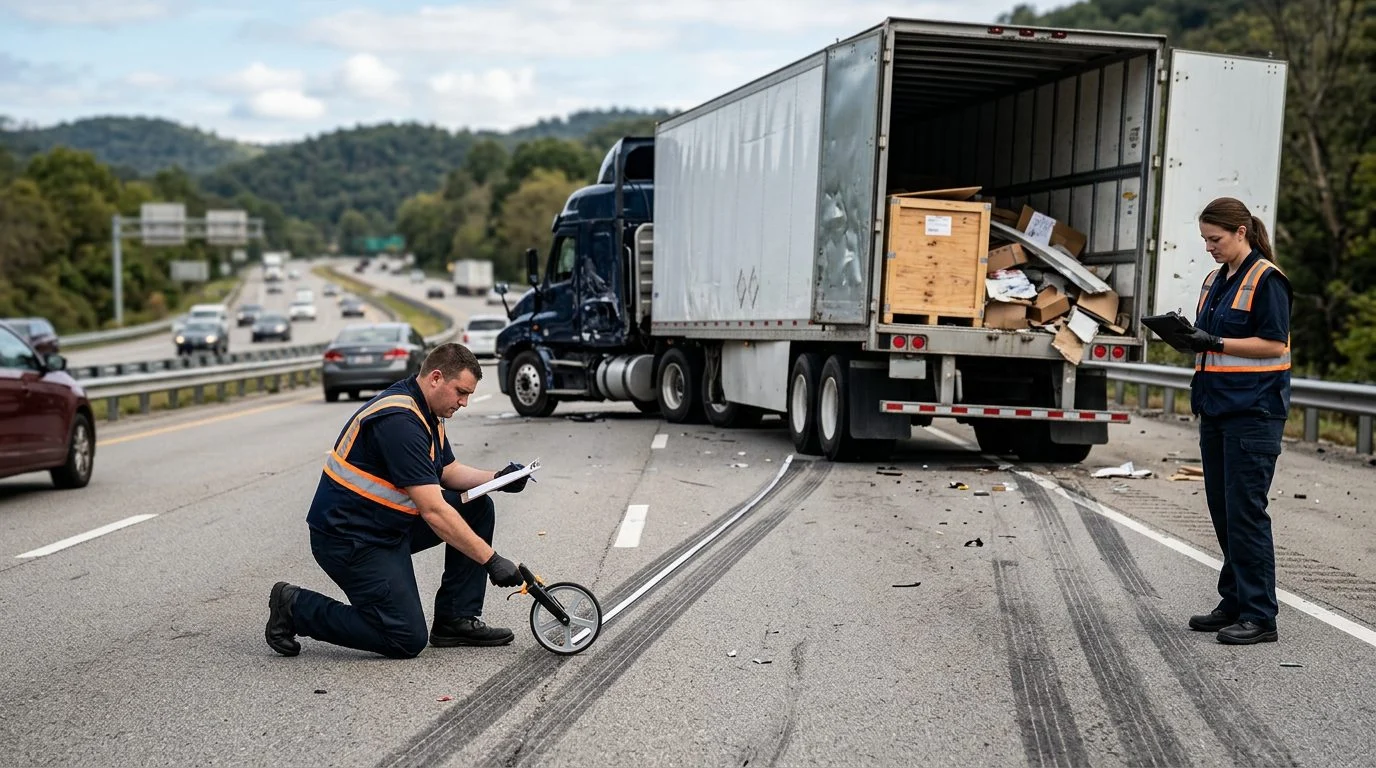
Take photos from multiple angles and distances. Photograph the overall scene first, showing the position of all vehicles. Then take close-up photos of damage to every vehicle involved, including the undercarriage, wheels, and any visible mechanical damage.
Document the road and environment. Photograph road conditions—wet pavement, potholes, debris, skid marks, traffic signals, and road signs. Note the date, time, weather (rain, snow, fog, clear), lighting (daylight, dusk, night), and road surface (dry, wet, icy, gravel).
Capture commercial-vehicle-specific details. Photograph the commercial vehicle’s cargo area, load, and any visible equipment. If the vehicle is carrying cargo, note what it is and whether the cargo shifted or spilled. Photograph the commercial vehicle’s company name, logo, and any identifying information. If you see hazardous material placards on the vehicle, photograph those too. These details matter because Federal Motor Carrier Safety Regulations govern how commercial vehicles must be loaded, maintained, and operated.
Record your account. Write down how the accident happened in your own words while details are fresh. Note the speed limit, the direction each vehicle was traveling, and what you believe caused the crash.
Have questions about what happened?
Ask our team directly. The first conversation is free, confidential, and there is no obligation to continue.
Records to Preserve and Obtain
After the scene documentation, preserve every record related to the accident.
Police report. Request a copy of the accident report from the West Virginia State Police or the local law enforcement agency that responded. This report contains the officer’s observations and may include citations or findings about who was at fault.
Medical records. If you or anyone else was injured, keep all emergency room reports, treatment notes, imaging studies, and follow-up care records. Medical documentation is essential evidence of injury and damages. The National Institute of Neurological Disorders and Stroke emphasizes that traumatic brain injuries require prompt medical evaluation and ongoing monitoring—early records establish the injury’s severity.
Insurance correspondence. Preserve all communications with insurance companies, including claim numbers, adjuster names, and any settlement offers or denials.
Receipts and expenses. Keep receipts for vehicle rental, medical treatment, medications, transportation, and any lost wages caused by the accident.
Video footage. Preserve any video from nearby businesses, traffic cameras, or dash cameras. Many accidents are recorded by surveillance systems or other vehicles.
Property damage. Document damage beyond the vehicles themselves—guardrails, utility poles, signs, or other roadside infrastructure.
Special Considerations for Commercial Vehicle Accidents
Commercial vehicles operate under federal regulations that distinguish them from passenger cars. Federal rules govern how long commercial drivers may operate before resting, and these hours-of-service requirements can be relevant to liability.
The commercial vehicle’s company may have its own insurance and may be liable in addition to or instead of the driver. Do not sign any documents or statements from the commercial vehicle’s company or its insurance without understanding what you are signing.
West Virginia law recognizes comparative fault, meaning your recovery may be reduced if you were partially at fault for the accident (W. Va. Code § 55-7-13c). Thorough documentation helps establish what each party did and who bears responsibility.
What to Do With Your Documentation
Organize all photos, notes, medical records, and receipts in one place—a folder on your phone, a cloud storage account, or a physical file. Do not post details about the accident on social media; anything you post can be used against you later.
Share your documentation with your insurance company as requested, but do not feel pressured to accept a settlement offer immediately, especially if you suffered a serious injury.
Want to know where you stand?
Tell us what happened and our team will walk you through the options available to you, at no cost.
When to Reach Out for Legal Guidance
If you or a family member was seriously hurt in a commercial vehicle accident, or if someone died, the process becomes complex and the stakes are high. A lawyer can review your documentation, the accident report, and your medical records to advise you on your rights and next steps.
Many people in your situation reach out after a commercial vehicle accident because they are unsure whether they have a claim, what their case might be worth, or how to handle communications with insurance companies and the other party’s lawyers.
If you or someone you care about was seriously injured in a commercial vehicle accident, or if someone died, reach out to discuss what happened—people in your situation can contact us to understand their options.
Related practice areas
- Commercial Vehicle Accidents in West Virginia: Your Rights & Next Steps
- Commercial Vehicle Accident Liability in West Virginia