
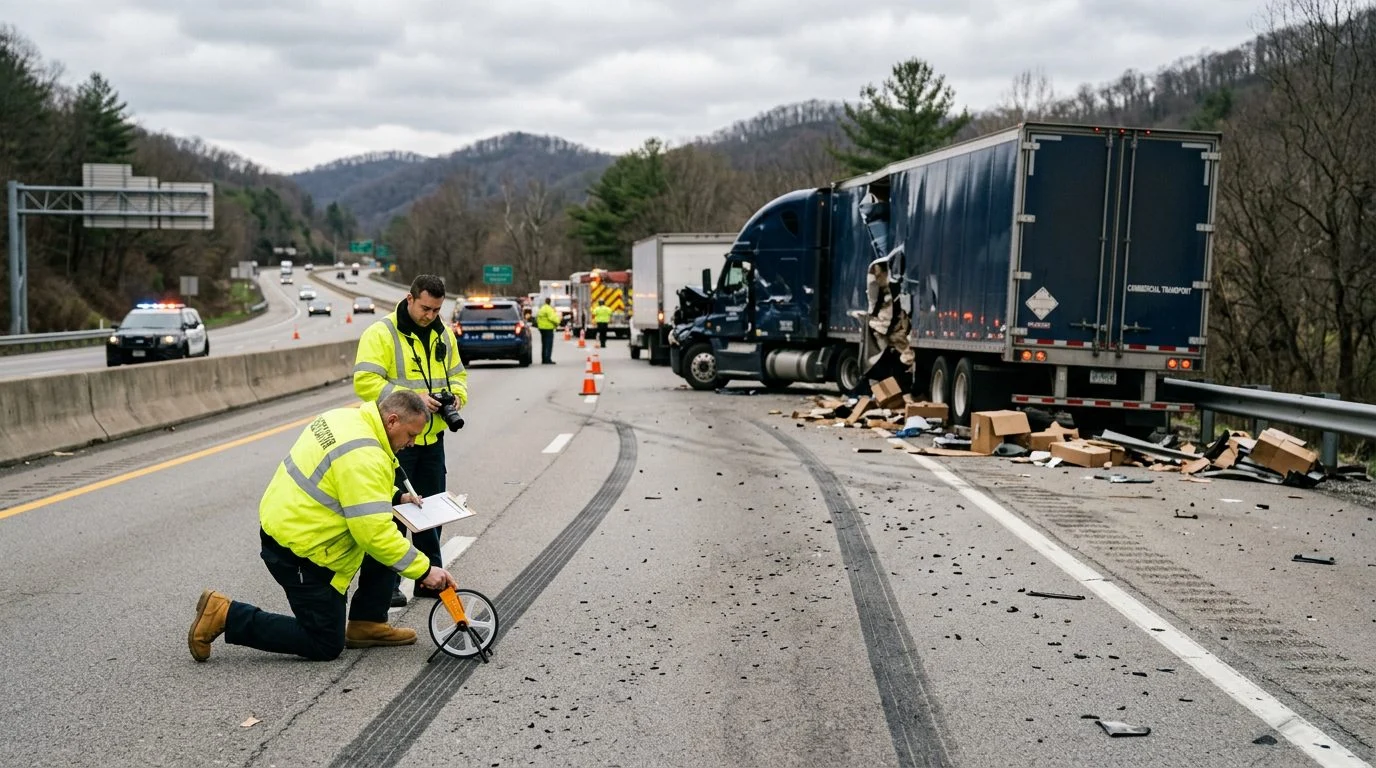
Commercial Vehicle Crashes | Serving West Virginia
Hurt in a Commercial Vehicle Crash? Start With a Free Case Review
Big Bubba Injury Law serves people across West Virginia who were hurt in crashes involving trucks and other commercial vehicles. Tell us what happened, and we will explain the general options that may apply to your situation.
Published October 11, 2026
A free case review is a first meeting where you tell us what happened in a crash with a commercial vehicle, and we explain the general options that may apply. Big Bubba Injury Law serves people across West Virginia. This page explains what the review covers, what to bring, and what generally happens next, so you can decide your next step with clear information.
What a Free Case Review Is and Who It Is For
A free case review is a no-cost first meeting to talk through your crash, your injuries, and the options that may fit your situation. We listen to your account, look at the papers you bring, and explain how a claim generally works.
The review does not predict a result, and it does not put a value on your case. You are not required to hire us after it. You can take the information and decide what to do next.
The review fits several kinds of people:
- Drivers and passengers hurt when a truck or other commercial vehicle hits their car.
- Pedestrians and cyclists struck by a commercial vehicle.
- Families who lost a loved one in a fatal crash.
In a wrongful death case, a claim is generally brought by the personal representative of the deceased person’s estate. W. Va. Code § 55-7-6 sets out this rule. Exceptions may apply depending on the facts.

Not sure what your next step is?
Talk it through with our team — the first case review is free, confidential, and carries no obligation.
Commercial Vehicle Crashes We Handle
We handle crashes involving semi-trucks, tractor-trailers, box trucks, delivery vans, and other work vehicles. These crashes can happen on West Virginia interstates, U.S. routes, and local roads.
W. Va. Code § 55-7-32 defines a “commercial motor vehicle” to include truck tractors, trailers, and semitrailers. It also defines an “employer defendant” to include the vehicle’s owner and the operator’s employer. Whether any of these parties may be liable depends on the facts of each case.
The same statute limits some noneconomic damages in certain commercial motor vehicle cases. Its limit generally does not apply where listed conditions are present, so whether a limit applies depends on the facts.
One possible claim after a truck crash is negligent hiring, and whether such a claim may be available generally depends on the facts of each case. Whether a company may be liable for how it hired, retained, or supervised a driver generally depends on the facts of each case.
Crashes with large trucks can also cause traumatic brain injury and spinal cord injury. Some crashes lead to wrongful death. These injuries can require long-term medical care, and their effects vary from person to person. Each case is reviewed on its own facts.
What to Have Ready Before You Request a Review
You do not need a complete file to start. Bring what you have, even if it is partial. The more detail you share early, the better we can see the facts.
- Crash details: date, time, location, weather, and road conditions.
- The truck company’s name or the vehicle owner’s name, if you know it.
- The police report number, photos, and any video.
- Medical records, bills, and discharge papers to date.
- Letters or messages from any insurance company.
- Names and phone numbers of witnesses.
- Your own notes, written while your memory is fresh.
Under federal rules, motor carriers are generally required to keep drivers’ records of duty status and supporting documents for at least six months from the date the carrier receives them (49 C.F.R. § 395.8(k)(1)), although exceptions and other record-keeping rules may apply depending on the facts. Under the federal record-of-duty-status rule, a motor carrier subject to that part generally must require each driver it uses to record the driver’s duty status for each 24-hour period, in many cases using an electronic logging device (ELD), though exceptions may apply. That six-month period is generally a minimum the carrier must meet, not the deadline for bringing a claim, and the time limits that may apply to your situation depend on the facts.
Under the federal ELD recordkeeping rule, a driver and the motor carrier generally must ensure that the driver’s ELD records are accurate, and the driver generally must review, correct and certify those records. Whether these records matter to your case depends on the facts. Mention them early so they can be considered.
What Happens During Your Free Case Review
A free case review generally has four steps. You make first contact, meet with us, learn the general process, and then discuss next steps.
- First contact. You reach out by phone or through our online form. A team member collects basic facts and schedules your review.
- The review. We listen to your account and go through the documents you bring. We note the legal questions that may apply to your crash.
- The process. We explain how a claim generally moves. That can include investigation, communication with insurers, possible negotiation, and, when needed, filing a lawsuit.
- Next steps. We discuss what information is still missing and which options may fit your facts.
The review has limits. It does not confirm who is at fault, what a claim is worth, or how long a case may take. Those points depend on the facts and on how the case develops.
Have questions about what happened?
Ask our team directly. The first conversation is free, confidential, and there is no obligation to continue.
Insurance Calls, Recorded Statements, and Early Steps After a Truck Crash
You may hear from a trucking company or its insurer soon after a crash. This applies while the injured person is a hospital inpatient or cannot work. Exceptions may apply.
The same statute generally allows an injured person to disavow a settlement or release made in violation of it, under its terms, and exceptions may apply. Whether that matters in your case depends on the facts.
Some steps are generally helpful right away:
- Get prompt medical evaluation and follow your provider’s advice. This matters for your health and for documenting your injuries.
- Ask the caller for their name, company, and phone number. You can say you will respond after you review your options.
- Think before posting about the crash online. Posts may be looked at later, depending on the facts.
- Read any release carefully before you sign it, and ask questions first.
How Timing and Deadlines Generally Work in West Virginia
West Virginia generally gives two years to bring a personal injury lawsuit, but exceptions may apply. Under W. Va. Code § 55-2-12, a personal injury action generally must be brought within two years after the right to sue accrues.
Wrongful death claims follow a similar two-year general rule. Under W. Va. Code § 55-7-6, an action generally must be commenced within two years after the death. Missing a deadline may affect your ability to file suit. Whether it does depends on the facts of each case.
West Virginia generally uses a modified comparative fault rule. Under W. Va. Code § 55-7-13c, a plaintiff’s own fault generally does not bar recovery unless it is greater than the combined fault of all others responsible. Recovery is then reduced in proportion to the plaintiff’s fault. Exceptions may apply.
How long a claim takes varies with injuries, medical treatment, insurance positions, and whether a lawsuit is filed. No timeline can be predicted for any one case.
Serving West Virginia Families Hurt in Truck and Commercial Vehicle Crashes
Big Bubba Injury Law handles personal injury matters from car accidents, truck accidents, and commercial vehicle accidents. We also handle catastrophic injuries, traumatic brain injury, spinal cord injury, and wrongful death claims.
We serve all 55 West Virginia counties, including Charleston, Huntington, Morgantown, Wheeling, Martinsburg, Parkersburg, Beckley, Clarksburg, Fairmont, and Weirton.
Frequently Asked Questions
Does a free case review commit me to hire you? No. You can decide after the review whether to move forward.
What if I don’t have all my paperwork? You can still request a review. Bring what you have, and we will note what else may help.
Who brings a wrongful death claim in West Virginia? Generally, the personal representative of the estate brings it. Exceptions may apply.
How do I request a free case review? You can tell Big Bubba what happened through our contact page.
Want to know where you stand?
Tell us what happened and our team will walk you through the options available to you, at no cost.
Related practice areas
- Commercial Vehicle Accidents in West Virginia: Your Rights & Next Steps