
Commercial Vehicle Injuries | West Virginia
Spinal Cord Injuries From Commercial Vehicle Crashes
A spinal cord injury can change how a person moves, feels, and cares for themselves. Big Bubba Injury Law represents injured people and families across West Virginia. Tell us what happened and we will explain your options.
Why These Cases Need Careful Attention
Large commercial vehicles
Trucks and other commercial vehicles are heavy and often carry cargo under federal and state safety rules. Those rules can shape how a crash is investigated.
Records that matter
Driver logs, maintenance files, inspection reports, and dispatch communications can all be relevant. Some of these records can be lost if they are not requested promptly.
Medical questions
Spinal cord injuries are often classified by the level of the spine and how much function is affected. Symptoms can change over time, so ongoing medical care is important.
Families affected too
A serious spinal cord injury can affect work, family roles, and daily routines. Caregiving and lost income are common concerns for the whole household.
Published October 09, 2026
A spinal cord injury commercial vehicle accident can damage the nerves that run through the spine. That damage can change how a person moves, feels, and controls body functions. This guide explains what the injury means, how commercial vehicles cause it, why it can be hard to prove early, and which West Virginia rules apply.
If you are reading this for someone you love, you may be trying to understand medical terms and fast changes all at once. Take it one step at a time. This information is general, and every injury and every crash is different.
Not sure what your next step is?
Talk it through with our team — the first case review is free, confidential, and carries no obligation.
What Is a Spinal Cord Injury, and Why Do Truck Crashes Cause It?
A spinal cord injury is damage to the bundle of nerves that carries signals between the brain and the rest of the body. The spinal cord has three layers of protective tissue. Cerebrospinal fluid (CSF) surrounds it and acts as a cushion against shock, according to the NINDS spinal cord injury overview.
A broken bone and a spinal cord injury are different problems. A fractured vertebra can heal on an X-ray while the nerves inside stay damaged. That is why a person can look stable on paper and still struggle to move a leg or feel their hands.
Commercial vehicle crashes are a common setting for severe spinal trauma. A loaded truck can weigh many times more than a passenger car, so the force of impact is far greater. The injury may not be obvious at the scene. Numbness, weakness, or pain can appear or change over hours and days, so early medical evaluation matters.
What Is the Difference Between a Complete and an Incomplete Spinal Cord Injury?
A complete injury blocks all movement and feeling below the injury. An incomplete injury leaves some signals getting through, so some movement or sensation remains.
Doctors describe an injury by its level along the spine. The cervical nerves (C1 to C7) run through the neck. They control signals to the back of the head, the neck and shoulders, the arms and hands, and the diaphragm, the main muscle used for breathing. The thoracic nerves (T1 to T12) reach the chest and many organs. The lumbar nerves (L1 to L5) reach the lower abdomen, lower back, buttocks, and parts of the legs. The sacral nerves (S1 to S5) reach the thighs, lower legs, and feet.
Higher injuries affect more of the body. An injury between C1 and C4 can stop breathing, because the nerves in that region drive the diaphragm. The NINDS spinal cord injury overview explains these patterns in more detail.
Medical teams usually decide whether an injury is complete or incomplete over time. That label can change during recovery, so early labels are not final.
How Do Car Accidents Cause Spinal Cord Injuries?
Car accidents hurt the spine through sudden force, rapid slowing, twisting, and pressure on the spinal canal. Those forces can break a vertebra, push a disc out of place, or squeeze the cord itself.
Common spine injuries from car crashes include:
- Fractured vertebrae: cracks or breaks in the bones of the spine
- Herniated discs: the soft cushion between bones pushes out of place
- Dislocations: vertebrae shift out of their normal alignment
- Spinal cord compression: swelling or bone pressure presses on the cord
Spinal stenosis is a narrowing of the spinal canal. Some people already have it before a crash. A crash can make existing narrowing worse or bring on symptoms that were mild before. A pre-existing condition does not mean the crash caused no new harm. Medical records, imaging, and the doctor’s notes show what changed.
How Do Spinal Cord Injuries Happen in Truck and Commercial Vehicle Crashes?
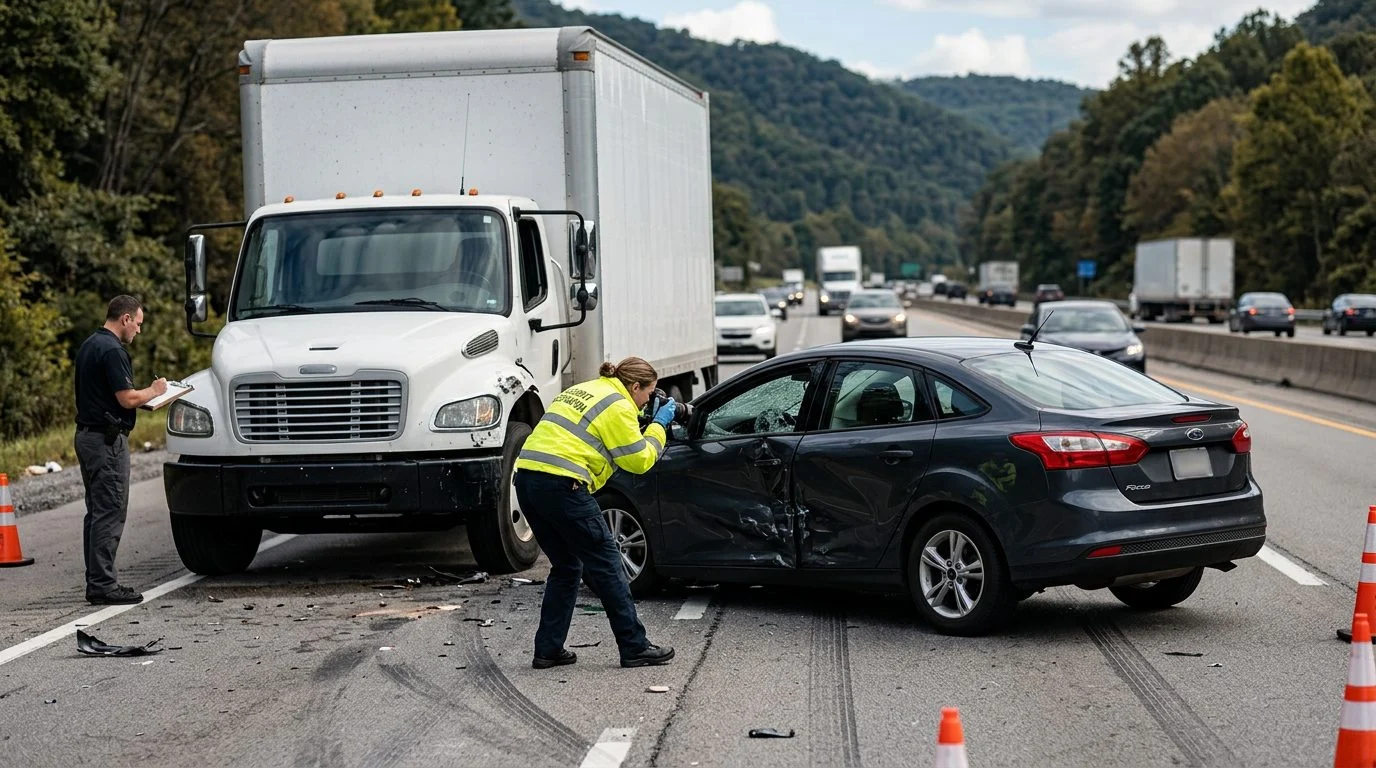
A spinal cord injury commercial vehicle accident often involves a much heavier vehicle hitting a smaller one. The people in the smaller vehicle absorb far more force. Several crash patterns come up often.
- Underride crashes: a passenger car slides under the back or side of a trailer.
- Rollovers and jackknifing: a truck tips over or folds at the trailer. Weight shifts fast, and occupants can be thrown or pinned.
- Rear-end collisions: a car hits a truck that has slowed or is parked in a travel lane.
- Cargo and trailer problems: loads that are not secured can shift or fall. Falls from cab height can add to spinal trauma.
Federal rules set limits for these vehicles. Whether these rules were followed is one question investigators ask about each crash.
Have questions about what happened?
Ask our team directly. The first conversation is free, confidential, and there is no obligation to continue.
Why Are Spinal Cord Injuries Hard to Prove Right After a Crash?
Spinal cord injuries are often hard to pin down in the first days. Early scans may not show the full extent of nerve damage. Swelling after trauma can blur the picture, and symptoms may develop or change over days or weeks.
That is a normal part of the medical process. Doctors often order follow-up tests and refer patients to other doctors, such as neurologists, as the picture develops. What matters most is that the person gets consistent care and reports symptoms honestly at every visit.
Gaps in treatment can lead to questions later. A missed appointment, a delayed diagnosis, or a stretch with no records can make an injury harder to document. An insurer may also begin its own investigation quickly after a crash involving a commercial carrier. Clear notes from the first emergency visit, copies of imaging, and a written history of symptoms all help show what happened.
What Are the Long-Term Costs of a Spinal Cord Injury?
Many people with a spinal cord injury face ongoing medical needs, equipment, and changes at home and at work. These effects can last for years or for life.
Traumatic spinal cord injuries affect thousands of people in the United States each year, often with lasting physical and financial consequences. Ongoing needs can include rehabilitation, wheelchairs and other equipment, home modifications, medications, and future medical care. Families may also face lost income, less ability to work, and new caregiving roles.
Recovery timelines vary widely. Some people regain function over time. Others have lasting effects. Early on, it is often unclear which path a given person will take.
Costs are individual. They depend on the level and severity of the injury, the person’s age, and the care they need. Group estimates are not a prediction for any one person. Records from every provider, receipts for equipment, and notes about missed work are how one person’s real costs get documented.
What Affects the Value of a Spinal Cord Injury Claim?
No one can predict the outcome of a claim from general information. Factors that are typically looked at include how severe the injury is, whether it is permanent, what care it requires, and how it affects work and daily life.
Other factors matter too. These include the insurance coverage available, how many parties may share responsibility, and what evidence shows how the crash happened. A claim may involve more than the driver. Those claims depend on their own facts.
Each claim is different. Two crashes can look alike on paper and still produce very different medical and financial pictures. The commercial vehicle accidents guide gives broader context on how these cases are built.
What Are West Virginia’s Time Limits and Fault Rules?
In West Virginia, a personal injury lawsuit generally must be brought within two years after the right to bring it arises. That deadline comes from W. Va. Code § 55-2-12. Other deadlines can apply in some cases, so check the time limit early.
West Virginia uses comparative fault. Each person’s share of fault is expressed as a percentage, and recovery follows those percentages (W. Va. Code § 55-7-13a). Under W. Va. Code § 55-7-13c, the injured person’s fault does not bar recovery unless it is greater than the combined fault of everyone else. If it is less, recovery is reduced in proportion to that person’s share. For more detail, read the comparative fault guide.
Early contact rules also matter. For 20 days after a personal injury, while the injured person is in the hospital or unable to work, no one may negotiate a settlement or obtain a release or statement for that purpose, subject to the exceptions in the statute (W. Va. Code § 55-7-11a). A settlement made in violation may be disavowed by the injured person at any time within one hundred eighty days from the date of the personal injury, under the terms the statute sets (W. Va. Code § 55-7-11a). The West Virginia injury deadlines guide covers more time limits.
Want to know where you stand?
Tell us what happened and our team will walk you through the options available to you, at no cost.
What Records Should You Keep After a Spinal Injury Crash?
Keep every record you can gather, starting with the crash itself. The police report, photos, and witness names come first. If the truck’s company name or U.S. DOT number is visible, write it down. Then keep every medical record from every visit, including imaging reports and discharge papers. The how to document a crash guide has a fuller checklist.
A simple daily log helps too. Write down symptoms, pain, numbness, and changes in movement. Note missed work, appointments, rides, and help needed at home. Notes made close to the event are often more useful later than memory alone.
Frequently Asked Questions
Can symptoms of a spinal cord injury commercial vehicle accident appear later? Yes. Symptoms can develop or change over days or weeks, so follow-up care matters.
Does a spinal cord injury always mean paralysis? Some injuries are described as incomplete, and some function may remain. The medical team sets the classification over time.
How long do you have to file a lawsuit in West Virginia? Generally two years, under W. Va. Code § 55-2-12. Other deadlines can apply, so check early.
If someone you love lost movement or feeling after a crash with a truck, you may be facing questions you never planned for. You do not have to sort out the medical, insurance, and legal pieces by yourself. We serve injured people and their families across West Virginia, and you can start with a free case review whenever you feel ready.
Related practice areas
- Commercial Vehicle Accidents in West Virginia: Your Rights & Next Steps
- Truck Accident Settlement vs. Trial in West Virginia