
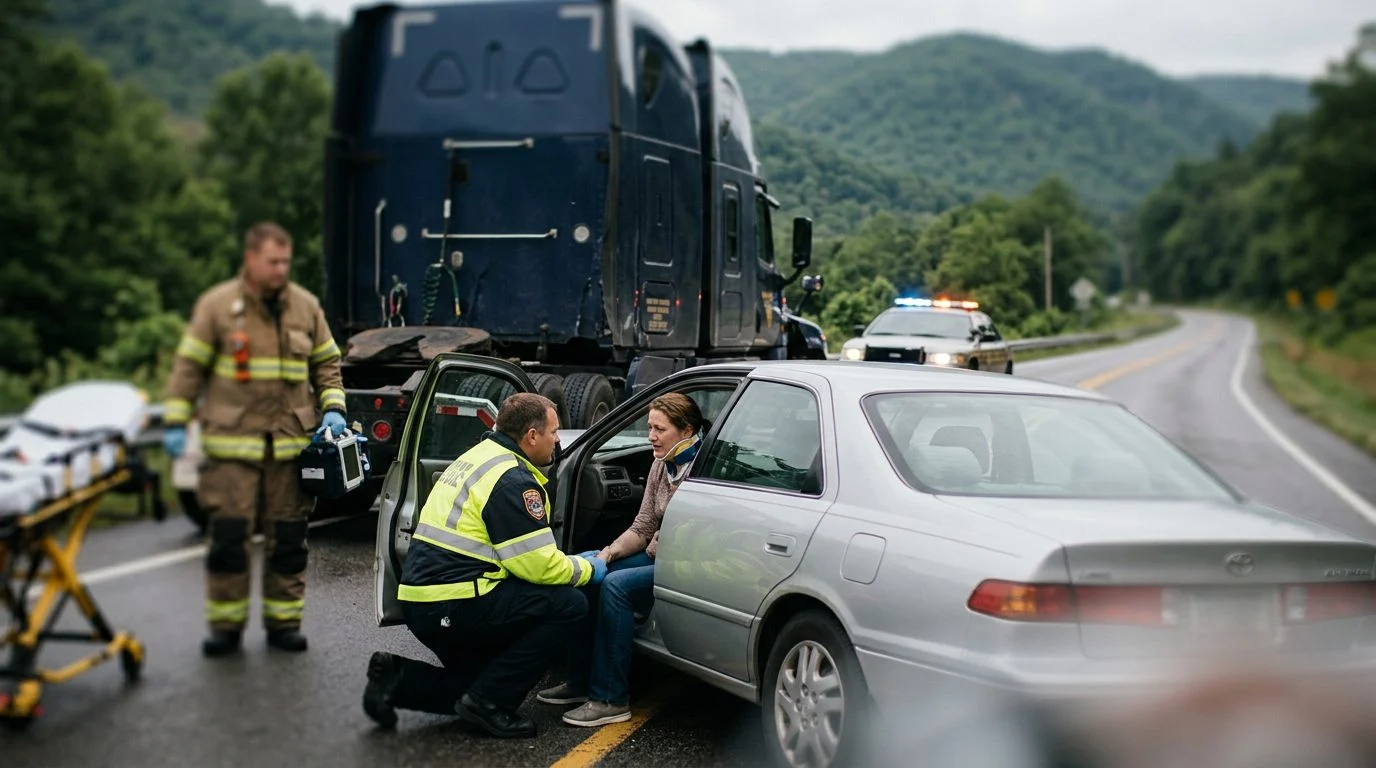
Spinal Cord Injury from Commercial Vehicle Crash in West Virginia
A spinal cord injury from a commercial vehicle crash is catastrophic. Commercial vehicles weigh 10,000 to 80,000 pounds or more. Passenger cars weigh 3,000 to 4,000 pounds. The force difference is enormous. Once the spinal cord is damaged, it does not regenerate. Understanding how these injuries happen and what your legal options are is the first step forward.
How Commercial Vehicle Crashes Cause Spinal Cord Injuries
The mass and force of a commercial vehicle is why these crashes cause spinal cord injuries so often. A loaded truck can weigh 80,000 pounds. A passenger car weighs around 3,500 pounds. When a commercial vehicle hits a car, the occupants experience forces far beyond what the car’s structure can absorb.
The spinal cord sits inside the vertebral column. It is protected by bone but remains vulnerable to damage from sudden, violent motion. In a commercial vehicle crash, the spine can be damaged several ways:
- Direct impact from the vehicle itself
- Sudden acceleration or deceleration causing whiplash
- Compression of the vertebrae
- Shearing forces that twist or bend the spine beyond normal range
Even a crash without a broken bone can tear or bruise the spinal cord’s nerve tissue.
According to the National Institute of Neurological Disorders and Stroke (NINDS), nerve fibers in the spinal cord do not regenerate once damaged. This is why a spinal cord injury is often permanent. Immediate medical attention is critical.
Not sure what your next step is?
Talk it through with our team — the first case review is free, confidential, and carries no obligation.
Complete and Incomplete Spinal Cord Injuries
Not all spinal cord injuries are the same. The difference between complete and incomplete injuries matters for recovery and your legal claim.
A complete spinal cord injury means the cord is fully severed or so severely damaged that no nerve signals pass below the injury site. A person with a complete injury loses all sensation and movement below the injury level. This loss is permanent.
An incomplete spinal cord injury involves partial damage to the cord. Some nerve fibers remain intact. Some function may be preserved or recovered with rehabilitation. People with incomplete injuries often regain some movement or sensation, though the extent varies widely.
The injury level also determines what body parts are affected. A cervical (neck) injury typically results in quadriplegia—loss of function in all four limbs and often loss of breathing function. A thoracic (mid-back) or lumbar (lower-back) injury usually results in paraplegia—loss of function in the legs and lower body. Higher spine injuries cause more extensive loss of function.
Spinal Cord Injury vs. Other Spine Injuries
Many people use “spinal cord injury,” “broken spine,” “herniated disc,” and “whiplash” interchangeably. They are not the same. The severity, treatment, and long-term outlook differ greatly.
A spinal cord injury is damage to the nerve tissue itself. Once damaged, the spinal cord does not fully heal. Loss of function can be permanent.
A broken vertebra or fractured spine is damage to the bone surrounding the spinal cord. A broken vertebra may or may not involve cord injury. Many broken vertebrae heal with rest, bracing, or surgery without permanent nerve damage.
A herniated disc occurs when soft material inside a spinal disc bulges out and presses on nearby nerves. This often causes pain and may cause temporary weakness or numbness. Nerve damage is usually not permanent. Herniated discs often improve with physical therapy, medication, or surgery.
Whiplash or soft-tissue injury involves damage to muscles, ligaments, and tendons around the spine. These injuries are painful but typically heal over time with rest and rehabilitation.
A single commercial vehicle crash can cause multiple injuries at once. A person might have a broken vertebra, a herniated disc, and a spinal cord injury all from the same crash. This is why imaging and thorough neurological examination are so important in the hours and days after a crash.
Diagnosis and Initial Treatment After a Commercial Vehicle Crash
If you have a spinal cord injury, it will be diagnosed in the emergency room or hospital immediately after the crash. The first step is emergency imaging—usually a CT scan or MRI—to see the extent of damage to the spine and spinal cord. A neurological examination follows, in which a doctor tests your sensation and motor function at different body levels. This exam helps determine where the injury is and how severe it is.
Acute treatment in the first hours and days focuses on stabilization, reducing swelling, and preventing further damage. You may be immobilized with a collar, brace, or halo device. Medications to reduce inflammation may be given. Surgery may be performed if bone fragments or disc material press on the cord. Once you are stable, rehabilitation begins—physical therapy, occupational therapy, and other treatments aimed at preserving function and relearning how to move and care for yourself.
Rehabilitation from a spinal cord injury is a long process. It may continue for months or years. The goal is to maximize your independence and quality of life, though recovery extent depends on the injury severity and level.
Have questions about what happened?
Ask our team directly. The first conversation is free, confidential, and there is no obligation to continue.
Spinal Cord Injury Compensation in West Virginia
People often ask what a “typical” settlement is for a spinal cord injury. Each case is unique. The value of a claim depends on many factors specific to your situation.
Compensation in a West Virginia personal injury case reflects several categories of harm:
- Medical costs (emergency care, hospitalization, surgery, rehabilitation, ongoing therapy)
- Future medical care and equipment
- Lost wages and lost earning capacity
- Pain and suffering
- Loss of enjoyment of life
For a spinal cord injury, medical costs and lost earning capacity are often substantial because the injury is permanent and lifelong care may be needed.
Factors that influence what a claim is worth include whether the injury is complete or incomplete, the injury level, your age and work capacity before the crash, the strength of evidence that the other driver was at fault, and the clarity of medical evidence linking the crash to your injury. A 25-year-old with a complete cervical injury will have very different lifetime costs and lost wages than a 65-year-old with an incomplete lumbar injury. Each case must be evaluated on its own facts.
Settlement discussions typically happen after you have reached maximum medical improvement—the point at which your condition has stabilized and a clearer picture of your long-term needs has emerged. This can take months or longer.
West Virginia Comparative Fault Rules and What They Mean for Your Claim
If you were seriously hurt in a commercial vehicle crash, the way damages are figured in a West Virginia personal injury case can be complex, and we can walk you through how it may apply to your situation.
After a serious crash, you may be dealing with pain, suffering, loss of enjoyment of life, and emotional distress, and you can reach out to us to talk through what you are going through. Under West Virginia’s modified comparative fault rule (W (W. Va. Code § 55-7-13c). Va. Code § 55-7-13c), you may recover damages if you are not more than 50% at fault for the crash, though your recovery is reduced by your share of responsibility.
However, West Virginia’s comparative fault rules still apply (W. Va. Code § 55-7-13c). Under W. Va. Code § 55-7-13c, in any action for damages, the liability of each defendant for compensatory damages is generally several only and may not be joint, so each defendant is liable only for the amount of compensatory damages allocated to that defendant in direct proportion to that defendant’s percentage of fault, and a separate judgment is rendered against each defendant for his or her share of that amount, though exceptions may apply. However, under W. Va. Code § 55-7-13c, joint liability may be imposed on two or more defendants who consciously conspire and deliberately pursue a common plan or design to commit a tortious act or omission, and any person held jointly liable has a right of contribution from other defendants that acted in concert. Understanding West Virginia comparative fault law can help clarify how these rules apply to your crash.
Proving a Spinal Cord Injury Claim After a Commercial Vehicle Accident
Proving that a commercial vehicle crash caused your spinal cord injury requires solid medical evidence and proof of how the crash happened.
Medical evidence is central. Your medical records, imaging (CT and MRI scans), neurological examination findings, and testimony from your doctors establish that you have a spinal cord injury and that it was caused by the crash, not by a pre-existing condition. If you had back or spine problems before the crash, medical records help clarify what the crash caused and what was already there. Learn more about personal injury medical evidence.
Proof of how the crash happened comes from several sources: the police report, witness statements, photographs of the crash scene and vehicle damage, and accident reconstruction. For commercial vehicle crashes, data from the truck’s black box can be crucial. Federal regulations require commercial vehicles to have hours-of-service recorders. This data can show whether the driver was fatigued or violating safety rules.
Spinal cord injuries are among the hardest injuries to prove in a personal injury case. They require clear medical causation and thorough documentation of both the injury and the accident. Working with someone who understands West Virginia law and has experience with commercial vehicle accident claims is important.
Next Steps After a Spinal Cord Injury from a Commercial Vehicle Crash
If you have not already received emergency medical care, seek it immediately. Spinal cord injuries require urgent evaluation and stabilization.
Preserve evidence. Take photographs of the crash scene, vehicle damage, and your injuries if you are able. Keep all medical records, bills, and receipts. Write down the names and contact information of any witnesses. If a police report was filed, get a copy.
Do not sign anything or give a recorded statement to the commercial vehicle operator’s insurance company without legal advice. Insurance adjusters work for the insurance company, not for you. Anything you say can be used against your claim.
Understand that commercial vehicle crashes often involve multiple insurance policies—the driver’s personal policy, the company’s commercial policy, and sometimes additional coverage. These cases are more complex than typical car accidents. The rules about who is responsible and how much insurance is available are different.
If you are trying to understand what happened, what your injury means for your future, and whether you have a legal claim, reaching out to someone who handles these cases regularly can help clarify your options and next steps.
Want to know where you stand?
Tell us what happened and our team will walk you through the options available to you, at no cost.
FAQ
What is the difference between a complete and incomplete spinal cord injury?
A complete injury means the spinal cord is fully severed or so damaged that no nerve signals pass below the injury site. An incomplete injury involves partial damage with some nerve function remaining, which may allow for some recovery with treatment.
How quickly must I act after a spinal cord injury from a commercial vehicle crash?
Seek emergency medical care immediately if you have not already. Medical evidence gathered in the first hours and days is critical to your claim. West Virginia has a statute of limitations (a deadline) for filing a personal injury lawsuit. Do not delay in consulting with an attorney about your legal rights.
Can a spinal cord injury from a truck accident improve or recover?
Incomplete spinal cord injuries may allow for some recovery or preservation of function with intensive rehabilitation. Complete spinal cord injuries result in permanent loss of function below the injury site. Recovery potential depends on the injury severity and level.
What role do federal hours-of-service rules play in my case?
Federal regulations limit commercial drivers to 11 hours of driving within a 14-hour window. If the driver was fatigued or violated these rules, it can strengthen your claim that the driver was negligent.
Is there a “typical” settlement for a spinal cord injury in West Virginia?
No. Each case depends on the injury severity, your age and work capacity, medical costs, lost wages, the strength of evidence of fault, and other factors unique to your situation. Settlement amounts vary widely.
If you or a family member is recovering from a spinal cord injury caused by a commercial vehicle crash in West Virginia, you’re likely facing questions about medical care, long-term needs, and whether you have a legal claim. Many people in your position reach out to Big Bubba to understand what happened and to explore their options. For questions about catastrophic injury compensation in West Virginia or truck accident liability, contact us for a case review and let us help you navigate what comes next.
Big Bubba Personal Injury Law
Contact us today to tell Bubba what happened.