
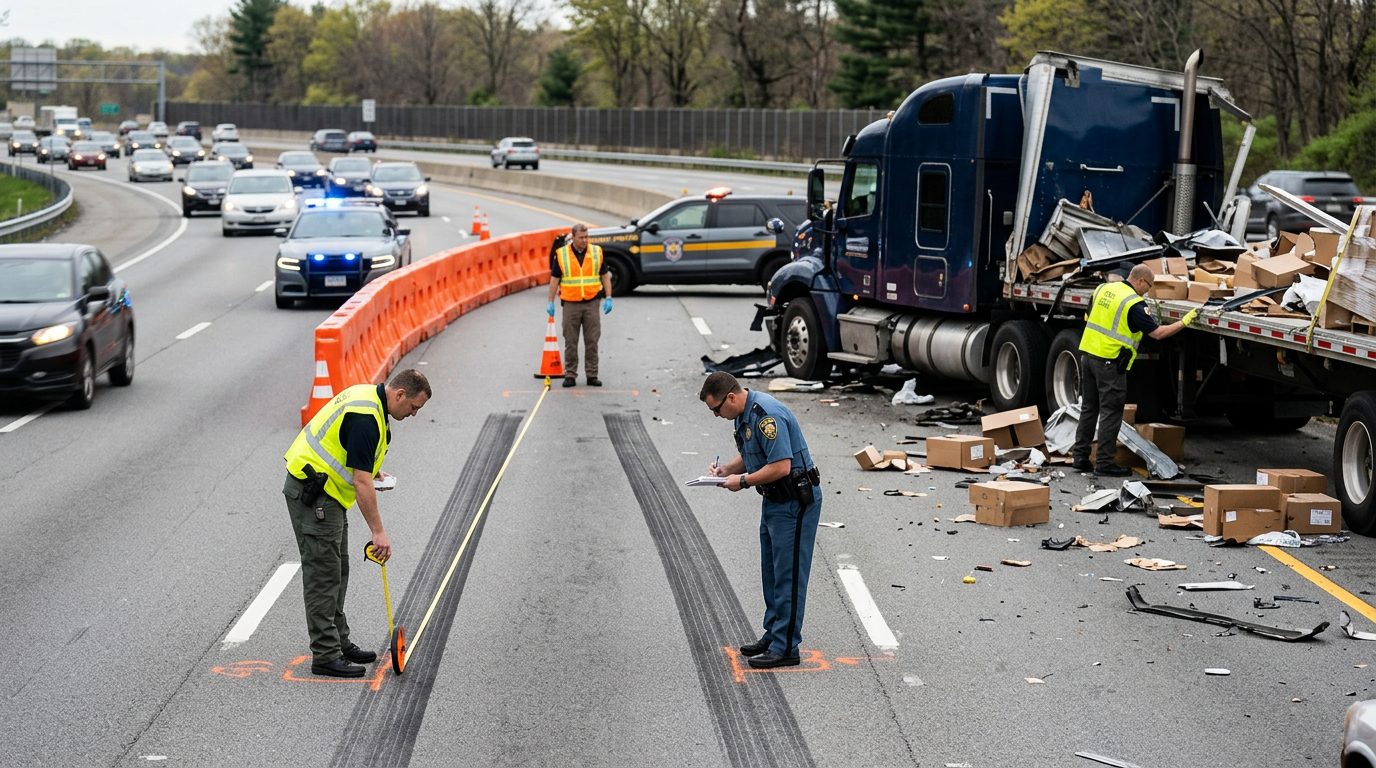
Commercial Vehicle Accidents
Can I Sue a Truck Company for a Commercial Vehicle Accident?
Yes. We handle truck accident claims across West Virginia.
Published October 08, 2026
Yes, you can sue a truck company for a commercial vehicle accident. In West Virginia, a company that operates a commercial truck can be held legally responsible for injuries caused by its driver’s negligence or by the company’s own failure to maintain the vehicle, hire safely, or follow federal safety rules. This legal principle is called vicarious liability—the company is responsible for the actions of its employees when those actions happen during work.
Yes, You Can Sue a Truck Company for a Commercial Vehicle Accident
A truck company can be held liable even when the driver directly caused the crash. When a crash involves someone who was driving for work, questions can arise about the role of the employer as well as the driver. This means if a truck driver working for a company causes an accident, the company itself can be sued for the injuries that result.
The company typically has more insurance and financial resources than an individual driver. That’s why most injured people pursue claims against the company, not just the driver. The company’s insurance is often where recovery comes from.

Not sure what your next step is?
Talk it through with our team — the first case review is free, confidential, and carries no obligation.
When Is a Truck Company Legally Responsible?
A truck company can be held responsible in several ways:
The driver was negligent. If the driver was speeding, distracted, fatigued, or drove recklessly, and that caused your accident, the company may be liable for the portion of fault assessed against the driver if the driver was acting as its agent or servant, under W. Va. Code § 55-7-13d.
The company failed to hire safely. Federal rules require motor carriers to investigate each driver’s safety performance history with Department of Transportation regulated employers during the preceding three years. Federal regulations require motor carriers to obtain each driver’s motor vehicle record covering the prior 3-year driving history within 30 days of hiring. If the company skipped this step or ignored red flags, it may be liable.
The company failed to keep the driver. West Virginia recognizes negligent retention: an employer is liable for keeping an employee it knew or should have known was unfit or unsafe. Federal regulations require motor carriers to review each driver’s motor vehicle record at least once every 12 months to determine whether the driver still meets minimum safety standards. If the company kept a driver with a dangerous record, it may be liable.
The company failed to supervise. In West Virginia, a defendant is generally liable only for the share of damages that matches its percentage of fault. If the company didn’t train the driver properly or didn’t enforce safety rules, it may be liable.
The company failed to maintain the truck. Federal regulations require motor carriers to systematically inspect, repair, and maintain all motor vehicles, with parts and accessories kept in safe and proper operating condition at all times. If a mechanical failure caused your accident because the company neglected maintenance, the company may be liable, and West Virginia applies comparative fault to determine each party’s share.
The company pressured the driver to break safety rules. Federal rules prohibit a motor carrier from aiding, abetting, encouraging, or requiring its employees to violate federal safety rules. If the company pushed the driver to violate hours-of-service regulations or other federal safety rules, and that caused your accident, that may help establish the company’s fault. See 49 C.F.R. § 390.13.
Large trucks weigh 20–30 times as much as passenger vehicles, so even a small mistake by a truck driver can cause catastrophic injuries. This is why holding the company accountable matters.
Suing the Truck Driver vs. Suing the Truck Company
You can sue the driver, the company, or both. Here’s what matters:
The company usually has more money. An individual truck driver may not have enough personal assets or insurance to cover your damages. The company’s commercial insurance policy is typically much larger.
The driver may be an employee or an independent contractor. If the driver was acting as the company’s agent or servant, the company may be held liable for the portion of fault assessed against the driver, under W. Va. Code § 55-7-13d. If the driver is an independent contractor, the company may still be liable under other theories—like negligent hiring or negligent entrustment (letting someone drive whom the company knew or should have known was unfit). A state-law claim that a broker negligently hired an unsafe motor carrier is not preempted by federal law, so these claims can move forward.
You can recover from both. There’s no rule that says you have to choose one. Your attorney can pursue claims against the driver, the company, or both, depending on the facts.
What You Need to Prove
To win a claim against a truck company, you generally need to show:
-
The company owed you a duty of care. All drivers—and the companies that employ them—have a duty to operate vehicles safely and follow traffic laws.
-
The company breached that duty. The driver was negligent, or the company failed to hire, train, supervise, or maintain properly.
-
The breach caused your accident. Your injuries wouldn’t have happened but for the company’s negligence.
-
You suffered damages. You have medical bills, lost wages, pain and suffering, or other losses.
Evidence may include accident reports, the driver’s hiring file and training records, the truck’s maintenance logs, the driver’s driving history, witness statements, and photos of the accident scene.
Have questions about what happened?
Ask our team directly. The first conversation is free, confidential, and there is no obligation to continue.
Comparative Fault in West Virginia
West Virginia follows a modified comparative fault rule. This means that even if you were partly at fault for the accident, you can still recover damages—as long as your fault is not greater than the combined fault of all other parties. Your recovery is reduced in proportion to your degree of fault. For example, if you were 20% at fault and the truck company was 80% at fault, you can recover 80% of your damages.
How Long Do You Have to File a Claim?
In West Virginia, you generally have two years from when the right to bring the claim accrued to file a lawsuit for personal injuries. This deadline is critical. If you miss it, you may lose your right to sue, and exceptions may apply. Don’t wait.
Frequently Asked Questions
Can I sue the truck company if the driver was an independent contractor?
Yes, in many cases. The company may still be liable under theories like negligent hiring or negligent entrustment, even if the driver is not an employee.
What evidence do I need?
Accident reports, the driver’s record, maintenance logs, witness statements, and medical records all matter. Your attorney will gather and analyze the evidence.
How much can I recover?
That depends on your injuries, medical costs, lost wages, and other damages. Every case is different, and there’s no standard amount.
Should I settle or go to trial?
Many cases settle before trial. Whether to settle depends on the strength of your case, the extent of your injuries, and the company’s insurance offer. Your attorney can help you weigh your options.
Want to know where you stand?
Tell us what happened and our team will walk you through the options available to you, at no cost.
What Happens Next
If you were injured in a commercial vehicle accident in West Virginia, you have the right to explore your legal options. Understanding whether you have a claim against the truck company is an important first step. The facts of your accident—where it happened, who was involved, what caused it, and how badly you were hurt—all matter.
An attorney experienced in commercial vehicle accidents can review what happened, explain the company’s potential liability, and help you decide what to do next. You don’t have to figure this out alone.
Related practice areas
- Commercial Vehicle Accidents in West Virginia: Your Rights & Next Steps
- Commercial Vehicle Accidents in Charleston
- Commercial Vehicle Accidents in Huntington
- Commercial Vehicle Accidents in Morgantown