
Car Accidents | West Virginia
Need a Police Report After a West Virginia Car Crash?
Learn which agency likely has the report, how to request it, and how the firm can help you use it as your claim moves forward.
Published November 11, 2026
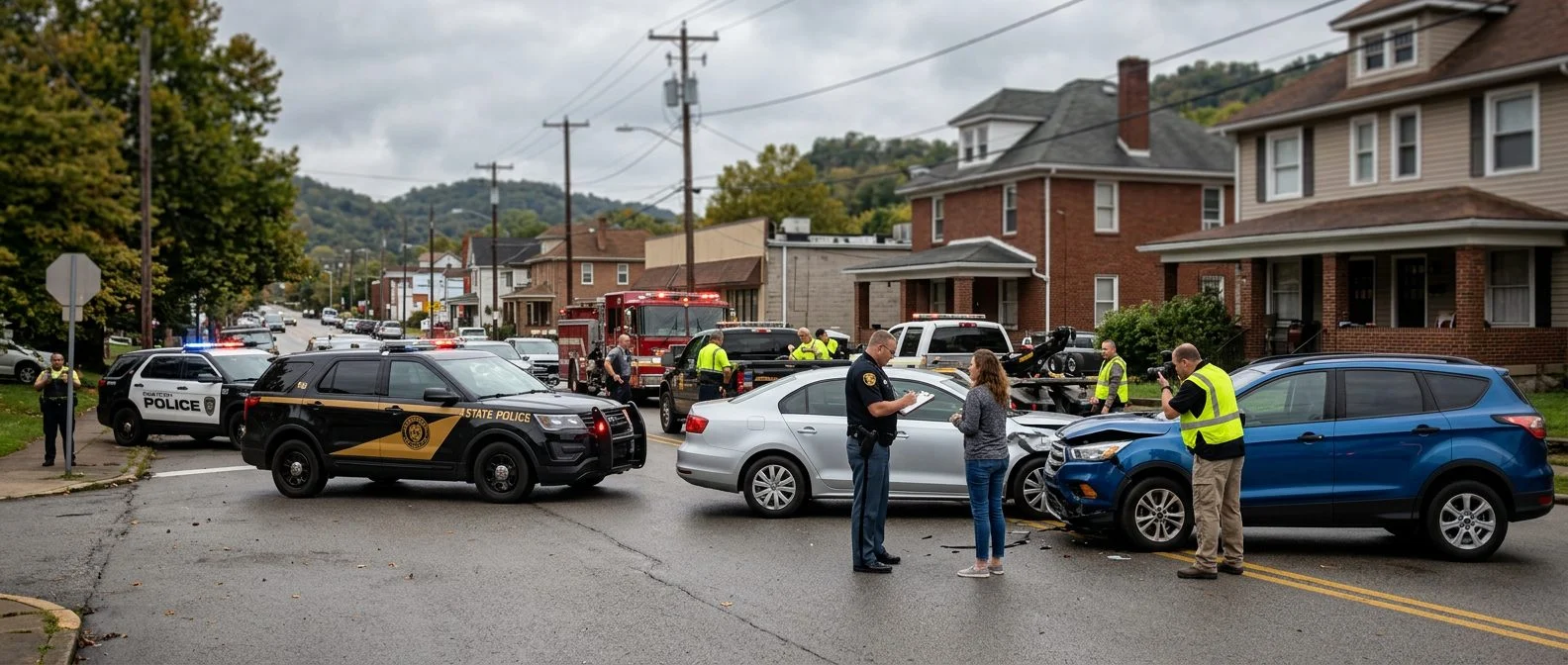
If you were hurt in a car accident in West Virginia, you may need a copy of the police report to move your claim forward. The report is usually held by the agency that investigated the crash. That could be a city police department, a county sheriff’s office, or the West Virginia State Police. You can ask that agency for a copy.
Many people do this while still sore, dealing with a damaged car, and fielding calls from insurers. You don’t have to solve everything at once. Work through the steps below one at a time.
Why the Police Report Matters After a West Virginia Car Accident
The crash report is the official written record of what the investigating officer observed and documented at the scene. It usually lists the date, time, and location, the drivers and vehicles, and any injuries or damage noted. Insurers and attorneys may review it, and it may be relevant to a lawsuit.
The report is one piece of evidence. It does not decide fault on its own. West Virginia generally uses a modified comparative fault system, which measures fault as a percentage. Under W. Va. Code § 55-7-13a, recovery in a personal injury action is based on comparative fault, and each person’s share is set in proportion to that person’s percentage of fault.
That is why the details matter. Witness names, photos, and repair records may also help show what happened. Keep them together from the start.
If a crash left you injured or a loved one gone, the firm offers a free case review, and you can reach out to talk it through. Talk it through with Big Bubba — the first case review is free, confidential, and carries no obligation.

Which Agency Investigated the Crash and Where the Report Is Kept
The investigating agency is usually the office that holds the official crash report. The agency that responded depends on where the crash happened. City police may respond to crashes inside city limits. A county sheriff’s office may respond in unincorporated areas. The West Virginia State Police may respond on state roads and highways.
Check the paperwork you received at the scene. Look for the officer’s name, the agency name, a badge number, and a case or report number. If you have no paperwork, the crash location and road type are good clues. You can also ask a local city or county office which agency covers that road.
Each agency’s own website lists its current records-request steps and contact details. Start there, since those steps reflect that office’s current process.
Steps to Request a Copy of the Crash Report
Start by gathering the details that help the agency find your file. Useful facts include the date, time, and approximate location, the drivers’ names, a vehicle plate or make, and any report or case number.
Request routes vary. Some agencies accept an in-person visit, a mailed request, or an online portal. The agency may ask for identification and may ask who is requesting the report and why. Answer simply and truthfully.
Keep a short log. Write down the date you asked, the name of the person you spoke with, and any reference number you receive. If you don’t hear back within the time the agency gave, follow up with that reference number. The log helps if a question about the report comes up later.
Copy Fees and Turnaround Times for Crash Reports
Each agency sets its own copy fee and payment methods. Check the current amount on that agency’s records page, or ask when you request the report, so you know what to expect.
It also notes that copying fees may apply.
Turnaround time varies. It depends on the agency’s workload and on whether the investigation is still open. A report may not be ready right away, especially after a serious crash that needs more follow-up. Ask the agency for an estimated date when you request it.
What the Crash Report Contains and How to Read It
Many agencies use the State of West Virginia Uniform Traffic Crash Report form. Common sections include the parties and vehicles, driver and insurance details, a crash diagram, the officer’s narrative, contributing factors, and injury or damage codes. Some reports also include supplemental pages for witnesses or extra vehicles, so check for those too.
Codes are defined in the agency’s key or instructions. Check them before you draw conclusions from a number or a checked box. Read the diagram next to the narrative so the two tell the same story.
The narrative reflects what the officer saw and what people said at the scene. Other people may describe events differently, and a later account can differ from the first one. Write down anything that looks wrong, with the section and the date you noticed it. That list will help if you ask for a correction.
When a Crash Must Be Reported in West Virginia
Whether a particular crash must be reported can depend on the injuries, deaths, or property damage involved.
Reporting also matters for insurance. Under W. Va. Code § 33-6-31, uninsured and underinsured motorist coverage may carry conditions for recovery. One listed condition is reporting the accident to a police, peace or judicial officer within twenty-four hours after the insured discovers it, if physically able to report, unless the accident has already been investigated by a police officer.
If you missed that window, a late report may still help. If you’re unsure whether your crash had to be reported, reporting it to the agency that covers the location is a sound step.
Not sure what your next step is?
Talk it through with Big Bubba — the first case review is free, confidential, and carries no obligation.
Getting a Report When No Report Was Filed, the Driver Left, or the Report Has Errors
If the other driver left the scene, report the crash to the agency that covers the location as soon as you can. Write down the vehicle’s make, color, and plate number if you saw it, plus the direction it traveled.
If the other driver’s identity is unknown, the insurance rules may add another step. Under W. Va. Code § 33-6-31, one condition for uninsured motorist coverage is notifying the insurance company within sixty days after the accident that the insured or a legal representative has a cause of action against a person whose identity is unknown, and setting forth the facts in support.
If the report has errors, ask the agency to add or correct information through its written amendment process. Common fixes include a misspelled name, a wrong plate number, or an incorrect location. The agency decides whether a correction is made. An officer’s narrative may not change just because you disagree with it. In that case, keep your own written account and supporting evidence, such as photos, witness contact details, medical records, and repair estimates.
Requesting a Report for an Injured or Deceased Family Member
A family member may ask for a report on someone else’s behalf. The agency may require proof of the relationship or a written authorization. Call first and ask what identification or documents it needs.
When a person has died, a wrongful death claim is brought by the personal representative. Under W. Va. Code § 55-7-6, that action is brought in the name of the duly appointed personal representative. W. Va. Code § 55-7-6 reads: “The provisions of this section shall not apply to actions brought for the death of any person occurring prior to July 1, 1988.”
Families often handle this while coping with a hospital stay, a loss, or caregiving. If you’re gathering a crash report for a relative after a serious injury or a death, the firm offers a free case review. We serve injury victims across West Virginia, including Charleston, Huntington, and Morgantown. You can contact the firm to talk through what happened.