
Car Accidents | West Virginia
Rear-End Crash? Here's How Fault Is Looked At in West Virginia
Clear answers for people hurt in a crash where another vehicle hit them from behind, and for families trying to understand what comes next.
Published November 12, 2026
If you’re reading this after a rear-end crash, you’re probably trying to make sense of something that happened very fast. Maybe the crash involved you. Maybe it involved someone you love.
Short answer: in West Virginia, the driver behind is often the first focus in who is at fault in a rear-end crash, but the facts decide the result. More than one driver can share responsibility, and each share is stated as a percentage. For broader context on serious crash injuries, read our guide on traumatic brain injury in car accidents.
Why Fault in a Rear-End Crash Is Not Always Simple
The driver who strikes from behind is often the first focus, but the facts of each crash decide who is responsible. Police, insurers, and courts usually start by asking who had room to stop. That is a useful starting point. It is not an automatic answer.
A rear-end crash can involve a sudden stop, a lane change, a blocked view, a commercial truck, or a chain of several vehicles. Each detail can change how fault is split. Two crashes that look alike on paper can be judged very differently once the details come out.
This page explains how West Virginia approaches fault. It looks at when the lead driver may share responsibility, when the driver behind may be questioned, and what happens in multi-vehicle crashes. It also covers time limits, evidence, and insurance questions that often come up after a crash like this.
If someone you love was hurt in a rear-end crash, you don't have to sort out fault alone. You can reach out for a free case review. Talk it through with Big Bubba — the first case review is free, confidential, and carries no obligation.

How West Virginia Law Approaches Fault
West Virginia uses a modified comparative fault system. That means more than one person can share fault for the same crash, and each share is stated as a percentage. W. Va. Code § 55-7-13a explains that recovery in a personal injury case is based on comparative fault. Each person’s liability is allocated in direct proportion to that person’s percentage of fault.
The bar on recovery is narrower than many people expect. Under W. Va. Code § 55-7-13c, an injured person’s fault bars recovery only when it is greater than the combined fault of all other persons responsible. If the injured person’s fault is less than that combined fault, recovery is reduced in proportion to that person’s share. Under W. Va. Code § 55-7-13c, a plaintiff’s fault generally does not bar recovery unless it is greater than the combined fault of all other persons responsible for the total amount of damages, if any, to be awarded.
A reduction may apply even when the injured person is not barred. Under W. Va. Code § 55-7-13c, if the plaintiff’s fault is less than the combined fault of all other persons, the plaintiff’s recovery is generally reduced in proportion to the plaintiff’s degree of fault. Courts apply these rules to the facts of each case. The same type of crash can be judged differently when the road, the weather, or each driver’s actions are different.
When the Lead Driver May Share Responsibility
The driver in front can share responsibility when their own actions helped cause the crash. This happens more often than many people assume. Common examples include:
- A sudden stop with no clear reason
- Brake lights that were not working
- A sudden lane change or cut-in that leaves little space
- Backing up in traffic
If another driver was at fault, the crash may look different than it first appears. A stop for a real hazard is treated differently. A driver who brakes for a pedestrian, debris in the road, or a vehicle that stalled may have had a legitimate reason to slow.
The front driver’s account is often central. That driver’s version may differ from the account of the driver behind. Photos of the scene, skid marks, and any dashcam video may help show what each driver did and when. Many people assume the lead driver is always blameless. That assumption can leave a real question unexamined.
When the Trailing Driver May Be Questioned
The driver behind may be questioned when they did not keep enough distance to stop safely. Following too closely is a common point in these reviews. The question is whether that driver had enough room and time to react to traffic ahead.
Other factors can also be examined:
- Phone use or other distraction
- Speed that was too fast for the road or weather
- Fatigue, including long hours behind the wheel
- Impairment from alcohol or drugs
- Glare, rain, snow, or poor road surfaces
Impairment can carry its own rules. Under W. Va. Code § 55-7-13c, a defendant whose driving under the influence is a proximate cause of the plaintiff’s damages may be jointly and severally liable. That can change how a claim is handled.
Being hit from behind does not settle fault on its own. The lead driver’s conduct may still matter. A driver who was struck from behind may still have a basis to argue that the other driver contributed, and that argument may change the percentages.
Multi-Vehicle and Chain-Reaction Crashes
A multi-vehicle crash involves more than two vehicles. A chain-reaction crash happens when one impact pushes vehicles into others. In these crashes, each driver may be examined separately, and the first impact and each later impact can raise different questions.
Under W. Va. Code § 55-7-12, a release or settlement with one joint tortfeasor does not bar a claim against another for the same cause of action. This matters when several drivers are involved. An agreement with one party does not automatically close the door on the others.
Defendants may also name a nonparty they say was at fault. Under W. Va. Code § 55-7-13d, a defending party generally may give notice that a nonparty was wholly or partially at fault no later than one hundred eighty days after service of process upon that defendant; the notice must be filed with the court and served upon all parties, designating the nonparty and giving a brief statement of the basis for believing the nonparty at fault. The court may then assign a percentage to that nonparty, but that finding does not subject the nonparty to liability in that or any other action.
Crashes involving commercial trucks raise added questions. Federal hours-of-service rules limit how long a property-carrying driver may drive. For drivers of property-carrying commercial motor vehicles, the hours-of-service rules apply to all motor carriers and drivers under 49 CFR 395.1, except as provided in paragraphs (b) through (x) of that section; the 10-hour off-duty, 14-hour and 11-hour driving limits are set out in 49 CFR 395.3. Under 49 CFR 395.3(a)(3)(ii), a driver may not drive once more than 8 hours of driving time have passed without at least a consecutive 30-minute interruption in driving status, unless the driver qualifies for one of the short-haul exceptions in § 395.1(e)(1) or (2). You can read more about hours-of-service violations in truck crashes.
If the other driver left the scene, see our page on hit-and-run car accident injuries.
Can the Other Driver Be Sued After a Rear-End Crash?
A driver who causes injury may generally be held responsible in a civil claim, and exceptions may apply. Under W. Va. Code § 55-7-9, a person injured by the violation of a statute may recover the damages sustained because of that violation, unless the statute says a penalty takes the place of damages. W. Va. Code § 55-7-9 reads: “Any person injured by the violation of any statute may recover from the offender such damages as he may sustain by reason of the violation, although a penalty or forfeiture for such violation be thereby imposed, unless the same be expressly mentioned to be in lieu of such damages.”
Time limits matter. West Virginia generally allows two years to bring a personal injury claim under W. Va. Code § 55-2-12, and exceptions may apply. Don’t assume the same deadline fits every case.
Timing also matters in the first weeks after a crash. Under W. Va. Code § 55-7-11a, a person generally may not negotiate a settlement, seek a release, or obtain a statement from the injured person within twenty days of the injury while the injured person is a hospital inpatient or partially or totally unable to engage in his or her usual trade, profession or occupation. The injured person’s express request is an exception only for obtaining a statement: a person acting for and on behalf of the injured person may obtain a statement, oral or written, upon the injured person’s express request.
If the injuries are serious, long-term needs become part of the picture. Readers asking about those needs can read about a life care plan after a brain injury.
Not sure what your next step is?
Talk it through with Big Bubba — the first case review is free, confidential, and carries no obligation.
Evidence That May Help Show Who Did What
The police crash report is often the first document reviewed. You can request it from the investigating agency, which may charge for a copy. The report usually lists the vehicles, the drivers, the statements taken, and the officer’s notes.
Other evidence may include:
- Photos of vehicle damage and the scene
- Dashcam or nearby video
- Witness names and phone numbers
- Medical records that describe the injury and when symptoms began
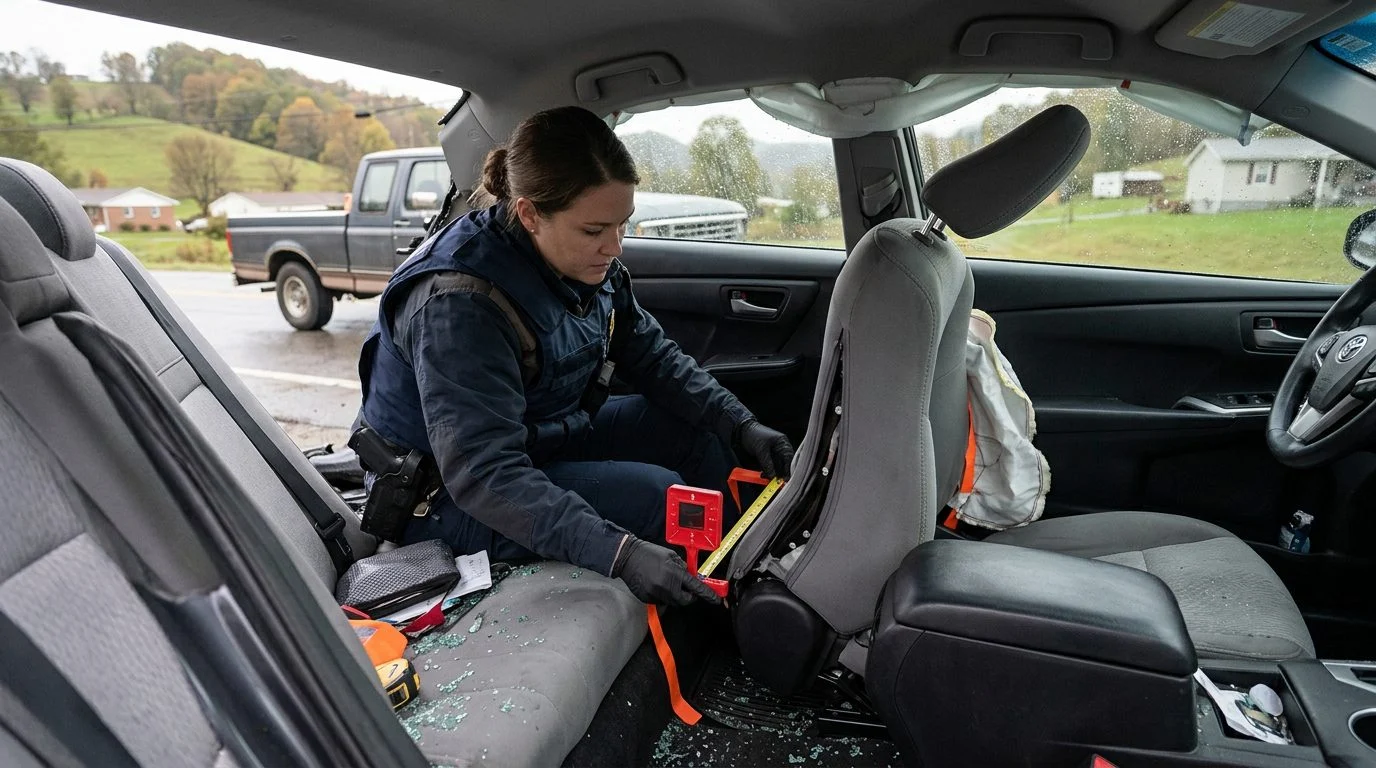
Vehicle damage patterns, skid marks, and final rest positions of the cars may be relevant. These details can help show how the impacts happened and in what order.
Write down your own account soon after the crash, while memory is fresh. Note the time, the weather, the traffic, and what you saw and heard. Keep records of treatment, missed work, and bills. Some records may be lost over time, so it may help to ask early.
Insurance Disputes and Your Own Share of Fault
Some insurers may dispute a claim or question who was at fault. The other driver’s insurer may ask you for a recorded statement. It can help to think through the facts before you answer, and to say only what you clearly remember.
Insurance rules come from state law as well. The West Virginia Division of Motor Vehicles explains auto insurance requirements and proof of coverage. That page can help you understand what coverage a driver must carry.
The Centers for Medicare & Medicaid Services explains those reporting requirements.
How fault is split between drivers can change how much a claim may recover. That is why the specific facts of each crash matter so much.

What to Know After a Rear-End Crash
If you’re looking into this for a parent, spouse, or friend who can’t easily do it themselves, you’re carrying a lot right now. You may be asking whether the other driver was at fault, whether your own share of fault matters, or how timing could affect a possible claim.
You can request a free case review with the firm. The review is confidential and carries no obligation to continue.
We handle car accident, truck accident, and catastrophic injury claims, including traumatic brain injury, spinal cord injury, and wrongful death. We serve injury victims across West Virginia.