
Car Accidents | West Virginia
Asked for a Recorded Statement After a West Virginia Car Accident?
Before you answer an insurance adjuster's questions, talk with the firm. We handle car, truck and commercial vehicle crash cases across West Virginia.
Published November 1, 2026
Short Answer: Is a Recorded Statement Required After a West Virginia Car Accident?
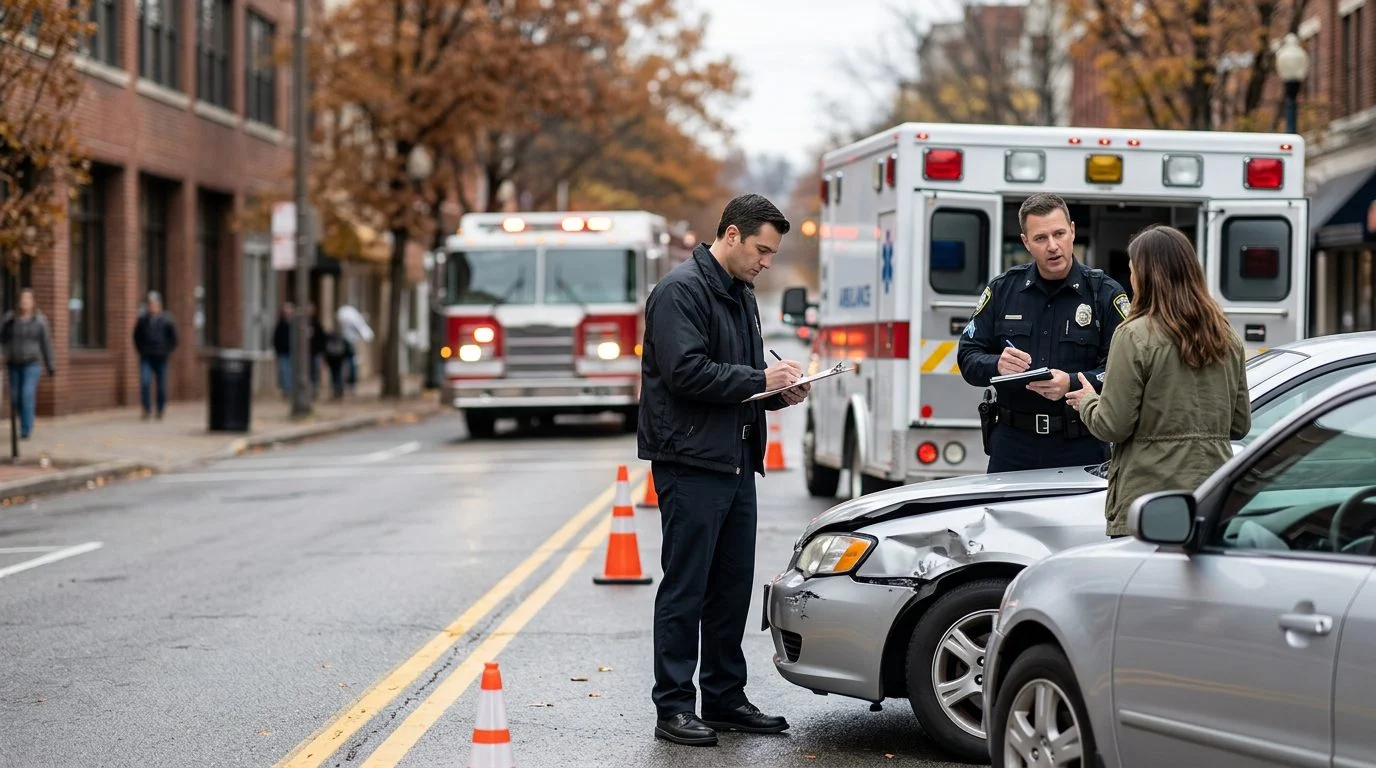
A recorded statement after a car accident in West Virginia is a request from an insurance company, not a court order. Whether you have to agree depends on who is asking and what your own policy says. The other driver’s insurer and your own insurer are different situations, and you should know the difference before you answer.
The request often arrives within days of the crash. That timing matters. Many people are still in pain, taking medicine, or waiting for test results. They may not yet know how serious their injuries are, and that makes it harder to answer questions with confidence.
Under West Virginia Code § 55-7-11a(a), some early contact in the first 20 days after an injury is restricted, but only while the injured person is a hospital inpatient or is partially or totally unable to engage in his or her usual trade, profession or occupation. The rest of this page explains what that means and which questions to weigh first.
If an adjuster asked you for a recorded statement while you are still hurt, you do not have to face that call alone. We can talk through your options in a free case review. Talk it through with Big Bubba — the first case review is free, confidential, and carries no obligation.
What an Insurance Recorded Statement Is and Why Insurers Ask for One
A recorded statement is a question-and-answer session with an adjuster. The call is recorded, usually typed into a transcript, and placed in the claim file. You answer the questions the adjuster asks, and the words you use become part of the record.
Insurers say they ask for these statements to learn what happened. The usual goal is to gather facts about how the crash occurred, who was involved, and what damage and injuries resulted. Many claims include this step, so the request itself is not unusual.
Keep in mind who the adjuster works for. An adjuster acts for an insurance company, even when the call sounds friendly and sympathetic. The company’s interests and yours are not the same. Your goal is an accurate account of your losses. The company’s goal includes deciding how much to pay.
The recording does not disappear when the call ends. It stays in the file and can be referred to later in the claim. If a dispute arises, the words you used may come back into the discussion. A casual answer can carry more weight than it seemed to at the time.
Whether a recording can be used in court depends on the rules that apply to that case. The West Virginia Rules of Evidence set out how statements and records are handled in state court proceedings.
The Other Driver’s Insurer vs. Your Own Insurance Company
The other driver’s insurer asks questions to evaluate its own insured’s liability. Its questions serve its side of the claim, and its adjuster is trying to limit what that insurer must pay. You should treat that request with care.
Your own insurer is a different case. Your policy is a contract, and its terms control what it asks of you after a crash. Read the policy language you have before you answer its questions, so you know what the policy requires and what it does not.
Your own policy may also matter if the other driver does not have enough coverage. Under W. Va. Code § 33-6-31, an underinsured motor vehicle is one whose applicable liability limits are either less than your underinsured motorists’ coverage limits or have been reduced by payments to other injured people. That is one reason your own carrier’s requests carry their own weight.
An insurance claim and a lawsuit are separate paths, and they can run at the same time. A claim is handled through insurers. A lawsuit is filed in court. Under W. Va. Code § 55-2-12, a personal action for damages for personal injuries must be brought within two years after the right to bring it accrued.
Common Questions Adjusters Ask During a Recorded Statement
Adjusters usually ask about the crash, your condition, and what you did before the impact. Expect questions about where and when the crash happened and how each vehicle was moving. They will ask what you saw and heard, and whether anyone was hurt.
Expect questions about your health and past medical history too. The adjuster may ask about prior injuries, prior treatment, or how you feel today. Answers to these questions can later be used to question the injury claim, so think before you speak.
Other questions may cover your own actions before the crash, such as your speed, whether you were using a phone, or whether you were distracted. Precise wording matters here. Under W. Va. Code § 55-7-13c, any fault chargeable to you does not bar recovery unless your fault is greater than the combined fault of all other persons responsible. If your fault is less, your recovery is reduced in proportion to your share.
Other people can also be part of the fault picture. Under W. Va. Code § 55-7-13d, fault of people who contributed to the damages is considered, and a defending party can give notice that a nonparty was at fault no later than one hundred eighty days after service of process upon said defendant. Vague answers about the scene can leave room for that argument.
Why a Statement Given Too Early Can Cause Problems
A statement given too early can be used later, even when your symptoms change. Many injuries are not fully known in the first days after a crash. Symptoms can appear or grow over time, and a head or spinal injury may be hard to judge right away.
Early memory can also be unreliable. Confusion, memory gaps, and trouble concentrating can make details hard to recall accurately. If you told an adjuster you felt fine, that answer may be quoted back to you when later symptoms come up.
West Virginia law addresses some of this. Under W. Va. Code § 55-7-11a, any settlement, release of liability, or statement entered into, obtained, or made in violation of the twenty-day rule may be disavowed by the injured person at any time within one hundred eighty days from the date of the personal injury. The disavowal must be a written statement sent to the person who violated the section. The statute also sets conditions, including repayment of any money paid.
You can ask the adjuster for more time. You can request a later date so you can review your medical records and talk with your doctor about your symptoms first.
Steps to Take Before You Speak With an Adjuster
Before you agree to a recorded statement, get the request in writing and write down who is asking. Note the adjuster’s name, the company, and the claim number. Keep a simple log of every call, including the date, time, and what was said.
Get your medical records and documentation of your symptoms as they change. Medical records are often central to an injury claim, so a clear record of your condition helps you as the claim moves forward.
If the other driver cannot be identified, timing matters for your own coverage. Under W. Va. Code § 33-6-31, when the driver is unknown, within twenty-four hours after the insured discovers the accident and is physically able to report it, the insured or someone acting on their behalf reports it to a police, peace or judicial officer, unless the accident has already been investigated by a police officer, and the insured must notify the insurance company within sixty days after the accident that a cause of action exists against a person whose identity is unknown. The statute also requires the insured to establish at trial that the unknown vehicle was a “hit and run” vehicle: for property damage, one that made physical contact with the insured’s property, and for bodily injury, one that made physical contact with the insured or with a vehicle the insured was occupying.
If you are in pain, taking medication, or still shaken, you can ask to reschedule the call.
Not sure what your next step is?
Talk it through with Big Bubba — the first case review is free, confidential, and carries no obligation.

Talking Through Your Situation Before You Decide
You may be dealing with pain, paperwork, and a recorded-statement request all at once. Some people are helping a family member who cannot speak for themselves. That is a heavy load, and you do not have to decide every question on your own.
The firm handles car accident, truck accident, and commercial vehicle claims, along with catastrophic injuries, traumatic brain injury, spinal cord injury, and wrongful death. We serve injury victims across West Virginia, including Charleston, Huntington, Morgantown, and Wheeling. We can review the facts of the crash and your injuries, and help you understand your options before you answer questions for an insurer.
For more on the injuries that often make early statements risky, see our traumatic brain injury accidents page. Related resources cover treatment gaps, family members suing after a crash, and rib and chest injuries.
If you want to talk through your situation, you can request a free case review. The review is confidential and carries no obligation to continue.
Related practice areas
- Traumatic Brain Injury from Car and Truck Accidents in West Virginia
- Catastrophic Injury Litigation in West Virginia Explained
- Gap in Treatment Car Accident Claim West Virginia