
Wrongful Death | Car & Truck Crashes | West Virginia
When a Crash Takes a Loved One, Your Family Deserves Answers
Big Bubba Injury Law represents West Virginia families in wrongful death cases arising from car and commercial truck crashes. We serve Charleston, Huntington, Morgantown, Wheeling and communities across the state.
Published October 30, 2026
If someone you love died in a car or truck crash in West Virginia, a wrongful death claim may be available under West Virginia law. The claim seeks compensation for the losses the death left behind. This guide explains wrongful death car accident damages in West Virginia, who can bring the claim, and when the deadline applies.
What a Wrongful Death Claim Means After a Car Accident
A wrongful death claim is a civil lawsuit. It is brought after someone dies because another party’s negligent or wrongful act caused the death. In a car or truck crash, that party might be a driver, a vehicle owner, or an employer.
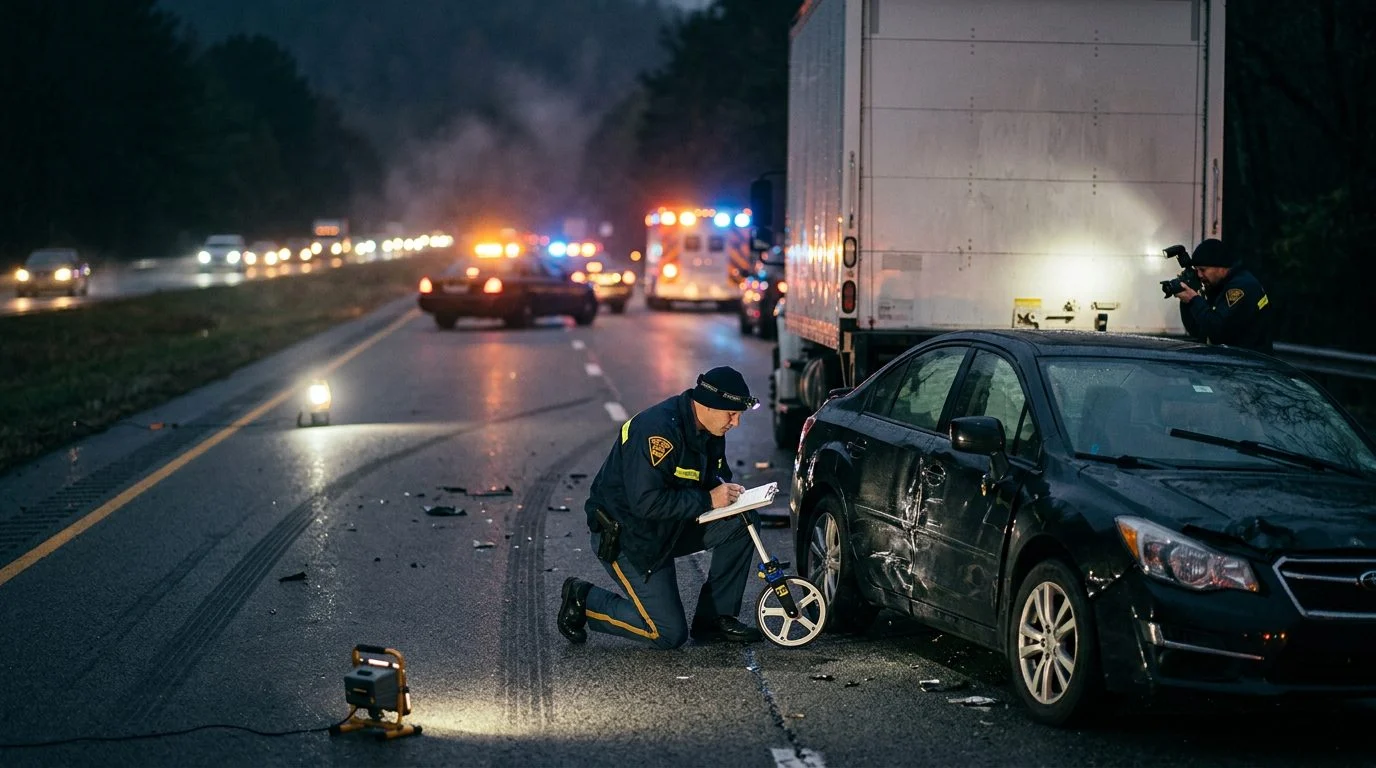
In a fatal crash, a wrongful death claim may depend on showing who caused the crash and how it led to the death.
A civil claim is different from a criminal case. The state brings a criminal case against the person charged with an offense. A civil claim seeks compensation. The West Virginia DMV describes criminal consequences when impaired driving causes injury or death.
Crashes involving commercial motor vehicles can involve more parties. The driver, the company that employs the driver, the company that owns the truck, and a maintenance provider may each share some responsibility.
Most families are grieving when they first ask these questions. The law addresses the losses that remain after a death, and those questions can be answered one step at a time.
Not sure what your next step is?
Talk it through with Big Bubba — the first case review is free, confidential, and carries no obligation.
Who Can File and Who Can Recover in West Virginia
A personal representative of the deceased person’s estate brings a West Virginia wrongful death action. The personal representative must be duly appointed. W. Va. Code § 55-7-6 sets out this rule.
The damages go to people the statute names. These include the surviving spouse, children (including adopted children and stepchildren), brothers, sisters, and parents. The statute also covers people who were financially dependent on the person who died.
If there are no surviving spouse, children, or other qualifying survivors, the damages follow the decedent’s will. Without a will, they follow the state’s laws of descent and distribution. § 55-7-6 explains this order.
The personal representative has legal authority to bring the case. If no one has been appointed yet, families should take that step early.
What Families Can Recover in a West Virginia Wrongful Death Case
Families can seek several types of damages. The main categories are funeral expenses, medical and hospital care, lost income and support, and loss of companionship and guidance. § 55-7-6(c) lists these categories.
- Funeral expenses. The statute allows reasonable funeral expenses.
- Medical and hospital care. Care and treatment tied to the injury that caused the death.
- Lost income and support. The expected loss of the decedent’s income, plus lost services, care, and assistance.
- Sorrow, mental anguish, and solace. This can include companionship, comfort, guidance, and advice the person gave.
The jury must list funeral, hospital, and medical expenses separately. § 55-7-6(c)(2) requires this breakdown.
A separate survival claim may apply if the injured person lived for a time after the crash. § 55-7-8 allows a separate claim for damages incurred between the injury and the death where not otherwise provided for in sections five and six of this article, and if it is brought, it must be joined in the same proceeding as the wrongful death action. The statute allows only one recovery for each element of damages.
For some commercial vehicle cases, § 55-7-32 limits noneconomic damages against an employer defendant to $5 million per occurrence. The limit does not apply to every case. It depends on the employer’s insurance, the driver’s conduct, and whether the crash happened after July 1, 2024.
No one can predict the amount of any category in advance. The value turns on the crash, the person’s age and earnings, and family relationships.
Proving Fault in a Fatal Car or Truck Crash
A wrongful death claim may depend on showing that another party’s negligence caused the crash and the death.
West Virginia uses modified comparative fault, which is a shared-fault rule. Under § 55-7-13c, fault chargeable to the plaintiff does not bar recovery unless it is greater than the combined fault of everyone else responsible. W. Va. Code § 55-7-13c reads: “(c) Any fault chargeable to the plaintiff shall not bar recovery by the plaintiff unless the plaintiff’s fault is greater than the combined fault of all other persons responsible for the total amount of damages, if any, to be awarded.” If it is less, the recovery is reduced in proportion to that fault.
Under W. Va. Code § 55-7-13c, any fault chargeable to the plaintiff does not bar recovery unless the plaintiff’s fault is greater than the combined fault of all other persons responsible for the total amount of damages, if any, to be awarded.
Commercial vehicle cases often turn on company records. Driver logs, maintenance files, load paperwork, and company policies can all matter. Under 49 C.F.R. § 379.3, companies subject to that part must retain records for the minimum retention periods provided in its appendix A. After those required periods, the records may be destroyed at the discretion of each company’s management, though this does not excuse compliance with any other governmental body that prescribes longer retention periods for any category of records.
After a crash involving a loss of life, 49 C.F.R. § 382.303 requires the employer to test for alcohol, as soon as practicable, each surviving driver who was performing safety-sensitive functions with respect to the vehicle. An alcohol test not given within two hours requires a written record of the reasons. Attempts end at eight hours.
Filing Deadlines and Criminal Cases
A wrongful death action generally must be started within two years after the death. § 55-7-6(d) sets this two-year limit. Other provisions of state law can affect timing, so each case needs its own review.
Because § 55-7-8a(c) points to the period that would have applied had the injured person not died, a survival action is generally measured by the limitation period for the injury itself, not by the separate wrongful-death filing period. § 55-7-8a(c) applies when the deadline had not passed at the time of death. The action must then be started within the same period that would have applied had the person not died.
A criminal case can move forward at the same time as the civil claim. The two cases run on separate tracks. The timing of one does not set the timing of the other.
Waiting can limit options. Evidence can disappear, and some business records have set retention periods.
Common Questions Families Ask About These Claims
Most families ask who can file, what the deadline is, and whether a truck crash changes the claim. The short answers are below.
Can a family file if a truck driver caused the crash?
Yes. Truck and commercial vehicle crashes can support wrongful death claims, and more than one party may be responsible.
The personal representative brings the case for them.
What if the death happened days after the crash?
A death that follows a crash can still support a claim. The timeline is reviewed as part of the facts.
Does the firm handle brain or spinal cord injuries that later lead to death?
The firm handles catastrophic injury, traumatic brain injury, and spinal cord injury matters, along with wrongful death claims.
Not sure what your next step is?
Talk it through with Big Bubba — the first case review is free, confidential, and carries no obligation.

How the Process Works and How to Take the Next Step
The process starts with a free case review. This is a confidential meeting with no obligation to continue.
- Reach out. Describe the crash, including the date, the place, and the people involved.
- Free case review. The firm reviews the facts and explains your options.
- Evidence gathering. Crash reports, records, and witness information are collected. Timing varies with the parties involved.
- Claim development. This may involve talks with insurers or other parties. If needed, the claim can be filed in court.
Timelines vary widely, so there is no fixed schedule at the start.
We serve families across West Virginia, including Charleston, Huntington, Morgantown, Wheeling, Martinsburg, Parkersburg, Beckley, Clarksburg, Fairmont, and Weirton.
If you lost someone in a car, truck, or commercial vehicle crash, you may be weighing what comes next. Tell Big Bubba what happened, and request a free case review.