
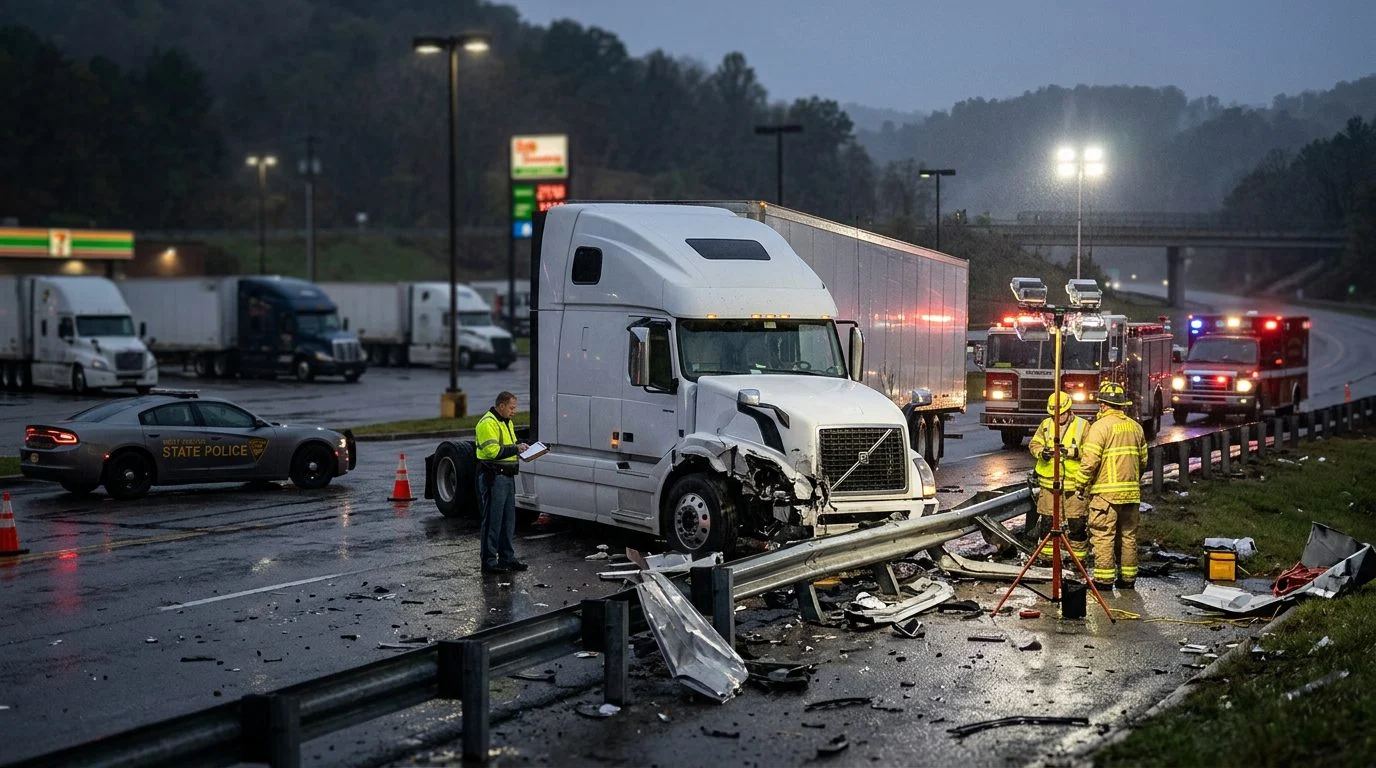
Truck Crashes in West Virginia
Hurt in a Truck Crash? Start With the Driver's Hours
After a collision with a commercial truck, many questions come up at once. Here is a plain-language way to think about one of the most important ones, and how to take the next step.
Published November 19, 2026
If a truck crash left you or someone you love hurt, you may be asking whether the driver had been on the road too long. Federal rules limit how long a truck driver may drive and stay on duty. These are called hours-of-service (HOS) rules. If a property-carrying truck driver was involved in your crash, how long that driver had been on duty may be part of the picture. Under the federal rules, a driver generally may drive up to 11 hours after 10 consecutive hours off duty, and may not drive once 14 consecutive hours have passed since that rest.
This page walks through each main limit in plain words. It also explains why the logs and records behind those hours can matter after a crash, and why timing matters when those records are requested.
Why Hours-of-Service Rules Come Up After a Truck Crash
Hours-of-service rules come up because a tired driver can be dangerous on the road. Federal law bars a driver from operating a commercial vehicle when fatigue, illness, or any other cause makes it unsafe, except in a case of grave emergency where compliance would increase the hazard, in which case the driver may continue to the nearest place at which that hazard is removed. 49 CFR § 392.3 states that rule, which covers impairment from fatigue, illness, or any other cause. Federal law also lets the Secretary of Transportation set maximum hours for motor carrier drivers. 49 U.S.C. § 31502 gives that authority.
After a serious crash, people often ask whether the driver was within these limits. That question is reasonable. Answering it usually means looking at the hours in the days and hours before the crash, not only the moment of impact.
Many commercial truck drivers fall under these rules, but not every vehicle or job does. The West Virginia Division of Motor Vehicles explains commercial driver’s license classes, which is a useful place to start. For a wider view of truck and brain injury claims, see our guide to traumatic brain injury after crashes.
If a truck crash has left someone you love hurt or gone, you don't have to work through these rules alone. We can talk through your questions in a free case review. Talk it through with Big Bubba — the first case review is free, confidential, and carries no obligation.

The 11-Hour Driving Limit
A property-carrying truck driver may drive a total of 11 hours after 10 consecutive hours off duty. The rule has two parts. First, a driver may not start driving without first taking 10 consecutive hours off duty. Second, the driving total cannot go past 11 hours within the 14-hour period that follows. 49 CFR § 395.3 sets out both parts.
Driving time means time behind the wheel. Loading, waiting, and paperwork are not driving time. Those tasks still matter, because they count toward the 14-hour window described in the next section.
A common mistake is treating the 11 hours and the 14 hours as the same clock. A driver can reach one before the other, depending on how the shift was built.
The rules include a narrow exception. Under 49 CFR § 395.1, a driver who faces adverse driving conditions may drive up to two more hours to reach a safe place. The exception applies only when those conditions kept the driver from safely finishing the run within the normal limit.
The 14-Hour On-Duty Window
Driving is generally not allowed once 14 consecutive hours have passed since a driver came on duty after 10 hours off. The clock starts when the driver comes on duty after a full rest. Under 49 CFR § 395.3, a driver may not drive after that 14th consecutive hour.
Time on duty but not driving counts toward the window. Loading, waiting for a dock, and inspections are examples. A driver who spends hours on those tasks may reach the end of the window before the 11 hours of driving are used up.
Once the window closes, the driver generally must stop driving until rest is taken. That is why the start time of a shift can matter as much as the total miles. Investigators may ask when the driver came on duty, and the answer may come from the driver’s record of duty status and supporting documents.
Required Breaks During the Workday
The interruption may be off-duty time, sleeper-berth time, on-duty time that is not driving, or a combination of these. Certain short-haul drivers are treated differently under this rule, based on the exceptions in 49 CFR § 395.1.
Break records can matter when the driving pattern before a crash is in question. A log that shows no qualifying break may raise questions for the people reviewing the case. Those questions are easier to answer when the driver’s logs and other records are read together, rather than one at a time.
Weekly Hour Caps and the 34-Hour Restart
A truck driver generally may not drive after 60 hours on duty in 7 days, or after 70 hours on duty in 8 days, depending on the carrier’s schedule. The 60-hour cap applies when the carrier does not run trucks every day of the week. The 70-hour cap applies when it does. 49 CFR § 395.3 sets both limits.
A 7- or 8-day period may end with the start of an off-duty period of 34 or more consecutive hours. That rule is the 34-hour restart. 49 CFR § 395.3 includes it in the same section.
Weekly totals matter because a driver may be close to the cap on the day of a crash. A week of long shifts can build up over time. Reviewing the full week, not only the crash day, may show whether the driver’s workload stayed within these caps. Each daily record feeds into that weekly count.
Sleeper Berth Time and How It Is Recorded
Time in a sleeper berth can count as rest, but it still has to be recorded. Sleeper-berth time can satisfy the 30-minute interruption described above.
Drivers must record duty status for each 24-hour period under 49 CFR § 395.8. Time spent resting in a sleeper berth is handled separately from that line, so the entries need careful reading.
The entries across a 24-hour record are meant to account for the full day. When the entries do not line up, questions can follow. Sleeper-berth rest is one place where a driver’s account and a carrier’s account may describe time differently. Reading the logs closely, and alongside other records, gives a fuller picture of what happened.
Not sure what your next step is?
Talk it through with Big Bubba — the first case review is free, confidential, and carries no obligation.
Logs, Electronic Logging Devices, and Other Records
Drivers generally must keep a record of duty status. That record may be on paper or in an electronic logging device (ELD). 49 CFR § 395.20 says an ELD used to record hours after December 18, 2017 must meet that subpart’s requirements. Some drivers still keep paper records under the rules.
Each change of duty status must show the city, town, or village and the State abbreviation. 49 CFR § 395.8 requires that detail, which helps place a truck on a map at a given time.
Other records can also show time on duty. 49 CFR § 395.11 lists supporting documents carriers must keep. These include bills of lading, dispatch or trip records, expense receipts for on-duty not-driving time, and payroll records.
Records can be lost or changed. 49 CFR § 395.11 bars a motor carrier or driver from obscuring, defacing, destroying, mutilating, or altering existing information in a supporting document. 49 CFR § 379.3 says companies keep records for minimum periods and may destroy them afterward at management’s discretion, but this does not excuse compliance with other governmental bodies’ lawful requirements for longer retention periods. Because those periods are limited, early requests for these records may matter. If you have a crash report, photos, or notes, keep them unchanged.
When a Possible Hours-of-Service Violation May Be Relevant to a Claim
An hours-of-service violation may be relevant to a truck crash claim, depending on the facts. A violation may bear on fatigue, on the driver’s condition, and on how the carrier supervised the driver. 49 CFR § 390.11 says a motor carrier must require drivers to observe the federal duties and prohibitions that apply to them.
A violation alone does not show who was at fault. Other factors may also be examined, including the crash report, road conditions, and the actions of other drivers. If another driver was at fault, that fact would be part of the claim’s review.
West Virginia law also includes a damages rule for certain commercial vehicle cases. Under W. Va. Code § 55-7-32, a limit on noneconomic damages against an employer defendant may not apply if the driver is found to have exceeded hours of operation. That section applies only to causes of action arising after July 1, 2024.
Some insurers may dispute a claim, so hours records may get a close look. Careful handling of those records from the start can help the people reviewing the claim.

If a Family Member Was Hurt or Killed in a Truck Crash
You may be reading these rules while a loved one is in the hospital, recovering from a brain or spinal cord injury, or after a death in the family. Those are hard places to be, and the questions pile up fast.
Families in this position often face several decisions. They may be deciding whether to ask for the driver’s logs, whether the truck was a commercial vehicle, and whether to talk with someone about a claim.
For a wrongful death claim, W. Va. Code § 55-7-6 says the action is brought by the personal representative of the person who died. It also says the action generally must be commenced within two years after the death, and exceptions may apply. Other injury claims have their own timing rules.
The firm handles truck accident and wrongful death claims in West Virginia, and we serve injury victims across the state. If these questions are on your mind now, you can reach out to the firm to request a free case review.