
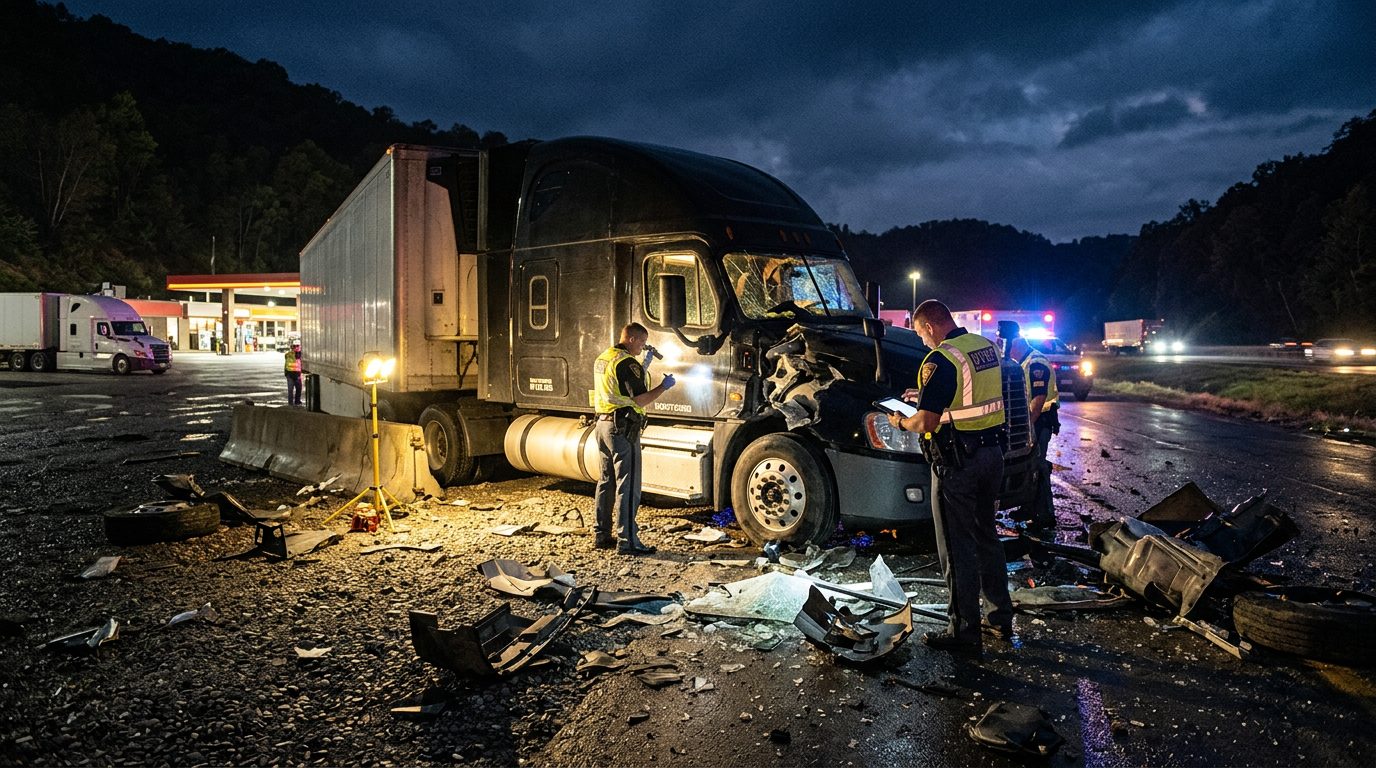
Truck Accidents in West Virginia
Truck Crash Logs and ELD Records: What Can Show What Happened on the Road
Driver logs, maintenance files, and carrier records can shed light on a truck crash. Reach out to the firm to talk through your situation.
Published November 13, 2026
After a crash with a large truck, families often ask what the trucking company has on file. Federal rules require carriers to keep several kinds of records, and some of them are kept only for a short time. This guide explains the main truck crash logs and ELD records, what each one can show, and what to request first in West Virginia.
It maps the paperwork that may exist, so you can ask the right questions early.
What records does a truck carrier keep after a crash?
Most commercial carriers must keep records tied to the driver, the trip, and the truck. Federal motor carrier safety rules set many of these duties. Which rules apply depends on the type of operation, so don’t assume every record exists for every trip.
The main groups are hours-of-service logs, supporting trip papers, driver qualification files, post-crash testing records, inspection and maintenance records, and the carrier’s accident register. Each group answers a different question about the trip and the truck.
If you were hurt, the medical side of your claim matters just as much. Our overview of traumatic brain injury claims is a good starting point.
If a commercial truck was part of a crash that hurt you or a family member in West Virginia, we can talk through which records to request first in a free case review. Talk it through with Big Bubba — the first case review is free, confidential, and carries no obligation.

What is an ELD, and what do the logs show?
An electronic logging device, or ELD, records a commercial driver’s hours of service. Federal rules require carriers to install ELDs and require drivers to use them. Manual logs are allowed in certain situations, as 49 C.F.R. § 395.8 explains.
The record of duty status, or RODS, is the driver’s log of driving, on-duty not-driving, off-duty, and sleeper-berth time. Often, the log is built from ELD data.
Logs can show when a driver was on the road and how long the driver worked before a crash. They can also show whether rest breaks were taken. They do not, by themselves, show that anyone was at fault.
Federal rules also bar false logs. See 49 C.F.R. § 395.8.
Which supporting documents check the logs?
Supporting documents are the everyday business papers that back up the logged times. 49 C.F.R. § 395.11 lists the categories a carrier must keep to verify on-duty, not-driving time.
These include bills of lading, itineraries, dispatch or trip records, and expense receipts tied to on-duty time.
Fuel receipts, toll records, and GPS trip data can be compared with logged times and places. That comparison can show whether a log matches the trip.
Carriers may not destroy or alter these papers. The same section says no motor carrier or driver may obscure, deface, destroy, mutilate, or alter existing information in a supporting document.
Which documents exist depends on the carrier’s operation and the trip involved.
Driver qualification and post-crash testing records
A carrier must keep a driver qualification file for each driver it employs. 49 C.F.R. § 391.51 lists what the file includes. That includes the driver’s application, a motor vehicle record, road test documentation, the medical examiner’s certificate, and a note on the annual record review.
The file is kept while the driver works for the carrier and for three years after.
Testing records are a separate group. After a commercial vehicle crash on a public road, the employer must test surviving drivers for alcohol and controlled substances as soon as practicable in defined cases. One case is a crash that caused a loss of human life, for drivers who were performing safety-sensitive functions with respect to the vehicle. See 49 C.F.R. § 382.303.
If an alcohol test is not administered within two hours following the accident, the employer must prepare and keep on file a written record of the reasons the test was not promptly administered. For alcohol, the employer must stop trying after eight hours. For controlled substances, the cutoff is 32 hours.
Asking whether a post-crash test was done, and whether it was documented, is a records question. It doesn’t claim that any driver was impaired.
Maintenance and inspection records for the truck
Carriers must keep records showing how each truck was inspected, repaired, and maintained. 49 C.F.R. § 396.3 requires systematic inspection and repair of vehicles under the carrier’s control. Those records are kept one year where the truck is housed or maintained, and six months after the truck leaves the carrier’s control.
The driver vehicle inspection report, or DVIR, is the driver’s written list of defects. Under 49 C.F.R. § 396.11, the driver prepares it at the end of each day’s work on each vehicle operated, but no report is required if no defect or deficiency was discovered by or reported to the driver. The rule does not cover intermodal equipment tendered by an intermodal equipment provider, and it does not apply to a private motor carrier of passengers (nonbusiness), a driveaway-towaway operation, or any motor carrier operating only one commercial motor vehicle. The carrier must repair listed defects that affect safety before the truck runs again, and must certify the repair. These reports are kept for three months.
The FMCSA Safety Measurement System publishes carrier-specific vehicle maintenance data, including inspection violations. Road conditions are a separate question from truck equipment. Our page on icy road car accidents covers that topic.
The carrier’s accident register and crash file
A carrier must keep an accident register for three years after each accident. 49 C.F.R. § 390.15 sets this rule. Each entry lists the crash date, the city or town and state, the driver’s name, and the number of injuries and fatalities. It also notes whether hazardous materials were released.
Under 49 C.F.R. § 390.15, motor carriers and intermodal equipment providers must make all records and information pertaining to an accident available to authorized FMCSA, State or local enforcement, or authorized third-party representatives within such time as the request or investigation may specify. The carrier must also give reasonable help with the investigation.
Carriers may also open an internal crash file. It may include the driver’s written report, photos, and company messages about the event. Whether one exists depends on the carrier, so ask.
Ask whether an accident register entry exists for your crash date and location.
Not sure what your next step is?
Talk it through with Big Bubba — the first case review is free, confidential, and carries no obligation.
Police crash reports and public crash data
A police crash report is a separate record from the carrier’s files. It can list the vehicles and drivers, witness names, and the officer’s observations at the scene. You can request it from the agency that investigated the crash.
Public crash data works differently. Federal and state agencies publish crash data showing patterns by place, year, and crash type. That data can show how often a type of crash happened in an area. It does not decide who was at fault in one crash.
A police report and a carrier’s logs may describe the same event from different angles. Comparing them can show where the accounts match and where they differ.
Records after a fatal truck crash
When a truck crash causes a death, a personal representative brings the wrongful death claim. W. Va. Code § 55-7-6 says the action must be brought by and in the name of the deceased person’s personal representative. Damages are distributed under that section, and can reach a surviving spouse, children, parents, and others who were financially dependent on the person who died.
West Virginia generally allows two years from the date of death to bring a wrongful death action, and exceptions may apply. The time limit is set out in W. Va. Code § 55-7-6.
A fatal crash often leads to a fuller investigation, which can produce more records. How far that investigation goes depends on the crash itself.
Records from the medical examiner or coroner are a separate source on the cause of death.

Why timing matters and what to request first
Records are kept on set schedules, so prompt requests matter. Federal rules set minimum periods that vary by record type: three months for driver inspection reports, and three years for the accident register.
A written preservation request is a common first step. It asks the carrier, in writing, to keep its records about the crash. A lawyer can help prepare that letter.
Request these items in this order:
- The police crash report.
- ELD data and records of duty status.
- Supporting documents, such as bills of lading, dispatch records, and receipts.
- The accident register entry for the crash.
- The driver qualification file and post-crash testing records.
- Inspection and maintenance records, including the DVIR for the truck.
Quick answers
How long must a truck company keep ELD records?
What is an accident register?
It is a carrier’s list of its accidents, kept for three years after each crash.
How long do I have to file a wrongful death case in West Virginia?
West Virginia generally allows two years from the date of death, and exceptions may apply (W. Va. Code § 55-7-6).
If a commercial truck was involved in a crash that left you or a family member seriously hurt, and the carrier hasn’t produced its records, tell the firm what happened. We serve West Virginia injury victims. A free case review is a confidential way to start, with no obligation to continue.