
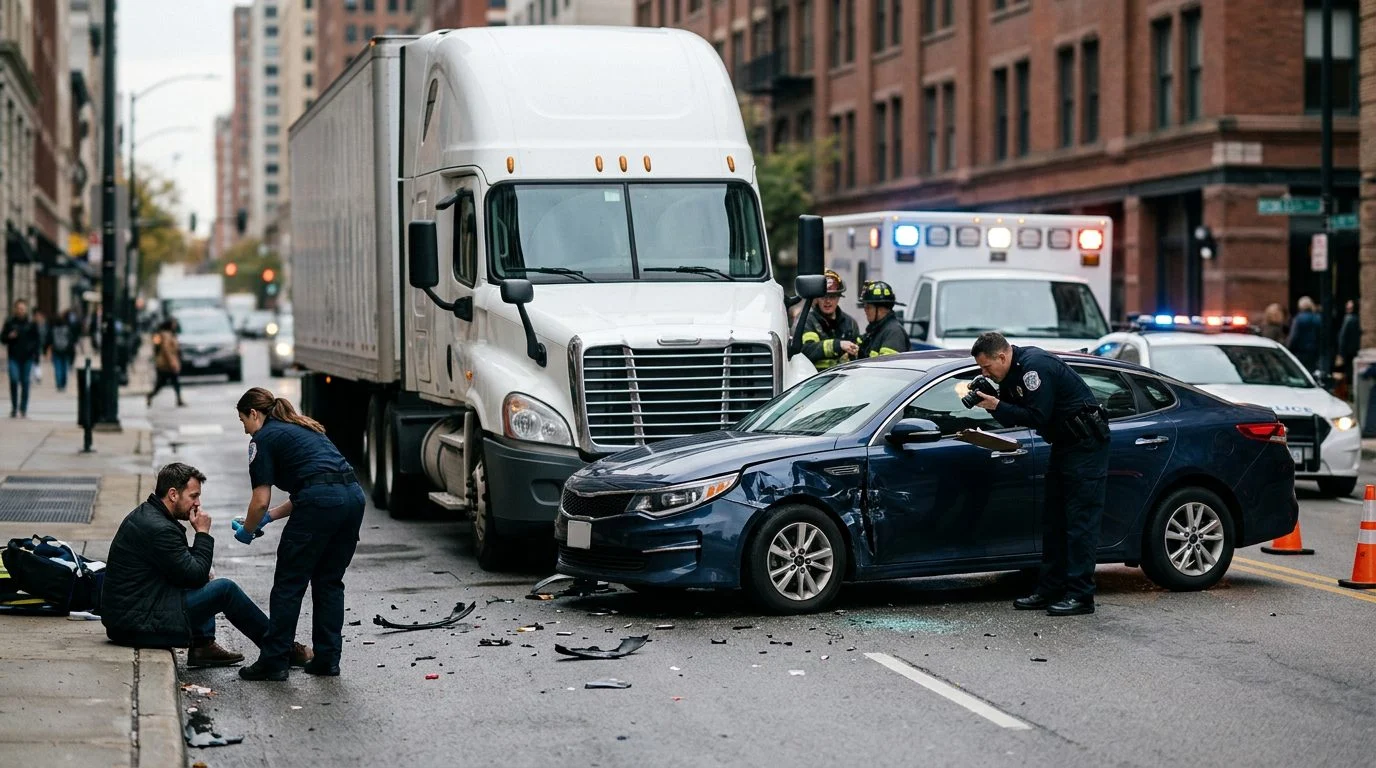
Truck Accidents
What Happens If a Truck Hits My Car: Injuries & Next Steps
Commercial trucks weigh 15,000 to 30,000 pounds or more. When one hits your car, the forces unleashed can cause severe injuries to your brain, spine, and internal organs. Learn what happens in these collisions and what to do right after.
Published October 07, 2026
When a truck hits your car, the collision creates forces that cause severe injuries because commercial trucks weigh 15,000 to 30,000 pounds or more—far heavier than a passenger car at 3,000 to 4,000 pounds. Your car absorbs most of the impact, and your body experiences rapid, violent motion that can injure your brain, spine, and internal organs even at relatively low speeds. Understanding what happens in these collisions—and what you need to do right after—can protect your health and your legal rights.
The Immediate Impact: What Happens in the First Moments
The physics of a truck-car collision are brutal. Your vehicle cannot absorb the energy the way a truck can, so you and your passengers experience severe acceleration or deceleration forces. Your head, neck, and spine are especially vulnerable because they move independently of the vehicle’s frame during impact.
Shock and adrenaline flood your system immediately after the crash. You may feel numb, alert, or strangely calm—these are normal responses to trauma. The problem is that adrenaline masks pain. You might feel “fine” at the scene and discover hours or days later that you have a serious injury. Many people walk away from truck collisions thinking they escaped unharmed, only to develop symptoms of traumatic brain injury or spinal cord damage within 24 to 72 hours.
Not sure what your next step is?
Talk it through with our team — the first case review is free, confidential, and carries no obligation.
Is It Possible to Survive Being Hit by a Truck?
Yes, many people survive truck-car collisions, but survival and injury severity depend on speed, angle of impact, which part of your car the truck strikes, and whether you were wearing a seatbelt. Modern airbags and safety features reduce injury severity in many crashes.
Rear-end and side-impact collisions often have higher survival rates than head-on collisions, but don’t mistake survival for avoiding serious injury. Even a truck hitting your car at 25 miles per hour can cause traumatic brain injury or whiplash severe enough to disable you for months or years. The weight disparity alone means your body experiences forces far beyond what a car-to-car collision creates.
Common Injuries When a Truck Hits Your Car
Traumatic brain injury (TBI) occurs when the brain moves violently inside the skull during rapid acceleration or deceleration. You don’t need to lose consciousness to suffer a TBI. Symptoms—headache, dizziness, confusion, memory problems, sensitivity to light—may appear immediately or develop over hours and days.
Spinal cord injuries result from sudden forces that compress, stretch, or tear the delicate nerve tissue in your spine. These injuries can cause permanent paralysis, loss of sensation, or chronic pain depending on severity and location.
Whiplash and neck injuries are especially common in rear-end collisions, where your body lurches forward while your head lags behind, creating extreme stress on your cervical spine (neck).
Broken bones, internal bleeding, and crush injuries occur from the direct force of impact and the vehicle’s deformation around your body.
Many of these injuries don’t announce themselves at the scene. You may feel sore the next day and assume it’s minor muscle strain, only to discover weeks later that imaging reveals a serious spinal fracture or that your cognitive symptoms point to a significant brain injury.
What to Do Right After a Truck Hits Your Car
Call 911 immediately. Do not assume you are uninjured. Emergency responders will document the scene, provide medical care if needed, and generate an official police report—a document you’ll need later if you pursue a claim.
Move to safety if you can. If your car is drivable and it’s safe to exit, move to the shoulder or a nearby parking lot away from traffic. If you’re trapped or seriously hurt, stay in the vehicle and wait for paramedics.
Turn on hazard lights. If safe to do so, place warning triangles or flares behind your vehicle to alert other drivers.
Do not admit fault or apologize. Even a casual “I’m sorry” can be used against you later. Stick to facts: “I was hit by a truck” or “The truck hit the rear of my vehicle.”
Get the truck driver’s information. Write down their name, phone number, commercial driver’s license number, trucking company name, and insurance information. If the driver is evasive or refuses to provide details, note that in writing.
Photograph everything. Take pictures of your vehicle damage, the truck (including its license plate and company markings), the road and weather conditions, and any visible injuries. These photos are evidence.
Get witness information. Ask anyone who saw the crash for their name, phone number, and a brief statement of what they saw.
Request the police report number before you leave the scene so you can obtain a copy later.
What Happens to Your Body When a Truck Hits You From Behind?
Rear-end collisions create a specific chain of injury. The truck strikes your vehicle from behind, pushing your car forward. Your body accelerates forward with the car, but your head lags behind momentarily due to inertia. This creates a whipping motion—the “whiplash”—that stretches and tears soft tissues in your neck and upper spine.
During this rapid acceleration, your brain also moves inside your skull. The brain can strike the interior of the skull or be stretched by the sudden motion, causing microscopic tears in nerve fibers. This is how traumatic brain injury happens without any direct blow to your head.
Symptoms may not appear immediately. You might feel stiff the next morning or develop a headache hours after the crash. Over the following days, you may notice difficulty concentrating, sensitivity to light, or balance problems—all signs of a significant brain injury that needs medical evaluation.
Have questions about what happened?
Ask our team directly. The first conversation is free, confidential, and there is no obligation to continue.
Medical Care and Documentation
Seek medical attention immediately, even if you feel okay. Tell the provider you were in a truck accident. This alerts them to screen for specific injuries like TBI and spinal cord trauma that might not be obvious on a quick exam.
Keep all medical records, imaging, and bills. These documents prove your injuries are real and connected to the crash. They’re essential if you later pursue a claim.
Follow your doctor’s treatment plan completely. If your doctor prescribes physical therapy, imaging, or specialist visits, complete them. Insurance companies and opposing lawyers will use any gaps in your care to argue your injuries aren’t serious.
Insurance and Your Claim
Report the accident to your insurance company promptly, but do not sign anything or give a recorded statement without reviewing it first. Insurance adjusters are trained to minimize payouts.
The truck driver’s commercial insurance may be liable for your injuries and vehicle damage. Commercial trucks carry much higher insurance limits than personal vehicles, which is important if your injuries are serious.
Your own uninsured/underinsured motorist coverage may apply if the truck driver lacks sufficient insurance.
Do not accept a quick settlement without understanding the full extent of your injuries. Many people settle too soon, before they realize how serious their injuries are or how long recovery will take.
Will I Lose My No-Claims Discount If a Truck Hits My Car?
After a collision that was not your fault, many people worry about how it may affect their insurance; this is one of the questions you can talk through when you reach out to us. The at-fault driver’s insurance should cover the damage, and your rates should not increase. Document everything—photos, the police report, witness statements—to support your not-at-fault status if the insurance company disputes liability.
What Happens Next: Liability and Legal Considerations
The truck driver or their employer may be liable for your injuries and vehicle damage. Commercial trucks are subject to federal regulations, including hours-of-service rules that limit driving time. Under West Virginia law, a person injured by the violation of a statute may generally recover damages they sustained by reason of the violation.
Truck accidents often involve multiple liable parties: the driver, the trucking company, the vehicle owner, and sometimes a cargo company. Determining who is responsible requires investigation into the driver’s logbook, maintenance records, and company policies.
You have the right to pursue a claim for medical expenses, lost wages, pain and suffering, and other damages. West Virginia law sets strict time limits (called the statute of limitations) for filing a lawsuit. Acting sooner rather than later can help protect your ability to pursue a claim.

Want to know where you stand?
Tell us what happened and our team will walk you through the options available to you, at no cost.
When to Contact a Lawyer
If you have been hit by a truck and injured, contact a lawyer as soon as possible—even while you are still receiving medical care. A lawyer can protect your rights, handle communication with insurance companies, investigate the accident, and preserve critical evidence.
In the catastrophic-injury cases our attorneys handle, early legal involvement makes a significant difference. Insurance companies are less likely to pressure you into a low settlement if they know you have representation. A lawyer can also identify all liable parties and ensure you pursue every source of recovery available.
Many people in your situation reach out to Big Bubba within days of the accident. We handle truck-accident cases and understand the urgency. You don’t have to face this alone while you’re recovering.
Frequently Asked Questions
What should I do if the truck driver fled the scene? Report the hit-and-run to police immediately and provide any details you remember about the truck. Contact your insurance company. Your uninsured motorist coverage may apply. A lawyer can help you investigate and locate the driver.
Can I sue a trucking company if their driver hit my car? Yes. Trucking companies can be held liable for their drivers’ negligence under the legal doctrine of vicarious liability, and also for their own negligence if they hired an unsafe driver, failed to maintain the vehicle, or violated safety regulations.
How long do I have to file a lawsuit in West Virginia? West Virginia law sets a statute of limitations for personal injury claims. Reaching out early can help protect your options for moving forward with a claim. Contact a lawyer immediately to ensure you meet all deadlines.
What if I was partially at fault? Under West Virginia law, the liability of each defendant for compensatory damages is several only and may not be joint, so each defendant is generally liable only for the share of damages allocated to that defendant in direct proportion to that defendant’s percentage of fault (W. Va. Code § 55-7-13c). You may still recover damages even if you were partly at fault, but your recovery is reduced by your percentage of fault. An investigation is critical to determine actual fault.
If a truck has hit your car and you’re injured—or you’re helping someone who is—you likely have questions about what comes next and whether you have a claim. Reach out to Big Bubba for a free case review. People in your exact situation can contact us, often within days of the collision, and we’re ready to help you understand your options.
Related practice areas
- Traumatic Brain Injury from Car and Truck Accidents in West Virginia
- How Hard Is It to Prove Wrongful Death?