
West Virginia Auto Accident Guide
Not Sure Whether Your Crash Qualifies? Start With the Facts.
Plain-language answers for drivers, passengers, and families across West Virginia who are asking what counts as an auto accident.
Published November 14, 2026
You were in a crash, or someone you love was, and now there are questions you didn’t expect. Maybe you’re wondering whether what happened even counts as an auto accident.
The short answer is that an auto accident generally involves a motor vehicle crash that causes injury, death, or property damage. The exact answer may depend on the facts of your case.
What qualifies as an auto accident?
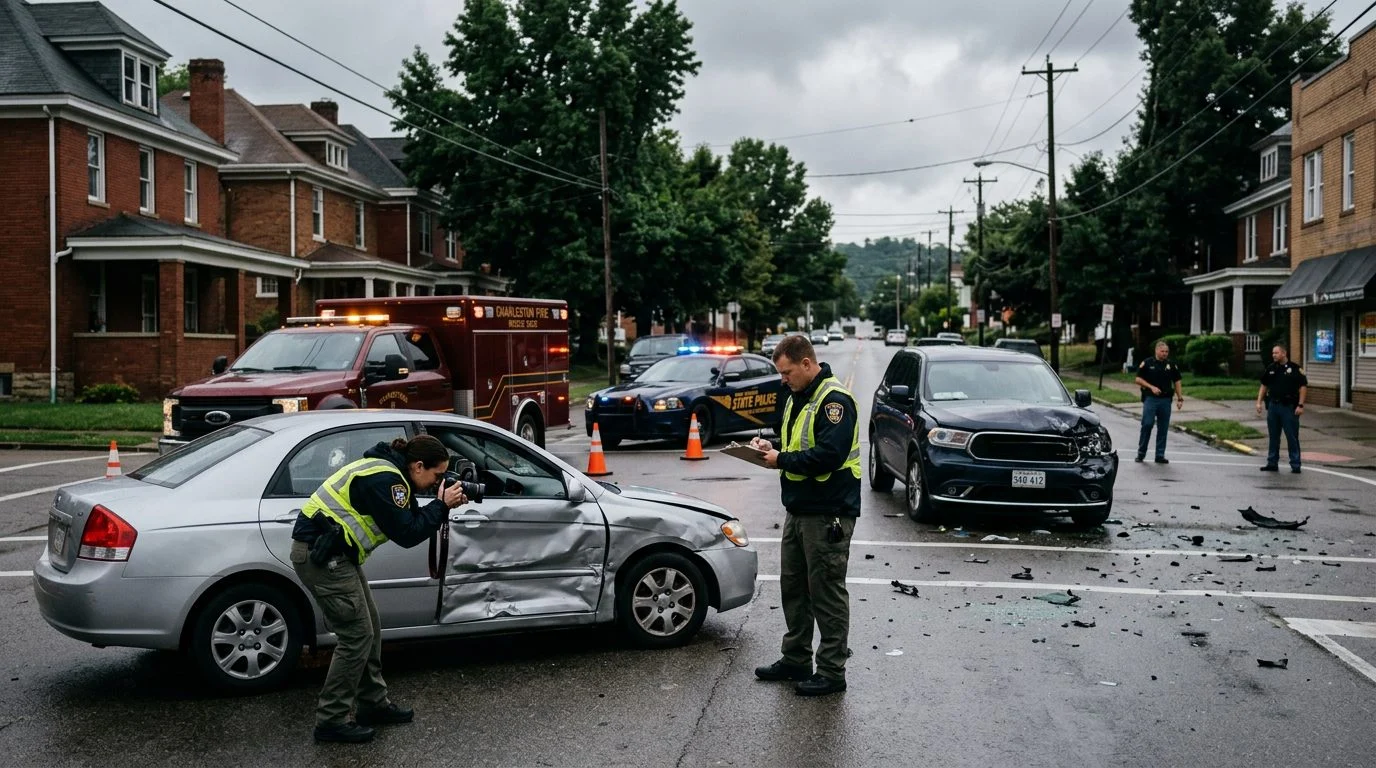
An auto accident generally has three parts: a motor vehicle, a crash, and some harm to a person or to property. A crash does not have to be large to count. A serious injury is not always required, depending on the facts, and damage to a vehicle alone can sometimes be enough.
Location can matter too. Most crashes happen on public roads, but a collision in a parking lot or on private property can still count, depending on the facts. The vehicles involved and how the crash happened can change the answer as well.
Good records help answer the question. Write down the time, the place, the weather, and the vehicles involved. Those basics often shape how a crash is described later, in a police report, an insurance file, or a claim.
If you're still unsure whether your crash counts, the firm can talk it through with you in a free case review, so you don't have to sort it out alone. Talk it through with Big Bubba — the first case review is free, confidential, and carries no obligation.

Auto, car, and motor vehicle accident: are they the same thing?
In everyday speech, yes. “Auto accident,” “car accident,” and “motor vehicle accident” usually describe the same kind of event. People use whichever phrase comes to mind first.
“Motor vehicle” is the broadest of the three. It generally covers cars, trucks, motorcycles, buses, and other motor-powered vehicles, not just passenger cars.
Commercial vehicles fall under the same idea. Federal law directs the government to set minimum financial responsibility levels for many motor carriers that transport property, as described in 49 U.S.C. § 31139. A crash with a commercial truck can involve different insurance than a crash with a family car.
If you’re also thinking about brain injuries that can follow a crash, our guide on traumatic brain injury accidents covers that wider picture.
Which vehicles and places are usually involved?
Auto accidents can involve passenger cars, pickup trucks, SUVs, motorcycles, commercial trucks, and buses. Each vehicle type can bring different rules and different insurance, so the type matters.
A crash between a motor vehicle and a pedestrian or bicyclist is often treated as an auto accident, depending on the facts. These cases often turn on who had the right of way and what each person could see.
Public roads, highways, and intersections are the settings most people picture. Parking lots and private driveways where vehicles move can also be part of the picture.
Name every vehicle involved, even one that only clipped you or left before police arrived. A missing vehicle can leave gaps in the record.
Common types of crashes that fall under auto accidents
Several familiar crash patterns fall under the auto accident label:
- Rear-end collisions, where one vehicle hits the back of another, often when traffic slows or stops.
- Intersection crashes, including red-light and stop-sign violations and collisions during turns.
- Sideswipes and lane-change crashes, where one vehicle moves into another’s space.
- Head-on collisions, and crashes where a vehicle leaves the roadway.
- Crashes caused by distracted, impaired, or tired driving, which can happen on any road.
Each type can cause injuries that range from minor to severe. Severity does not decide whether a crash is an auto accident. A crash with little visible damage can still count, depending on the facts.
Impaired driving deserves its own mention. The West Virginia Division of Motor Vehicles publishes information about impaired driving and its dangers on West Virginia roads.
Why the definition matters for an injury claim
The definition shapes the facts a claim is built on, including who was involved and where it happened. It also affects which insurance may apply.
Under W. Va. Code § 55-7-13c, a plaintiff’s own fault bars recovery only when it is greater than the combined fault of all others responsible for the damages. If it is less, recovery is reduced in proportion to the plaintiff’s fault.
West Virginia requires mandatory liability insurance for motor vehicles, according to the West Virginia Division of Motor Vehicles. Knowing which vehicles were involved helps identify which policies may respond.
A police crash report can record the vehicles, the people involved, the location, and what the officer observed. It is one piece of evidence. It does not decide fault on its own.
Some insurers may dispute how a crash is described, so consistent details help. For more on how fault is looked at, see what qualifies as an at-fault accident.
Questions to think about before speaking with an insurer
Insurers may ask for a recorded statement soon after a crash. West Virginia limits some early contact. For twenty days after an injury, the law generally restricts when a person may seek a settlement or statement from an injured person who is in the hospital or unable to work, with limited exceptions. Under W. Va. Code § 55-7-11a, an injured person who was an inpatient in a hospital or partially or totally unable to work during the first twenty days after a personal injury, and was approached during that period to negotiate a settlement, sign a release or give a statement, may disavow any settlement, release or statement entered into, obtained or made in violation of this section at any time within one hundred eighty days from the date of the personal injury by executing a written statement of disavowal and forwarding a copy to the person who violated the section, in which case it may not be admissible in evidence if any consideration paid is repaid or returned to the person who paid it.
Take notes now, while the details are fresh: the time, the location, the weather, and what each vehicle was doing. Your own policy may include uninsured or underinsured motorist coverage. W. Va. Code § 33-6-31 describes an underinsured motor vehicle as one whose applicable liability limits are below the limits you carried for that coverage, or have been reduced by payments to others.
Some insurers may dispute a claim, so it helps to understand what your own policy covers. For more on that, see uninsured motorist coverage.
Is a car accident the same as an auto accident?
Usually, yes. People use both terms for the same kind of crash involving a motor vehicle.
Can a family bring a claim after a fatal crash?
In West Virginia, a wrongful death action is brought by the deceased person’s personal representative. It generally must start within two years after the death, subject to certain exceptions under W. Va. Code § 55-7-6.
Not sure what your next step is?
Talk it through with Big Bubba — the first case review is free, confidential, and carries no obligation.

What to know after a serious crash
If you’re still working out whether what happened counts, you may be hurting, worried, or grieving. You might be asking for a family member with a head or spinal injury, or for a loved one lost in a fatal collision. The firm can go over those details with you during a free case review, which is confidential and carries no obligation to continue. We serve injury victims across West Virginia, including Charleston, Huntington, Morgantown, Wheeling, Martinsburg, Parkersburg, Beckley, Clarksburg, Fairmont, and Weirton. Share what happened.