
Truck Accidents | West Virginia
Hit by a Semi Truck in West Virginia? Know Your Options.
Truck crashes can cause serious injuries and complicated claims. Big Bubba Injury Law helps injured people and their families across West Virginia understand their next steps.
Where we serve
55
West Virginia counties
Free
Confidential case review
Published October 31, 2026
If you were hit by a semi truck in West Virginia, you may have a claim against the people responsible. Rear-end and side-impact crashes with a tractor-trailer have their own physical facts, and key evidence can disappear quickly. This guide explains how these crashes differ, who may be responsible, what evidence matters, and how a claim generally works. It also covers catastrophic injuries and wrongful death.
What a Semi Truck Rear-End or Side-Impact Crash Involves
A rear-end or side-impact semi truck crash happens when a tractor-trailer hits a car, motorcycle, or pedestrian from behind or from the side. These crashes happen on interstates, U.S. routes, and local roads across the state. The people hurt are often drivers and passengers in smaller vehicles, motorcyclists, and people on foot.
The smaller vehicle often has little time to react. Injuries can range from pain and bruising to brain injuries, spinal cord injuries, and death.
This page is for injured people and for families in wrongful death cases. The firm handles car accidents, truck accidents, commercial vehicle accidents, catastrophic injuries, traumatic brain injury, spinal cord injury, and wrongful death. We serve injury victims across West Virginia.
If a semi truck hit you or someone you love and questions keep piling up, we're ready to talk through your options in a free case review. Talk it through with Big Bubba — the first case review is free, confidential, and carries no obligation.
Why Tractor-Trailer Rear-End and Side Impacts Are Different
A tractor-trailer differs from a car in weight, height, stopping distance, and blind spots. Those differences change how these crashes happen and how injuries occur.
- Stopping distance. A loaded trailer needs much more room to stop than a car. A driver who brakes suddenly in traffic may be hit with little warning.
- Underride. A trailer’s rear can sit higher than a passenger car’s hood and windshield, so a car can slide under it. Federal rules require trailers with a gross vehicle weight rating of 10,000 pounds or more that were manufactured on or after January 26, 1998 to carry a rear impact guard, except pole trailers, pulpwood trailers, low chassis vehicles, special purpose vehicles, wheels back vehicles, road construction controlled horizontal discharge trailers, and trailers towed in driveaway-towaway operations. The guard’s lower edge may sit no more than 22 inches above the ground (49 C.F.R. § 393.86).
- Trailer swing. Wide turns, lane changes, and jackknifing can move a trailer into another lane quickly.
- Blind spots. Large blind spots, often called no-zones, surround a tractor-trailer. A driver may not see a car beside or just behind the cab.
These physical facts matter in a claim. They help show who was responsible and what records can answer what happened.
Who Can Be Responsible After a Semi Truck Crash
The driver is one possible source of responsibility, but not the only one. The trucking company and others in the chain may also share fault.
- The driver. Common questions include following distance, speed for conditions, lane position, and distraction.
- The motor carrier. The trucking company may be responsible for how it hired, trained, supervised, and dispatched the driver.
- A freight broker that arranged the load may share fault in some cases, depending on the facts.
- Others. Vehicle owners, maintenance providers, and parties who loaded or secured cargo may share fault when the facts support it.
West Virginia uses comparative fault. Each person’s share of fault is a percentage, and liability is divided in direct proportion to those percentages (W. Va. Code § 55-7-13a). Which parties are liable depends on the facts of each crash.
For a commercial driver’s license vehicle, West Virginia law sets a base limit of $5 million per occurrence on noneconomic damages against an employer defendant, but that limit is not available unless the employer carries at least $3 million in commercial motor vehicle insurance for the occurrence, and the statute also sets out separate exceptions (W. Va. Code § 55-7-32). Under W. Va. Code § 55-7-32(e), that limit increases each year from January 1, 2026 for inflation, up to 150 percent of the base amount. The cap is not available unless the employer carries at least $3 million in commercial motor vehicle insurance for the occurrence (W. Va. Code § 55-7-32).
Evidence That Disappears Fastest After a Tractor-Trailer Crash
The records and physical evidence that matter most are often the first to change, get repaired, or get lost.
- Driver logs. Federal rules limit driving time. Except as otherwise provided in other federal rules, a driver of a property-carrying commercial motor vehicle may not drive after a period of 14 consecutive hours after coming on duty following 10 consecutive hours off duty, and may drive a total of 11 hours during that period, but driving is not permitted if more than 8 hours of driving time have passed without at least a consecutive 30-minute interruption in driving status, unless the driver qualifies for a short-haul exception (49 C.F.R. § 395.3). Drivers and carriers may not make false reports in connection with a duty status (49 C.F.R. § 395.8).
- Drug and alcohol testing. After certain crashes, employers must test surviving drivers. Alcohol testing is due as soon as practicable. Controlled substance testing has a 32-hour window in similar cases (49 C.F.R. § 382.303).
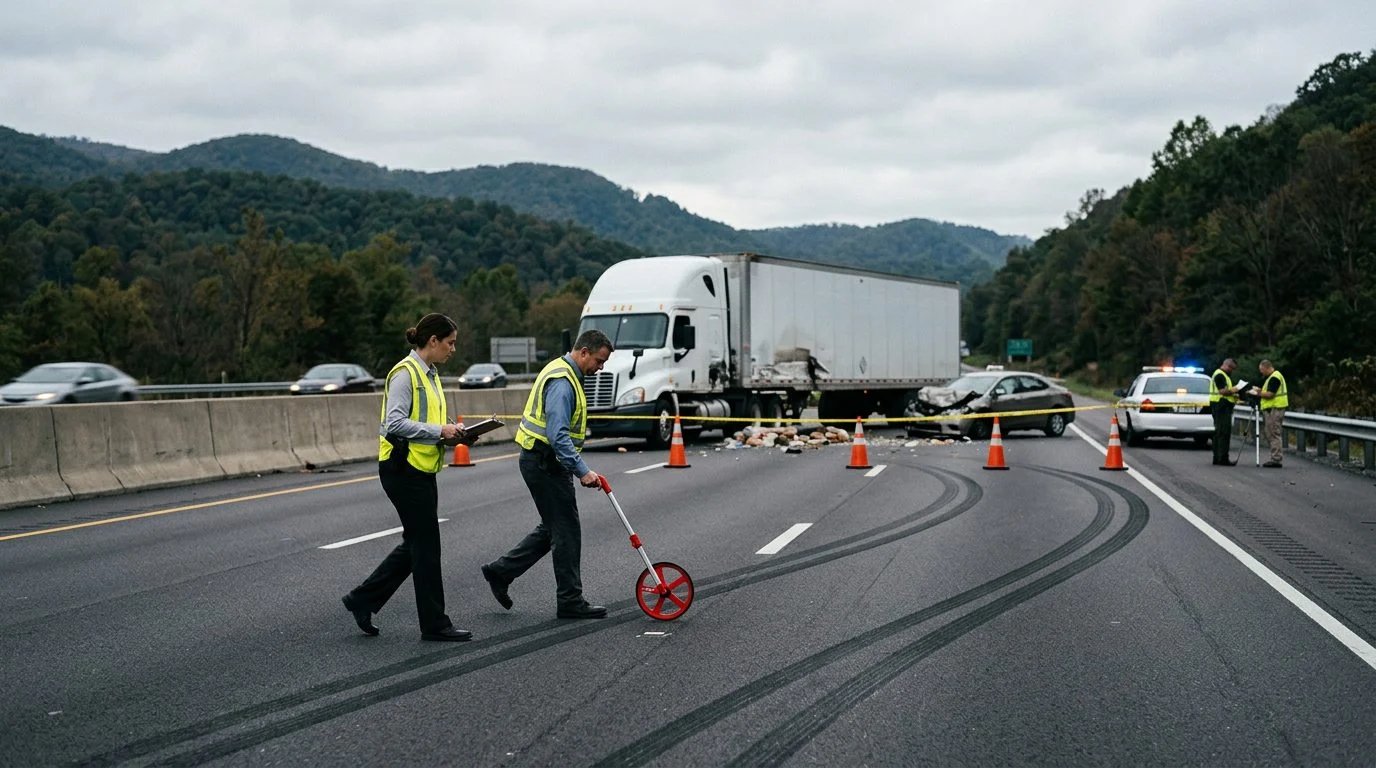
- Scene and vehicle evidence. Police reports, photos, skid marks, debris, and vehicle damage can be moved or repaired quickly.
- Video and maintenance records. Dash camera footage, witness names, and the truck’s inspection records can answer key questions.
- Medical records. Records that link injuries to the crash start at the first emergency visit.
Keep your own notes, photos, and receipts. Keep copies of every insurer letter. Think carefully before giving any recorded statement.
Injuries Common in Rear-End and Side-Impact Truck Crashes
Rear-end and side-impact truck crashes often cause serious injuries. A car offers little protection against a heavy trailer.
- Traumatic brain injury. This includes concussions and more serious brain injuries. Some symptoms may not appear right away.
- Spinal cord injury. Spinal injuries can affect movement and feeling.
- Broken bones and internal injuries. Crush injuries and burns also occur in these crashes.
- Catastrophic injuries. Some injuries need long-term care, rehabilitation, or changes to work and daily life.
Early and steady medical follow-up matters for two reasons. It supports your health, and it documents how your injuries connect to the crash. The firm handles catastrophic injury, traumatic brain injury, and spinal cord injury cases.
How a Semi Truck Injury Claim Generally Works
A semi truck injury claim usually moves through a free case review, evidence work, damage documentation, insurance talks, and, if needed, a lawsuit.
- Free case review. The firm listens to what happened and identifies the questions that need answers.
- Evidence preservation. Letters can ask the trucking company and insurers to keep logs, records, and equipment.
- Damages documentation. Damages are the money losses you suffered. Medical bills, lost income, and effects on daily life are gathered here.
- Insurance claim. Demands go to the responsible insurers, followed by negotiation.
- Lawsuit, if needed. If a fair resolution isn’t reached, a lawsuit may be filed. That process can include discovery and depositions.
Most claims take months to years. The timing depends on the injuries, the number of parties, and whether a lawsuit is filed. No one can promise a result or a settlement amount.
Deadlines matter. Under W. Va. Code § 55-2-12, a personal injury action generally must be brought within two years after the right to bring it accrued. Other limits can apply, so check early.
Not sure what your next step is?
Talk it through with Big Bubba — the first case review is free, confidential, and carries no obligation.
Frequently Asked Questions About Semi Truck Crashes
Here are short answers to common questions after a tractor-trailer crash.
What if I was hit by a semi truck in West Virginia and I was partly at fault?
West Virginia uses comparative fault, so your own share is measured as a percentage (W. Va. Code § 55-7-13a).
Does a police report decide who was at fault?
No single document decides fault. A police report is important evidence, but investigation can add to or change what it shows.
What if the truck driver got a ticket?
A citation is evidence to review. A civil injury claim looks at the full set of facts.
Can a family bring a claim if a loved one died in a semi truck crash?
In West Virginia, a wrongful death action is brought by the personal representative of the deceased person’s estate. It must begin within two years after the death, subject to the provisions of section eighteen, article two, chapter fifty-five (W. Va. Code § 55-7-6). W. Va. Code § 55-7-6 reads: “The provisions of this section shall not apply to actions brought for the death of any person occurring prior to July 1, 1988.” The firm handles wrongful death cases.
Should I talk to the trucking company’s insurer?
Think carefully before any recorded statement or early offer. The first words you say can shape how the claim is viewed.

Tell the Firm What Happened and Take the Next Step
If a tractor-trailer crash changed your life or your family’s, you don’t have to sort out every question at once. Medical bills, recovery, and insurance letters can arrive before you feel ready.
We serve injury victims across all 55 West Virginia counties, including Charleston, Huntington, Morgantown, Wheeling, Martinsburg, Parkersburg, Beckley, Clarksburg, Fairmont, and Weirton.
When you’re ready, tell Bubba what happened and request a free case review.