

West Virginia | Truck Crash Injuries
Hurt in a Truck Crash? Ligament Injuries Need Careful Attention
Some injuries take days to show. Here is what to watch for and how the firm can help you understand your options.
Published November 26, 2026
If a joint felt fine right after a truck crash but now swells or gives way, you may be wondering why. Ligament damage from a truck crash in West Virginia means harm to the tough tissue that holds bones steady at a joint. It can be a stretch, a partial tear, or a complete tear, and symptoms may not appear until days or weeks later.
Getting checked early and keeping clear medical records matters for your health and for any claim that follows.
What Ligament Damage Means After a Truck Crash
A ligament is a strong band of tissue that connects one bone to another. Ligaments help a joint stay steady while it moves. A sprain means a ligament has been stretched or partly torn. A tear means more of the ligament, or all of it, has been split.
Truck crashes create forces that can strain ligaments in several ways. A sudden impact can push a joint past its normal range. A twist can load a knee or ankle in the wrong direction. A rollover or hard stop can throw a body against a dashboard, seatbelt, or steering wheel. A person may not hit their head and may not look badly hurt, yet still have a serious joint injury.
Ligament injuries can also happen alongside other harm. A broken bone, a neck or back injury, or a head injury may occur in the same crash. Automobile accidents can cause a traumatic brain injury, which is severe brain damage from an outside force. That is why a joint injury should be checked along with the rest of the body.
If your joint still feels unsteady after a truck crash, you don't have to sort out the medical and legal questions alone. Talk it through with Big Bubba — the first case review is free, confidential, and carries no obligation.

Common Places Ligament Injuries Occur in Serious Crashes
Many joints can be hurt, and the spot depends on how the body moved in the crash. The knee, ankle, shoulder, wrist, and neck are common areas people ask about.
The knee is often discussed after a leg or knee strikes the dashboard. The anterior cruciate ligament (ACL) and medial collateral ligament (MCL) are two knee ligaments that can be stretched or torn by that kind of force. A knee that gives way or locks is a warning sign.
Ankle and foot ligaments may be affected when a foot is forced hard against a pedal or the floor. Pain on the inside or outside of the ankle that worsens with weight is worth reporting.
Shoulder, wrist, and elbow ligaments may be injured when someone braces against a seatbelt, a steering wheel, or a door during impact.
Spinal ligaments may be involved in neck and back injuries. These can overlap with concerns about a spinal cord injury, so a treating medical provider should promptly evaluate any neck or back pain, numbness, or weakness.
Why Ligament Symptoms Can Appear Days or Weeks Later
Ligament symptoms can show up days or weeks after a crash. Shock and adrenaline can dull pain in the first hours, so the full picture may take time to form.
Swelling, bruising, and stiffness often grow over the following hours and days. A joint that felt sore on day one may feel tight and hard to bend by the end of the week. Changes in how a joint moves are important to report.
Some signs need prompt medical attention. A joint that gives way, locks, or feels unstable is one. Pain when putting weight on a leg is another. These signs do not prove a specific diagnosis, but they are reasons to see a treating provider rather than wait.
A simple daily log can help. Write down pain levels, swelling, activity limits, and any missed work. Bring the log to appointments so the provider can see what you are experiencing over time.
Why Imaging and Follow-Up Care Can Matter
Imaging helps a treating provider see what is happening inside a joint. Doctors often use X-rays to check for broken bones. MRI scans are often used to view soft tissues like ligaments.
The right test depends on your symptoms and exam, so the provider decides what to order. Your job is to describe symptoms honestly and keep the follow-up visits that are recommended.
If a joint stays swollen, unstable, or painful, a treating provider may refer you to an orthopedic doctor. Physical therapy may also be part of recovery. Skipping recommended care or stopping therapy early can leave the provider without the information needed to judge progress.
Consistent follow-up also builds a record. When symptoms are reported early and repeated in the chart, that record shows when a problem started and how it has changed.
How Medical Records May Relate to an Injury Claim
Medical records are often central when a truck crash injury is reviewed. Emergency room notes, imaging reports, and treatment summaries show what was found and when.
Gaps in treatment may be questioned by others reviewing a claim. Some insurers may dispute a claim or the extent of an injury, so detailed, consistent records are useful.
Timing matters. West Virginia generally allows two years to bring a personal injury action, and exceptions may apply, so raise deadline questions early.
State law also limits early contact. Under W. Va. Code § 55-7-11a, for 20 days after a personal injury, certain settlement talks and statements are restricted when the injured person is in the hospital or unable to work. Under W. Va. Code § 55-7-11a, the injured person may disavow any settlement, release of liability or statement entered into, obtained or made in violation of that section at any time within one hundred eighty days from the date of the personal injury. The settlement, release or statement is not admissible in evidence in any court or other proceeding relating to the injury only if any consideration paid for it is repaid or returned to the person who paid it at the time the copy of the written statement of disavowal is forwarded. To do so, the injured person signs a written statement of disavowal and forwards a copy to the person who violated the section.
Fault works differently too. Under W. Va. Code § 55-7-13c, an injured person’s own fault reduces recovery in proportion to their share. Fault bars recovery only if it is greater than the combined fault of everyone else responsible. W. Va. Code § 55-7-13c reads: “(c) Any fault chargeable to the plaintiff shall not bar recovery by the plaintiff unless the plaintiff’s fault is greater than the combined fault of all other persons responsible for the total amount of damages, if any, to be awarded.”
Truck Crashes and Ligament Injuries Across West Virginia
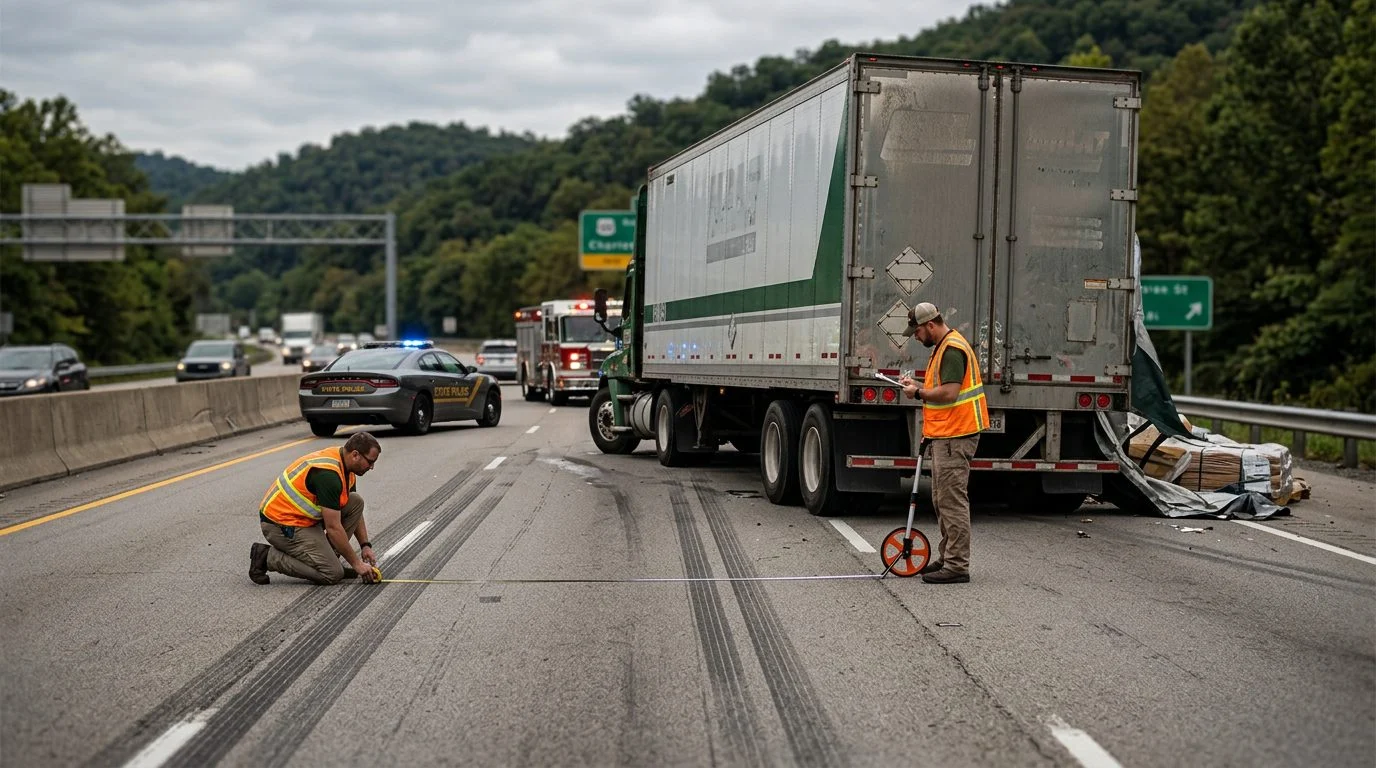
Truck and commercial vehicle crashes happen on interstates, U.S. highways, and local roads across West Virginia. Routes such as Interstate 79 and U.S. 19 carry truck traffic, and multi-vehicle crashes can send strong forces into smaller vehicles.
After a crash, the investigating officer’s report matters. Under W. Va. Code § 17C-4-7, for a crash resulting in bodily injury to, or death of, any person or total property damage to an apparent extent of $1,000 or more, the officer must submit the report within 24 hours after finishing the investigation. On request, the officer must also share owner, operator, and insurance details with the other parties within 24 hours, at no cost.
Drivers have duties at the scene too. Under W. Va. Code § 17C-4-3, a driver involved in a crash with injury, if physically able, must share identifying and insurance information and render reasonable assistance.
Many commercial carriers that transport property or passengers in interstate commerce must also follow federal trucking rules in 49 CFR Chapter III. Those rules can matter when a company’s driver or safety practices are at issue.
We serve injury victims across West Virginia, including Charleston, Huntington, Morgantown, Wheeling, Martinsburg, Parkersburg, Beckley, Clarksburg, Fairmont, and Weirton.
Not sure what your next step is?
Talk it through with Big Bubba — the first case review is free, confidential, and carries no obligation.
Talk With the Firm About Your Injury
After a truck collision, a knee, ankle, or back that feels unstable is worth raising with the firm in a free case review. Every crash is different, so the facts of yours matter.
Maybe your knee still gives way on the stairs weeks after a semi-truck hit your car. Maybe your ankle stays swollen while medical questions and insurance calls pile up. Those situations raise medical and legal questions at the same time.
Can a torn ligament show up days after a truck crash?
Yes. Symptoms can appear days or weeks later, so watch for swelling, instability, and pain.
Do I need an MRI for a ligament injury after a crash?
A treating provider decides which imaging fits your symptoms and exam. Imaging is one tool among several.
If your joint still feels unsteady after a truck crash, you don’t have to sort out the medical and legal questions alone. Request a free case review with the firm, and we’ll talk through how your crash and your records fit together.