
Wrongful Death | Truck Crashes | West Virginia
Losing a Parent in a Truck Crash? Understand Your Wrongful Death Options in West Virginia
Plain-language answers for families across West Virginia, from a firm that handles truck crash and wrongful death cases.
Published October 31, 2026
Parent Killed in Truck Crash in West Virginia: Wrongful Death
Losing a parent in a truck crash is sudden and painful. Families often have hard questions before they have any answers. This page explains what a wrongful death claim is, who can bring one in West Virginia, what it can cover, and what to do early. Under W. Va. Code § 55-7-6, a wrongful death action is brought by and in the name of the personal representative of the deceased person who has been duly appointed, and every such action must be commenced within two years after the death of the deceased person, subject to the provisions of section eighteen, article two, chapter fifty-five. W. Va. Code § 55-7-6 reads: “The provisions of this section shall not apply to actions brought for the death of any person occurring prior to July 1, 1988.” We serve families across West Virginia, including Charleston, Huntington, Morgantown, Wheeling, Martinsburg, Parkersburg, Beckley, Clarksburg, Fairmont and Weirton.
If your family is trying to understand a parent's death in a truck crash, we can talk through what happened and what it may mean for your claim. Talk it through with Big Bubba — the first case review is free, confidential, and carries no obligation.

Who a Wrongful Death Claim After a Parent’s Truck Crash Is For
A wrongful death claim is pursued when another party’s wrongful act, neglect, or default causes a death. West Virginia law makes the responsible party liable for damages even though the injured person has died, as W. Va. Code § 55-7-5 provides.
A parent killed in a truck crash may leave minor children, adult children, a spouse, or their own parents. Each of them may have a stake in the claim.
Under W. Va. Code § 55-7-6, the claim must be brought by the personal representative of the deceased person. The jury or court then decides how damages are shared. That can include the surviving spouse and children, adopted children and stepchildren, brothers, sisters, parents, and anyone who depended on the parent financially.
The personal representative is the person the court appoints to manage the estate. Some people call this role an administrator or executor. The appointment can take time after a death, so families should expect some delay before the claim moves forward.
Losing a parent in a crash can leave families with many questions about what comes next. The parent may have been driving, riding as a passenger, or walking near a roadway where a tractor-trailer or other commercial vehicle was involved.
What the Claim Can Cover
Under W. Va. Code § 55-7-6, the damages can include:
- Sorrow, mental anguish, and solace, which can include the companionship, comfort, guidance, and advice the parent gave
- Lost income and lost services, meaning the income the parent could reasonably have earned and the care and help the parent provided
- Care and treatment bills tied to the injury that led to the death, including hospital care
- Reasonable funeral bills
If the parent lived for a time after the crash, a separate claim may cover losses from the injury until death. W. Va. Code § 55-7-8 says there is still only one recovery for each element of damages.
The amount in each category depends on the parent’s age, earnings, health, and family role. It also depends on the facts of the crash. No one can predict the result of a claim.
Many families overlook the daily work a parent did, such as childcare, rides, and home repairs. Those services can matter to the claim when the facts support them.
Who May Share Responsibility in a Truck Crash
In a commercial truck crash, more than one party can share responsibility. Possible parties include:
- The driver
- The motor carrier that employs or contracts the driver
- The truck’s owner, or anyone who leases, rents, or controls it
- Other companies whose work affected the truck’s safe operation
The statute’s definition of an “employer defendant” includes the truck’s owner, the operator’s employer, and any person or entity with legal control over the vehicle or driver, and that definition applies to the noneconomic damages limit in W. Va. Code § 55-7-32.
Federal trucking rules set limits on driving time. A driver may not drive without first taking 10 consecutive hours off duty, per 49 C.F.R. § 395.3. A driver also may not operate a truck when fatigue, illness, or any other cause impairs, or is likely to impair, the driver’s ability or alertness so as to make it unsafe, under 49 C.F.R. § 392.3.
Your parent’s own conduct can also affect the claim. W. Va. Code § 55-7-13a uses comparative fault, which assigns each person a percentage of fault. Recovery follows those percentages, so how fault is assigned matters.
Evidence to Preserve Early
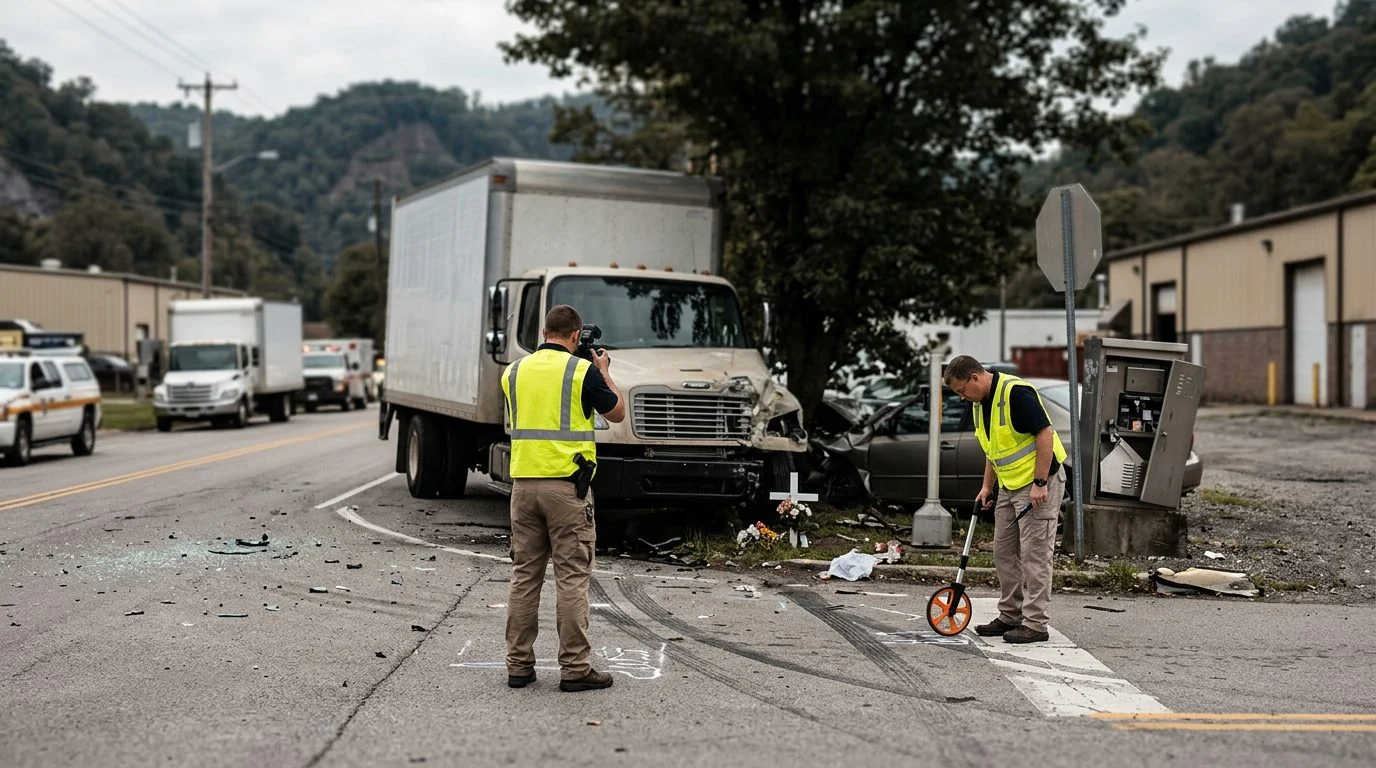
Evidence from a truck crash can disappear quickly. Early preservation helps protect what shows how the crash happened. Start with the basics:
- The police crash report and any citations
- Photos and video from the scene, including the truck and the road
- Names and contact details for witnesses
- 911 call records, when available
Maintenance records have their own clock. 49 C.F.R. § 396.3 requires records kept for 1 year, and for 6 months after the vehicle leaves the carrier’s control.
After certain serious crashes, the employer must test surviving drivers for alcohol and controlled substances, under 49 C.F.R. § 382.303. If an alcohol test is not given within eight hours, the employer must stop trying and keep a record of why.
Trucks may be repaired, sold, or returned to service soon after a crash. Early requests to keep the vehicle and its data can matter. Write down what you remember while it is fresh, along with any statements the driver or company made.
How Commercial Truck Insurance Shapes a Claim
Commercial trucks must carry insurance, and that coverage can shape a fatal crash claim. Federal law requires the Secretary of Transportation to set minimum levels of financial responsibility for motor carriers, under 49 U.S.C. § 31139.
West Virginia adds a limit for some large trucks. For a commercial motor vehicle that requires a commercial driver’s license, noneconomic damages against an employer defendant may not exceed $5 million for each person injured or killed, for each occurrence, under W. Va. Code § 55-7-32, which begins adjusting each year for inflation on January 1, 2026, not to exceed 150 percent of the amounts specified in the statute; however, the limit is not available to an employer defendant that does not have commercial motor vehicle insurance of at least $3 million for each occurrence covering the injury, and it does not apply if the operator or driver is found to have, for example, refused required post-incident testing, operated in willful or wanton disregard for the safety of persons or property, or driven while distracted. That limit applies only to causes of action arising after the July 1, 2024 effective date, under W. Va. Code § 55-7-32.
Two conditions matter. The limit is not available to an employer defendant without at least $3 million in commercial motor vehicle insurance per occurrence. The limit also does not apply if the civil action arises from an incident for which an operator or driver is found to have operated a commercial motor vehicle in excess of the hours of operation established under state or federal regulations, or in willful or wanton disregard for the safety of persons or property, among other listed situations.
A single crash can involve several policies, such as a carrier’s primary coverage and an excess layer. Insurance limits set practical boundaries on what can be recovered. The crash facts and the family’s losses decide how a claim is valued.
Not sure what your next step is?
Talk it through with Big Bubba — the first case review is free, confidential, and carries no obligation.
What to Expect, Step by Step
A wrongful death claim usually moves through several stages. The order and length depend on the facts.
- Free case review. The family shares the basic facts of the crash and who the family members are. The review is confidential and carries no obligation to continue.
- Investigation. We look at crash reports, driver and company records, and maintenance files. We may send preservation requests to the trucking company.
- Appointment. The personal representative is confirmed, so the claim can be filed for the family members the law names.
- Claim to responsible parties. The claim goes to the responsible parties and their insurers. Talks may follow once the losses are documented.
- Lawsuit if needed. If a fair resolution is not reached, a lawsuit can be filed. It then moves through discovery, motions, and possibly trial or settlement.
Timeline: W. Va. Code § 55-7-6 generally requires a wrongful death action to be brought within two years after the death, subject to the provisions of section eighteen, article two, chapter fifty-five. W. Va. Code § 55-7-6 reads: “The provisions of this section shall not apply to actions brought for the death of any person occurring prior to July 1, 1988.” Under W. Va. Code § 55-7-6, a wrongful death action must be commenced within two years after the death of the deceased person, subject to certain exceptions under state law, so families should keep that two-year deadline in mind from the start.
Questions Families Ask About Parent Wrongful Death Claims
Who files the claim after a parent dies?
The personal representative of the estate files the claim for the family members the law names. W. Va. Code § 55-7-6 sets out this rule.
What if my parent was partly at fault?
Fault is divided by percentage, so a parent’s share can reduce what the family recovers. W. Va. Code § 55-7-13a explains this comparative fault approach.
Does the deadline wait for the police or the company?
No. The two-year period generally runs from the date of death, whatever the police or the company decide.
What if the company says the crash could not be avoided?
Statements alone do not settle what happened. Records and physical evidence are what show how the crash occurred.
Who can share in a wrongful death recovery?
Understanding Wrongful Death Claims After a Parent’s Death
If you’re reading this in the weeks after losing a parent, you may be grieving while you care for other family members. You may still be learning what happened on the road. The decision in front of you may be whether to understand your options, preserve evidence, and learn who may be responsible. You can tell Bubba what happened, and we can explain what the next steps could look like for your family. The firm offers a free case review to start that conversation.