
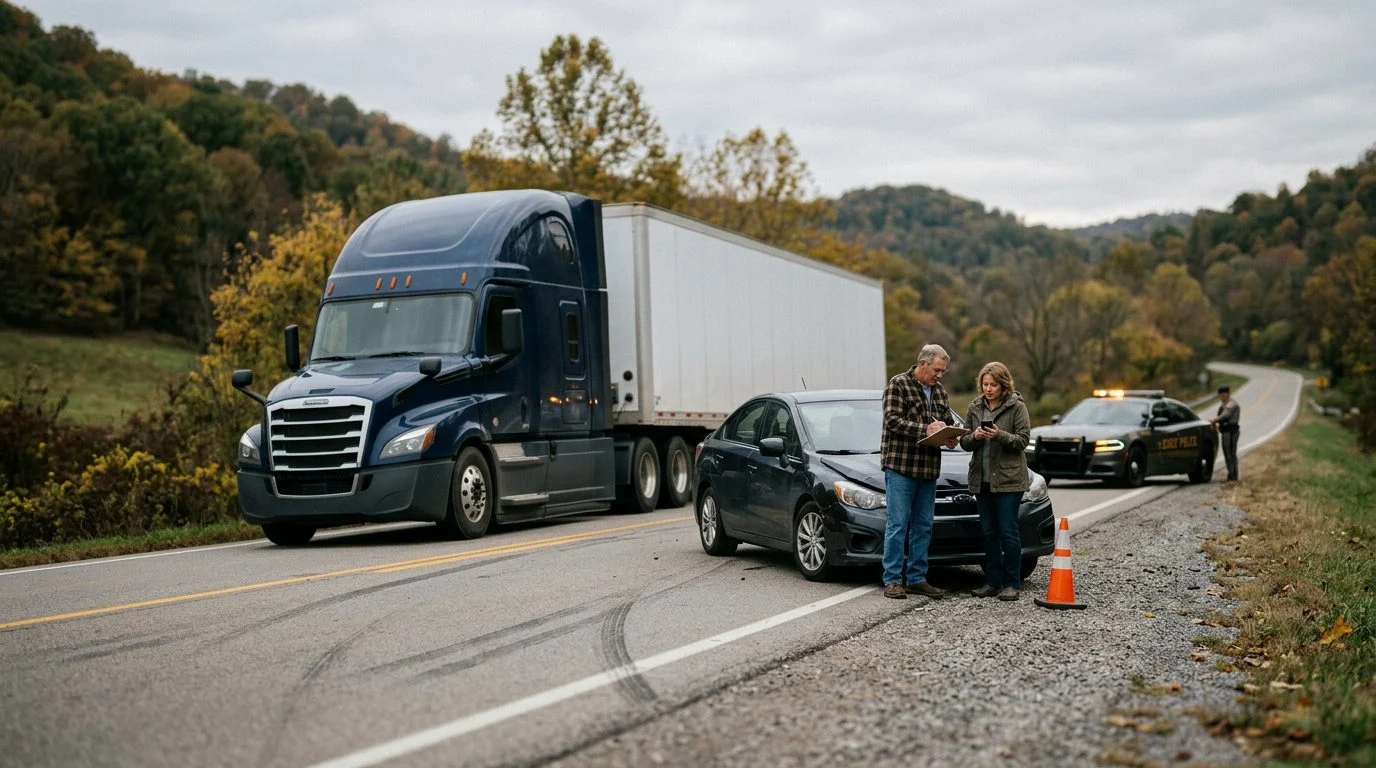
Truck & Car Crash Claims | West Virginia
Hurt in a Truck Crash? Big Bubba Injury Law Can Help You Understand Your Options
Trucking crash cases involve more parties, more paperwork and more evidence than a typical car accident. Request a free case review to talk through what happened and what comes next.
Serving injury victims across West Virginia
55
West Virginia counties served
Published October 26, 2026
Yes, You Can Often Sue the Trucking Company, Not Only the Driver
Yes. In many West Virginia crashes, you can bring a claim against the trucking company as well as the driver. The company can be named when the law makes it responsible for the crash.
Several parties may be named, including:
- The driver whose actions caused the crash.
- The motor carrier that operates the truck.
- The owner of the truck, or a person who leases or controls it.
- Other parties whose conduct contributed to the harm.
West Virginia law defines an “employer defendant” to include the vehicle owner, the driver’s employer, and anyone who holds legal control over the vehicle or operator. The definition appears in W. Va. Code § 55-7-32.
Commercial trucks are usually insured through a business policy. Naming every responsible party helps bring the right insurance into the claim. Every case turns on its own facts, so the firm looks at each party early.
Not sure what your next step is?
Talk it through with Big Bubba — the first case review is free, confidential, and carries no obligation.

How a Trucking Company Can Be Legally Responsible
A trucking company can be responsible for a driver’s negligence, or for its own negligent choices. Two main routes apply.
Vicarious liability. Under respondeat superior, an employer answers for an employee’s negligence when the employee was acting within the scope of the job.
Direct negligence. The company can also be liable for its own mistakes.
- Training, maintenance, and dispatch. Failures here, including schedules that push drivers past safe limits, are also examined.
Many lawsuits argue both routes at once.
Evidence That Often Shows Whether the Company Is Responsible
Key records include:
- Electronic logging device (ELD) records. Carriers must install and require drivers to use an ELD to record duty status, but a carrier may instead require manual records for certain vehicles, such as those manufactured before model year 2000. No driver or motor carrier may make a false report in connection with a duty status (49 C.F.R. § 395.8).
- Driver qualification files. Each carrier keeps a file for each driver, including the application, motor vehicle record, and medical certificate. The file is kept while the driver works and three years after (49 C.F.R. § 391.51).
- Post-accident testing records. After certain crashes, employers must test surviving drivers for alcohol and drugs. If an alcohol test is delayed past two hours, the employer must record why (49 C.F.R. § 382.303).
- Driver vehicle inspection reports. Drivers report defects, and carriers must repair safety defects before the truck runs again. Carriers keep these reports for three months (49 C.F.R. § 396.11).
- Dispatch messages and bills of lading. These can show pressure on the driver to meet a deadline.
Timing matters. Inspection reports need only be kept three months, so early action helps. A written preservation letter asks the company to keep its records. Records may be kept in any technology that accurately reflects all of the information in the record and remains accessible in a form that can be accurately reproduced later (49 C.F.R. § 379.7).
The firm can also help identify the correct company when a truck was leased, subcontracted, or run under another company’s authority.
Time Limits for Filing a Claim in West Virginia
Most West Virginia personal injury claims must be filed within two years (W. Va. Code § 55-2-12). Wrongful death claims also have a two-year limit, measured from the death.
- Injury claims. A personal action for personal injuries must be brought within two years after the right to sue accrues (W. Va. Code § 55-2-12).
- Wrongful death claims. The action must be commenced within two years after the death, subject to the provisions of section eighteen, article two, chapter fifty-five (W. Va. Code § 55-7-6). W. Va. Code § 55-7-6 reads: “The provisions of this section shall not apply to actions brought for the death of any person occurring prior to July 1, 1988.”
Waiting can cost more than time. Records can be lost, witnesses can move, and memories fade. The start date for the clock can turn on the facts, so an early review is wise.
Who Can Bring a Claim After a Crash
The injured person can bring a claim. After a fatal crash, the claim is brought by the personal representative of the deceased person’s estate.
- Injured people. Drivers and passengers in cars hit by commercial vehicles may have claims against the at-fault parties.
- Wrongful death families. Damages can include sorrow, mental anguish, and solace. They can also cover lost income and services, care and hospital costs from the injury, and reasonable funeral costs (§ 55-7-6).
- Catastrophic injuries. Traumatic brain injury and spinal cord injury can affect work and daily life for years. Claims look at future needs, not just early bills.
- Commercial vehicles. The commercial vehicle statute applies to vehicles that require a commercial driver’s license, except a vehicle serving as a common carrier of passengers, a commercial motor vehicle as defined in §17E-1-3(7)(C) of this code, a school bus as defined in §17E-1-3(33) of this code, or other vehicle that is primarily engaged in transporting passengers, and only to claims arising after July 1, 2024. It also limits noneconomic damages in some cases, but the limit is unavailable if the employer lacks at least $3 million in commercial motor vehicle insurance per occurrence, or certain violations occurred (§ 55-7-32).
Dealing With the Trucking Company’s Insurer
Speak carefully with the trucking company’s insurer, because early statements can be used later. The insurer may contact you soon after the crash.
- Recorded statements and early offers. Take time before giving a recorded statement or accepting an offer. Describe your injuries accurately, and avoid guessing.
- Keep your records. Save medical records, photos, and a written account of the crash.
- Several liability. Each defendant is generally liable only for its own share of fault, with limited exceptions (§ 55-7-13c).
- Nonparty fault. Fault of a nonparty shall be considered if the plaintiff entered into a settlement agreement with the nonparty or if a defending party gives notice no later than one hundred eighty days after service of process upon said defendant that a nonparty was wholly or partially at fault. The notice must be filed with the court and served upon all parties, designating the nonparty by name and last known address (or the best identification possible) with a brief statement of the basis for believing the nonparty to be at fault (§ 55-7-13d). That is why the firm looks at all responsible parties early.
Once the firm is involved, the firm handles communications with the insurer.
Not sure what your next step is?
Talk it through with Big Bubba — the first case review is free, confidential, and carries no obligation.
What to Expect After You Contact the Firm
The first step is a free case review. It is confidential and carries no obligation to continue.
- Free case review. You tell the firm what happened, and the firm reviews the facts and parties.
- Early investigation. Preservation letters go out for driver logs, maintenance records, inspection reports, and dispatch data.
- Medical documentation. The claim records your injuries, treatment, and expected future needs.
- Presenting the claim. The firm presents the claim to the company and its insurer. If needed, it files suit in court.
Timelines vary. Simpler claims may resolve faster. Cases with serious injuries, disputed fault, or a wrongful death commonly take longer.
The firm serves all 55 West Virginia counties, including injury victims in Charleston, Huntington, Morgantown, Wheeling, Martinsburg, Parkersburg, Beckley, Clarksburg, Fairmont, and Weirton.
Common Questions About Suing a Trucking Company in West Virginia
Can I sue the company if the driver was an independent contractor?
Questions like this depend on the facts of each case, and the firm can go over them with you in a free case review. The answer can turn on how much control the company had over the driver. The firm reviews this during the free case review.
Do I have to prove the driver was at fault?
Yes, fault must be shown. Under § 55-7-13c, your recovery is barred only if your fault is greater than the combined fault of others.
Can I sue a trucking company based out of state?
It may be possible. Where the company is based and where the crash happened both matter, and the firm checks both.
Can a passenger in a car hit by a truck sue?
Passengers may have claims against the at-fault parties, including the trucking company.
Should I wait to see how I feel?
Waiting can cost time and evidence. An early free case review is the safer step.

Talk With the Firm About Your Crash
If a commercial truck crash left you or a family member badly hurt, or took a loved one’s life, you may have a claim against the trucking company. Request a free case review and tell Bubba what happened, with no obligation to continue.