
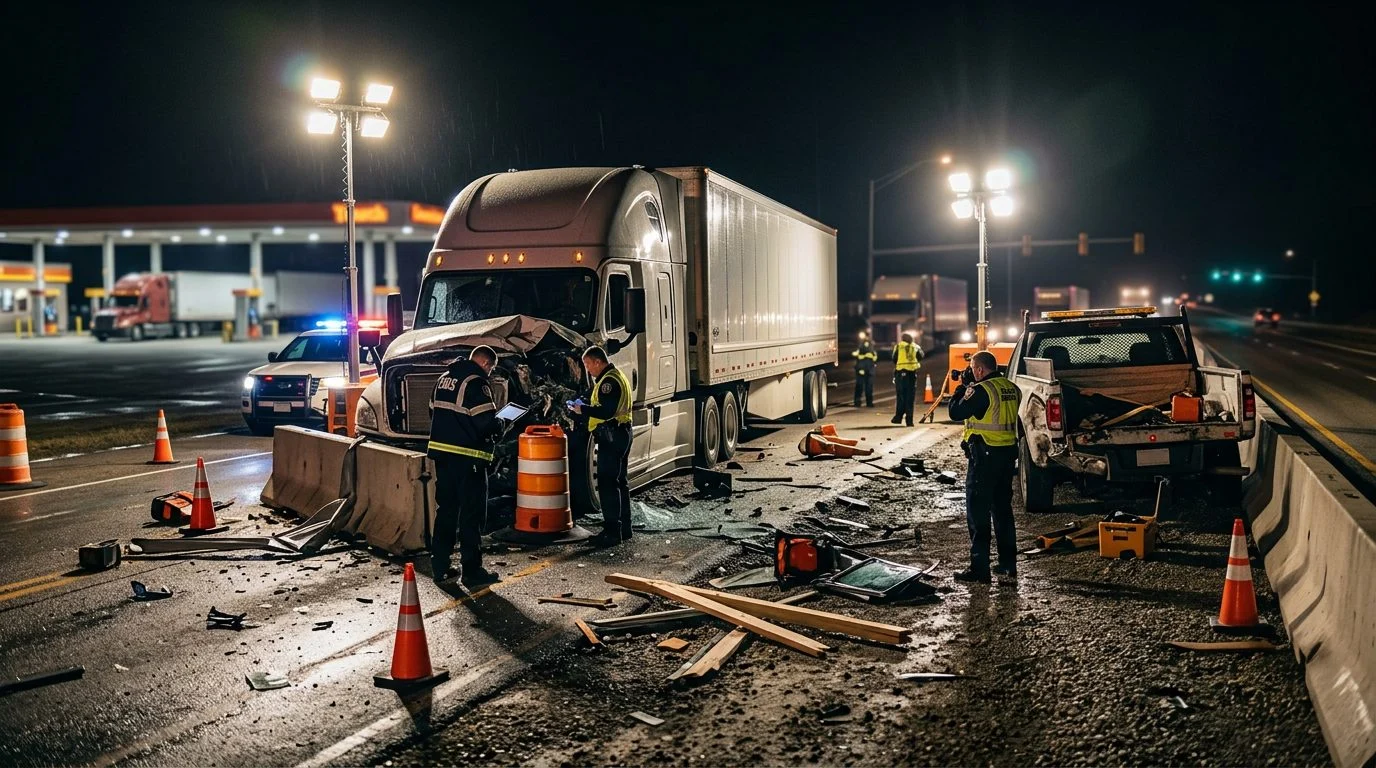
Truck Crashes in Work Zones | West Virginia
Hurt in a Work Zone Truck Crash? Find Out Who May Share Responsibility
Lane closures put trucks, equipment and crews in the same tight space. Our firm focuses on helping injured people and families sort out who may be involved.
Published November 9, 2026
If a truck hit you, a passenger, or a family member in a lane closure, you probably have many questions at once. This page answers one of them: who may be responsible for a truck crash in a construction zone in West Virginia? Often it is more than one party. The driver is only one possibility. The trucking company, the truck’s owner, equipment providers, and companies that set up or maintain the work zone may also be relevant, depending on the facts.
For a broader guide, read the firm’s truck accident page.
Why Truck Crashes in Work Zones Are Different
Work zones change the road in ways that can catch a truck driver off guard. Lanes may narrow or shift. Temporary barrels channel traffic close together. Speed limits often drop, and workers may stand near moving vehicles.
A loaded commercial truck also needs more room to stop. The federal brake standard recognizes that stopping distance varies by vehicle type, and it is greatest for combinations of commercial vehicles, as 49 CFR 393.52 explains. A late reaction to a slowed lane can leave less room for a safe stop.
A work zone also puts drivers, workers, and passing motorists in the same small space. One crash can injure all three groups. Each person’s claim can differ, because the responsible parties may differ.
If a truck crash in a work zone hurt you or someone you love, you may have a claim. Talk it through with Big Bubba — the first case review is free, confidential, and carries no obligation.

Who May Be Responsible When a Truck Crashes in a Work Zone
More than one party may share responsibility for the crash. The driver is one possibility, but not the only one.
The driver may bear responsibility if speed, distraction, or fatigue played a part, or if the driver ignored posted work zone signs. Federal rules bar a driver from operating a commercial motor vehicle while the driver’s ability or alertness is so impaired, or so likely to become impaired, through fatigue, illness, or any other cause, as to make it unsafe to operate, as 49 CFR 392.3 states, though a driver in a grave emergency, where the hazard to occupants or other highway users would be increased by compliance, may continue to the nearest place at which that hazard is removed.
The motor carrier or employer may also be relevant. West Virginia’s commercial vehicle statute defines “employer defendant” to include the truck’s owner, the operator’s employer, and any entity with legal control over the truck or driver, as W. Va. Code § 55-7-32 sets out.
If brakes, tires, or other equipment failed, the vehicle owner, lessor, or maintenance provider may be relevant. The general contractor, a subcontractor, or a traffic control provider may be relevant if lane closures, signs, barriers, or flaggers were set up or kept in place improperly. Some claims also involve a public agency, which can follow different rules.
West Virginia does not always bar a claim when the injured person shares some fault. Under W. Va. Code § 55-7-13c, a plaintiff’s fault bars recovery only if it is greater than the combined fault of all other responsible persons. Otherwise, recovery is reduced in proportion to the plaintiff’s fault. Each defendant’s share is generally several, in proportion to its percentage of fault.
Evidence That May Show What Happened
Records made in the days after a crash often matter most. Some can be lost or overwritten.
The crash report from the investigating agency records the scene, the parties, and early observations. Photos, nearby traffic camera video, and dash camera footage may show lane setup, signs, and where vehicles came to rest, if they still exist.
For the truck, electronic logging device data and driver hours records may bear on fatigue. Drivers must record duty status, and 49 CFR 395.8 bars false reports about it.
Post-accident testing creates another record. After a qualifying crash, the employer must test surviving drivers for alcohol and controlled substances as soon as practicable, under 49 CFR 382.303. If an alcohol test is not given within two hours, the employer must record why. Attempts to test for alcohol stop after eight hours, and attempts to test for drugs stop after 32 hours.
Traffic control plans, daily project logs, and contractor records may show how the work zone was set up and kept up. The West Virginia Division of Highways publishes work-zone safety information that can help explain how crews are expected to set up a zone. Access to project records can vary, so this step may take time.
Catastrophic Injuries and Wrongful Death in Work Zone Crashes
Truck crashes can cause serious injuries that change daily life for a long time. Traumatic brain injury and spinal cord injury are among the most serious. Crush injuries, burns, and fractures can also occur. Effects vary widely from person to person, and the full medical picture may take time to form.
These claims often need careful medical records and planning for ongoing care. Work, family routines, and independence may all be affected. Workers in the zone, as well as drivers and passengers, can be hurt. The catastrophic injuries overview covers these cases in more detail.
When a crash causes a death, the family may have a wrongful death claim. Under W. Va. Code § 55-7-6, the action is brought by the deceased person’s personal representative. Damages may include sorrow, mental anguish, and solace, reasonably expected lost income and services, medical and hospital costs from the injury, and reasonable funeral expenses. The court or jury may direct how damages are shared among surviving family members and dependents.
Deadlines and Claims Against Public Agencies
West Virginia generally allows two years for personal injury claims, and exceptions may apply. Under W. Va. Code § 55-2-12, a personal action for personal injuries must be brought within two years after the right to bring it accrued, when no other limit is set.
Wrongful death claims follow a related timeline. Under W. Va. Code § 55-7-6, an action is generally commenced within two years after the death, subject to the statute’s terms. W. Va. Code § 55-7-6 reads: “The provisions of this section shall not apply to actions brought for the death of any person occurring prior to July 1, 1988.”
Claims against a political subdivision follow separate rules. Under W. Va. Code § 29-12a-6, these actions generally must be brought within two years after the cause of action arose or after the injury was discovered or reasonably should have been discovered, whichever last occurs, or within any shorter period the code provides; for a child under ten at the time of injury, the deadline is that period or the child’s twelfth birthday, whichever is longer, and these deadlines are tolled for any period during which the political subdivision or its representative committed fraud or collusion by concealing or misrepresenting material facts about the injury.
Delay can make evidence harder to gather. Witnesses move, video is erased, and vehicles are repaired or sold. Early attention to the facts may help protect a claim.

Key Points About a Work Zone Crash Claim
If a truck struck you, a passenger, or a family member in a lane closure, shifting barrel line, or bridge work zone, the questions about records, medical care, and timing are probably in front of you now. The firm handles truck accident and commercial vehicle matters, catastrophic injury cases, traumatic brain injury and spinal cord injury claims, and wrongful death cases for people across West Virginia.
Reach out through the contact page to request a free case review of your crash.
Related practice areas
- Truck Accident Claims in West Virginia
- Truck Accidents in Charleston
- Truck Accidents in Huntington
- Truck Accidents in Morgantown