
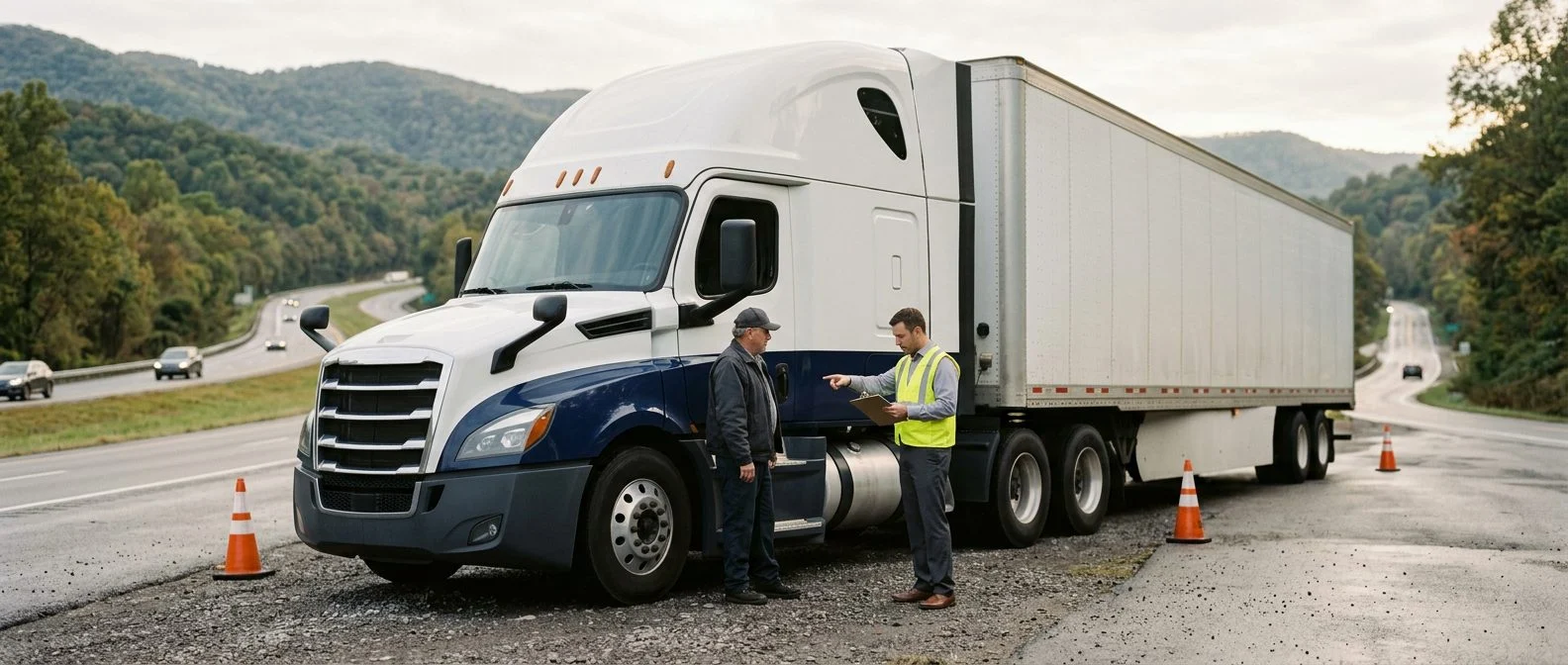
Truck Accident Claims | West Virginia
Trucking Company Insurance Claims in West Virginia: What to Know Before You Talk to an Adjuster
Trucking companies and their insurers often act quickly after a serious crash. Big Bubba Injury Law helps injured people and families understand the claim process and what to do next.
Published October 23, 2026
A trucking company insurance claim asks the motor carrier’s liability insurer to cover losses from a crash with a commercial truck. If the claim cannot be resolved fairly, a lawsuit may follow. If you were hurt in a truck crash, this guide explains the trucking company insurance claim West Virginia families and drivers usually face, step by step.
What a Trucking Company Insurance Claim Is and Who It Is For
A trucking company insurance claim is a demand made against the motor carrier’s insurer for injuries or losses caused by a commercial truck. It is usually handled before any lawsuit. A suit is filed only if the claim cannot be resolved.
Claims against trucking companies are often bigger and more involved than standard car claims. There are more parties and more records. Federal rules require for-hire interstate carriers of nonhazardous property in trucks rated 10,001 pounds or more to meet a minimum level of financial responsibility of $750,000 (49 C.F.R. § 387.9).
People who may bring a claim include:
- Injured drivers and passengers
- Other motorists and pedestrians hurt in the crash
- Families of someone killed, in a wrongful death case
This page covers injury and wrongful death claims from truck and commercial vehicle crashes.
Not sure what your next step is?
Talk it through with Big Bubba — the first case review is free, confidential, and carries no obligation.

Who Can Be Responsible in a Truck Crash Claim
More than one party can be responsible after a truck crash, not only the driver.
- The driver, whose hours and alertness are covered by federal rules.
- The motor carrier, the company that operates the truck.
- The truck owner or controlling company. West Virginia law counts the owner, the driver’s employer, and anyone with legal control of the truck or driver as an “employer defendant”.
- Others whose conduct contributed, such as a company that maintained or loaded the truck.
Each party may have its own insurance, so finding every party matters.
Federal hours-of-service rules also matter. A driver must have 10 consecutive hours off duty before driving. A driver may not drive after 14 consecutive hours from coming on duty, or drive more than 11 hours in that period (49 C.F.R. § 395.3). Federal rules also bar driving when fatigue makes it unsafe (49 C.F.R. § 392.3).
West Virginia caps noneconomic damages against an employer defendant at $5 million per occurrence in civil actions involving operation of a commercial motor vehicle requiring a commercial driver’s license. The cap has exceptions, such as an alcohol concentration of .04 or more. It is not available unless the employer carries at least $3 million in commercial vehicle insurance. It applies to claims arising after July 1, 2024 (W. Va. Code § 55-7-32).
What the Firm Can Handle in a Trucking Company Claim
The firm can handle insurer contact, evidence requests, injury review, and lawsuits. You do not have to manage each step alone.
- Insurer contact. The firm can speak with the trucking company’s insurer for you.
- Evidence. The firm can request police reports, electronic logging device (ELD) data, dashcam footage, maintenance and inspection records, and driver qualification files.
- Injuries. The firm reviews catastrophic injuries, traumatic brain injury, and spinal cord injury, along with medical records and future care needs.
- Lawsuits. When a fair resolution cannot be reached, the firm can file suit in the right West Virginia court.
- Wrongful death. A wrongful death action is brought by the deceased person’s personal representative. Damages can include sorrow, mental anguish, and solace; lost income and services; care and hospital expenses; and reasonable funeral expenses (W. Va. Code § 55-7-6).
We serve injury victims in Charleston, Huntington, Morgantown, Wheeling, Martinsburg, Parkersburg, Beckley, Clarksburg, Fairmont, Weirton, and communities across West Virginia.
How the Claim Process Works, Step by Step
Most truck claims follow five steps, from a free case review to a lawsuit if one is needed.
- Free case review. You describe the crash, the companies involved, and your injuries or losses.
- Early evidence requests. Letters ask the carrier to keep logs, dispatch records, and vehicle data. Commercial records can be lost if no one asks for them.
- Investigation. The firm gathers and reviews records. Commercial cases often take longer than car cases because there are more parties and records.
- Demand and negotiation. The firm presents the claim and supporting records to the insurer and negotiates.
- Lawsuit, if needed. West Virginia generally allows two years to bring a personal injury action (W. Va. Code § 55-2-12). A wrongful death action must be commenced within two years after the death, subject to the provisions of section eighteen, article two, chapter fifty-five (W. Va. Code § 55-7-6). W. Va. Code § 55-7-6 reads: “The provisions of this section shall not apply to actions brought for the death of any person occurring prior to July 1, 1988.” How long each step takes depends on the facts.
Acting early helps. Scene evidence is easier to preserve soon after a crash, and witness memories fade with time.
When the Trucking Company Disputes Fault or Denies the Claim
When an insurer disputes fault, the answer usually comes from the crash records.
Insurers often argue that the injured person caused the crash, that the truck did not cause the injuries, or that the injuries existed before the crash.
West Virginia uses comparative fault. Fault is split by percentage, and each party’s share of liability follows that percentage (W. Va. Code § 55-7-13a). That makes the percentages in a dispute matter.
Disputes are tested with the police report, ELD data, inspection records, and witness statements. For help getting the crash report, see how to get a police report. If fault is denied, how a truck crash lawsuit may proceed explains the next steps.
Early statements need care.
Frequently Asked Questions About Trucking Company Insurance Claims
Most questions come down to evidence, responsibility, and deadlines.
Do I need a police report to start a claim?
A police report helps, but it is not the only record that matters. The firm also reviews driver logs and ELD data.
Can more than one company be responsible?
Yes, more than one company can be responsible. West Virginia law counts the truck’s owner and the company controlling the driver as employer defendants.
Should I give a recorded statement to the insurer right away?
Be careful with recorded statements. They can be used later in a claim, so the firm can handle those insurer contacts for you.
What if the carrier is based in another state?
Carriers based in other states can still be involved in a West Virginia crash. Federal rules apply to interstate carriers, and the firm looks at both state and federal sources.
How long do I have to file?
Generally, two years for personal injury claims and two years after death for wrongful death. Deadlines are set by statute, so check your timing early.
Not sure what your next step is?
Talk it through with Big Bubba — the first case review is free, confidential, and carries no obligation.

Deciding What to Do Next After a Truck Crash
If you are reading this after a truck crash, you may still be recovering. You may also be looking into this for a family member while an insurer is already calling.
Gather the basics now. Note the date and place of the crash, the trucking company’s name, photos, medical and repair records, and names of witnesses. Gathering these early helps keep your options open.
You do not have to sort out the claim alone. When you are ready, request a free case review and tell the firm what happened on the road.