
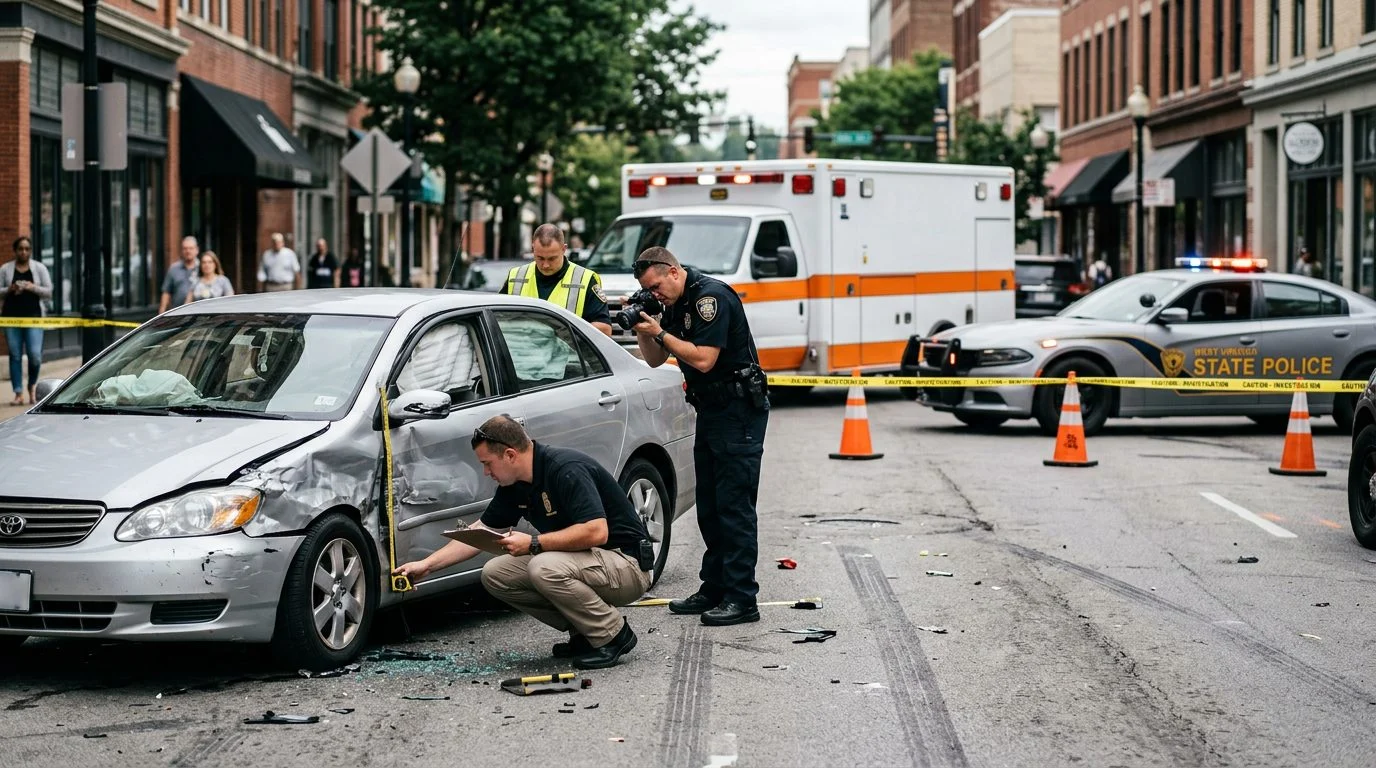
Car Accidents | West Virginia
Injured in a West Virginia Crash? Learn the Basics First
Plain-language guidance for drivers, passengers and families across West Virginia, from Big Bubba Injury Law.
Published October 23, 2026
West Virginia Auto Accident Laws: What Injured Drivers Need
What are the laws governing auto accidents in West Virginia? In short, West Virginia generally holds the at-fault driver responsible, reduces recovery when the injured person shares fault, and sets deadlines for filing, though exceptions may apply. This guide explains each rule in plain language.
If you were hurt in a crash, or you are helping a family member sort this out, the details can feel heavy. Insurance letters, medical bills, and questions about next steps can all arrive at once. You don’t need to be a lawyer to understand the basics. We serve people hurt in crashes across all 55 West Virginia counties, and this page is a starting point.
Not sure what your next step is?
Talk it through with Big Bubba — the first case review is free, confidential, and carries no obligation.
How West Virginia Handles Car Accident Claims
West Virginia is an at-fault state, so the driver who caused the crash is generally responsible for the injuries and losses that follow. That is the starting point for most car accident claims in the state.
There are two main routes after a crash. The first is a claim with the at-fault driver’s insurance company. The second, if the claim cannot be resolved, is a civil lawsuit filed in court. Each route has its own steps, and the facts of your crash shape which one fits.
Your health comes first. Many people are still treating injuries while they deal with adjusters, forms, and recorded calls. Keep your medical records, your crash details, and every letter in one place. That habit makes either route easier to follow later.
For a closer look at claims involving large trucks in West Virginia, read our guide to truck accident claims in West Virginia.
Fault and Comparative Negligence Under West Virginia Law
West Virginia uses a modified comparative fault rule, so your own share of fault reduces what you can recover. W. Va. Code § 55-7-13c says a plaintiff’s fault does not bar recovery unless it is greater than the combined fault of all other people responsible for the damages.
Here is what that means in plain terms. If your fault is smaller than everyone else’s combined, your recovery is reduced by your percentage of fault. If your fault is larger than everyone else’s combined, the claim cannot recover. Under W. Va. Code § 55-7-13a, fault is expressed as a percentage and divided among each person who proximately caused the harm.
Fault is decided on the facts of each crash. Those facts often include driver statements, physical evidence like skid marks and vehicle damage, and witness accounts. A common mistake is guessing at speeds or details at the scene. Small details can change how a crash is viewed later.
Whether any particular claim succeeds depends on the facts. No article can predict that result for your case.
Deadlines for Filing: The Two-Year Rule
For most car accident injury claims, West Virginia generally allows two years to file after the right to sue accrues, and exceptions may apply. W. Va. Code § 55-2-12 says a personal injury action must be brought within two years after the right to bring it accrues. The same two-year rule covers claims for damage to property.
Wrongful death has its own timeline. Under W. Va. Code § 55-7-6, a wrongful death action must be commenced within two years after the death, subject to the provisions of section eighteen, article two, chapter fifty-five. The section does not reach deaths that occurred before July 1, 1988. The case is brought by the personal representative appointed for the deceased person’s estate. Families should know early which person holds that role.
Missing a deadline can end a claim, even one with strong facts. That is why the start date matters so much. For an injury claim, the clock is tied to when the right to sue accrued. For a death claim, it is tied to the date of death. Write the key dates down now. Don’t assume the date on a crash report settles the question.
Minimum Auto Insurance Requirements in West Virginia
West Virginia requires drivers to carry liability insurance. Information about vehicle insurance is available from the West Virginia Division of Motor Vehicles.
Under W. Va. Code § 17d-4-2, the minimum proof of financial responsibility is $25,000 for bodily injury or death of one person in one accident. For two or more people in one accident, the minimum is $50,000. The property damage minimum is $25,000.
Those minimums are a floor, not a ceiling. A serious injury can bring losses well above these amounts. That is why the at-fault driver’s coverage, and your own coverage, both matter to your options. The next section explains how your own policy can help when the other driver’s coverage falls short.
Uninsured and Underinsured Motorist Coverage
Uninsured and underinsured motorist coverage can apply when the at-fault driver has no insurance or too little. Under W. Va. Code § 33-6-31, a motor vehicle policy must include an endorsement covering what the insured is legally entitled to recover from the owner or operator of an uninsured motor vehicle. W. Va. Code § 33-6-31 reads: “unless it contains an endorsement or provisions undertaking to pay the insured all sums which he or she is legally entitled to recover as damages from the owner or operator of an uninsured motor vehicle, within limits which shall be no less than the requirements of section two, article four, chapter seventeen-d of this code, as amended from time to time: Provided, That such policy or contract shall provide an option to the insured with appropriately adjusted premiums to pay the insured all sums which he or she shall be legally entitled to recover as damages from the owner or operator of an uninsured motor vehicle up to an amount of $100,000 because of bodily injury to or death of one person.” W. Va. Code § 33-6-31(b) provides that a policy may not be issued unless it contains an endorsement or provisions undertaking to pay the insured all sums which he or she is legally entitled to recover as damages from the owner or operator of an uninsured motor vehicle. W. Va. Code § 33-6-31 reads: “unless it contains an endorsement or provisions undertaking to pay the insured all sums which he or she is legally entitled to recover as damages from the owner or operator of an uninsured motor vehicle, within limits which shall be no less than the requirements of section two, article four, chapter seventeen-d of this code, as amended from time to time: Provided, That such policy or contract shall provide an option to the insured with appropriately adjusted premiums to pay the insured all sums which he or she shall be legally entitled to recover as damages from the owner or operator of an uninsured motor vehicle up to an amount of $100,000 because of bodily injury to or death of one person.”
W. Va. Code § 33-6-31, subsection (b), defines an underinsured motor vehicle as one that has liability insurance applicable at the time of the accident, but where that insurance’s limits are either less than the underinsured motorists’ coverage the insured carried, or have been reduced by payments to others injured in the accident to limits below that coverage.
Check your own policy. Look for uninsured and underinsured motorist coverage and note the limits. W. Va. Code § 33-6-31 reads: “unless it contains an endorsement or provisions undertaking to pay the insured all sums which he or she is legally entitled to recover as damages from the owner or operator of an uninsured motor vehicle, within limits which shall be no less than the requirements of section two, article four, chapter seventeen-d of this code, as amended from time to time: Provided, That such policy or contract shall provide an option to the insured with appropriately adjusted premiums to pay the insured all sums which he or she shall be legally entitled to recover as damages from the owner or operator of an uninsured motor vehicle up to an amount of $100,000 because of bodily injury to or death of one person.” Reviewing this part of your policy before a crash can help you understand what coverage you have. It is worth checking even when another driver caused the crash.
Not sure what your next step is?
Talk it through with Big Bubba — the first case review is free, confidential, and carries no obligation.
Reporting the Crash to Police and the DMV
A police crash report gives an early, written record of the scene, the vehicles, and the people involved. Ask for the report number before you leave the scene if you can. Our guide to obtaining a police crash report explains how to request and read one.
At the scene, exchange names, phone numbers, and insurance details with the other driver. Note the time, the weather, and the lanes involved. Photos help, too. Write down what you remember while it is fresh, because memories shift over time.
A report records what officers saw and were told. It does not decide fault on its own. An officer’s findings are one piece of the picture, not the final word.
If the DMV contacts you about insurance verification, act quickly. The West Virginia Division of Motor Vehicles provides general information about insurance verification notices.
West Virginia Traffic Laws and How They Come Up in Claims
West Virginia’s traffic laws set the standards drivers are expected to follow on the road. Speed, right-of-way, lane use, and signaling are common examples. When a driver breaks one of these rules, that break can become evidence in a claim.
A traffic violation can be relevant evidence that a driver acted carelessly. It is still one factor among many. A violation does not automatically prove fault, and the other side may point to facts that tell a different story.
Evidence that shows what the rules required often comes from several places. Photos of road markings, vehicle damage, and traffic signals can help. So can electronic vehicle data, nearby business video, and witness statements. Gathering these sources early matters, because they can disappear.
The goal is a clear picture of what happened. Each piece of evidence gets weighed together with the others.
When a Commercial Truck Is Involved
A crash with a commercial truck can involve more parties than a car crash.
Truck crashes can also fall under federal rules. Under 49 U.S.C. § 31139, certain motor carriers transporting property must meet minimum levels of financial responsibility sufficient to satisfy liability amounts established by the Secretary of Transportation; for certain hazardous materials, the level must be at least $5,000,000. Our page on federal trucking safety rules covers how these rules fit a crash.
West Virginia also limits some damages in certain commercial vehicle cases. Under W. Va. Code § 55-7-32, in a personal injury or wrongful death action involving a commercial motor vehicle requiring a commercial driver’s license, noneconomic damages against an employer defendant may not exceed $5 million for each occurrence, regardless of the number of claims or theories of liability, subject to the insurance requirement in subsection (c) and the exceptions in subsection (d). That limit has conditions, including the employer’s commercial insurance levels and listed driver conduct.
Equipment problems can matter too. A tire blowout crash shows how maintenance issues can become part of a claim. Keep every document from the crash, including photos, texts, and letters.
Understanding Your Options After a Crash
The firm can review how these West Virginia rules fit your crash. You may be reading this while recovering from injuries, or while grieving someone you love. Either way, the deadlines and paperwork can feel urgent.
Deciding whether to speak with a personal injury firm is a real step. You don’t have to make it today, and you don’t have to understand every rule first.
Frequently asked questions
How long do I have to file a car accident claim in West Virginia?
For most personal injury claims, the general deadline is two years under W. Va. Code § 55-2-12.
Does West Virginia reduce my recovery if I share fault?
Yes. Your recovery is reduced by your share of fault (W. Va. Code § 55-7-13c). It is barred if your fault is greater than all other responsible parties combined. W. Va. Code § 55-7-13c reads: “(c) Any fault chargeable to the plaintiff shall not bar recovery by the plaintiff unless the plaintiff’s fault is greater than the combined fault of all other persons responsible for the total amount of damages, if any, to be awarded.”
Is there a limit on damages in a commercial truck crash?
For causes of action arising after July 1, 2024, West Virginia caps noneconomic damages at $5 million per occurrence against certain commercial employers, subject to the statutory exceptions and conditions. That limit has conditions.
You can request a free case review with Big Bubba Injury Law and describe what happened in your own words.