
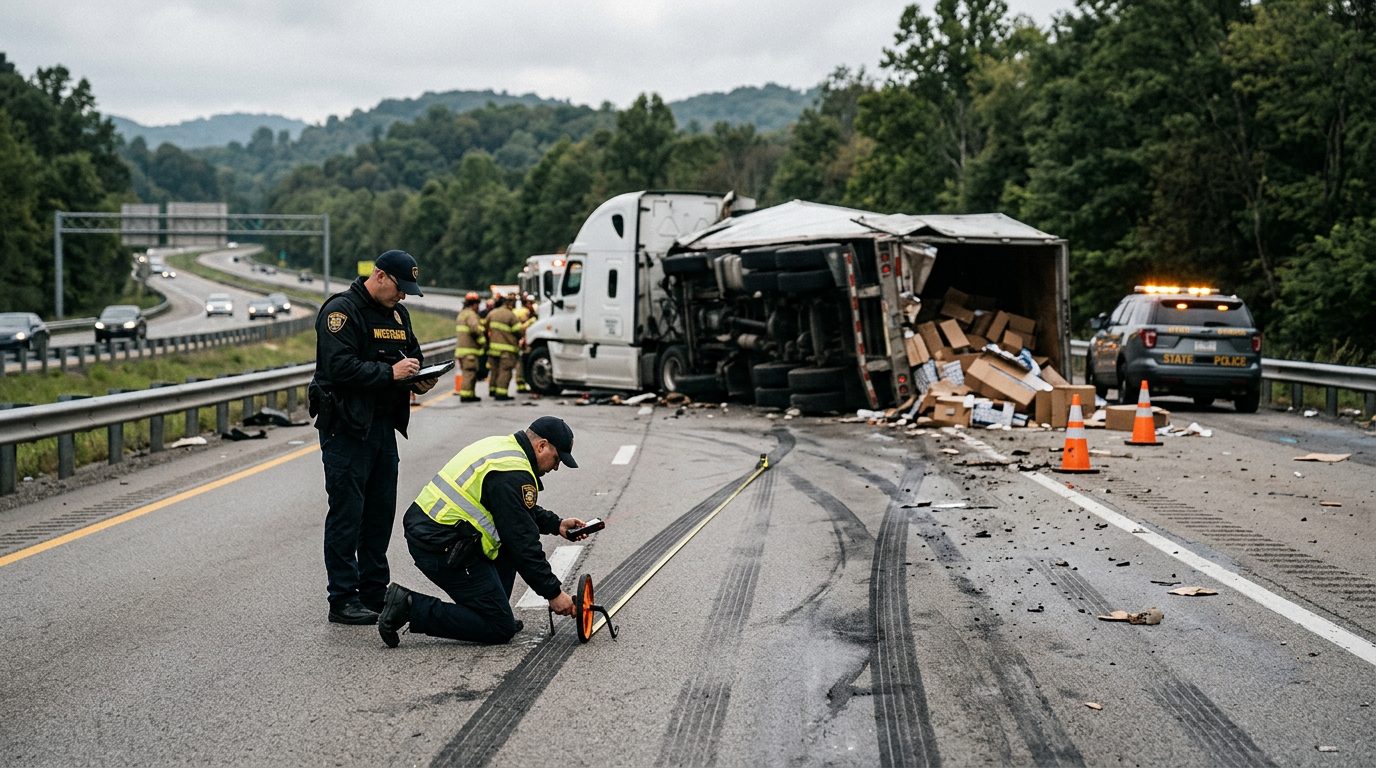
Wrongful Death | Truck Accidents
When a Truck Crash Takes a Life
We help West Virginia families pursue claims against trucking companies and other liable parties after a fatal accident.
Published October 08, 2026
Wrongful Death from a Truck Accident in West Virginia: What Families Need to Know
When a truck accident kills a family member, and another party’s negligence or wrongdoing may be to blame, West Virginia law allows a wrongful death claim for compensation, which the deceased’s personal representative must bring. This guide explains what families can recover, who can file, and how the process works.
Not sure what your next step is?
Talk it through with our team — the first case review is free, confidential, and carries no obligation.
What Is a Wrongful Death Claim from a Truck Accident?
A wrongful death claim is a civil lawsuit filed by surviving family members when a truck crash causes someone’s death through negligence, recklessness, or misconduct by the truck driver, trucking company, or another party.
Unlike a criminal case, a wrongful death claim seeks financial compensation for the family’s losses—not punishment of the wrongdoer. The claim arises when the defendant’s actions or failures directly caused the fatal accident. For example, if a truck driver was speeding, fatigued, or impaired, or if a trucking company failed to maintain the vehicle or hired an unqualified driver, that negligence can form the basis of a wrongful death action.
Who Can File a Wrongful Death Claim in West Virginia?
West Virginia law requires that a wrongful death action be brought by the personal representative of the deceased person’s estate—usually the executor or administrator appointed by a probate court.
The personal representative files the claim on behalf of eligible family members, who may include:
- The surviving spouse
- Children (including adopted and stepchildren)
- Parents of the deceased
- Siblings
- Any person who was financially dependent on the deceased at the time of death
The court distributes any recovery according to West Virginia law and the family’s circumstances. The will or the state’s laws of descent and distribution control only if there are no survivors in the categories above.
Time matters. The personal representative must bring the claim within two years after the death, subject to the provisions of W. Va. Code § 55-2-18. Waiting longer may bar the claim. Immediate steps—preserving evidence, obtaining the accident report, and documenting losses—are critical.
What Does a Wrongful Death Claim Cover?
West Virginia wrongful death damages include both economic losses and non-economic harm:
Economic damages: – Medical and hospitalization expenses incurred from the injury before death – Reasonable funeral and burial costs – Lost income the deceased would have earned over their lifetime – The value of services, care, and protection the deceased provided to family members
Non-economic damages: – Sorrow, mental anguish, and solace—including the loss of the deceased’s society, companionship, comfort, guidance, and advice – Loss of consortium for a surviving spouse (the loss of services, society, companionship, and marital relations) – Pain and suffering of the deceased if they survived briefly after the crash
Punitive damages may be available only if the plaintiff proves by clear and convincing evidence that the truck driver or company acted with actual malice or conscious, reckless and outrageous indifference to the health, safety and welfare of others. These damages are designed to punish the wrongdoer and deter similar conduct.
West Virginia Wrongful Death Statute and Timeline
West Virginia Code § 55-7-6 governs wrongful death claims. The statute sets a two-year deadline from the date of death to file the claim, subject to the provisions of W. Va. Code § 55-2-18. Missing this deadline may bar recovery.
In some cases, an exception to this deadline may apply. However, relying on this exception is risky and requires immediate legal advice.
Why timing is critical: Evidence deteriorates, witnesses’ memories fade, and documents are lost or destroyed. Acting quickly preserves the strongest possible case.
How Truck Accidents Lead to Wrongful Death Claims
Truck accidents often result in wrongful death claims because of the severity of injuries and the multiple parties who may bear responsibility:
Driver negligence: – Speeding, aggressive driving, or tailgating – Fatigue or falling asleep at the wheel – Distracted driving (phone use, eating, etc.) – Impaired driving (alcohol, drugs, or prescription medications) – Failure to follow traffic laws or adjust for weather and road conditions
Trucking company liability: – Hiring drivers with poor safety records or failing to conduct adequate background checks – Inadequate driver training or supervision – Pressure to violate hours-of-service rules, forcing drivers to work while fatigued – Failure to maintain the truck (brakes, tires, coupling devices, etc.) – Failure to repair known defects or safety violations
Mechanical failure: – Brake failure, tire blowouts, or steering defects – Coupling device failures – Lighting or visibility defects – Cargo securement failures
Cargo issues: – Improperly loaded or secured cargo that shifts or falls during transit – Overloaded trucks exceeding safe weight limits
Third-party liability: – Other vehicles or drivers who contributed to the crash – Road maintenance failures or hazardous conditions
Often, multiple defendants are liable—both the driver and the trucking company, for example. This complexity is why truck accident wrongful death cases require thorough investigation and detailed professional analysis.
Have questions about what happened?
Ask our team directly. The first conversation is free, confidential, and there is no obligation to continue.
What to Expect: The Wrongful Death Claim Process
Understanding the steps ahead can help families prepare emotionally and practically:
1. Initial case review Big Bubba listens to your story and evaluates whether a viable wrongful death claim exists. We ask detailed questions about the accident, the deceased, and the family’s losses.
2. Investigation We gather the accident report, witness statements, truck maintenance and inspection records, the driver’s logbook and history, dashcam or surveillance footage, and any other evidence relevant to liability and damages.
3. Identifying liable parties We determine whether the truck driver, trucking company, cargo loader, maintenance contractor, other vehicles, or other parties bear responsibility.
4. Calculating damages We work with economists, medical professionals, and other qualified professionals to quantify the family’s losses—both economic (lost income, medical costs) and non-economic (loss of companionship, pain and suffering).
5. Negotiation We attempt to reach a fair settlement with the trucking company’s insurance carrier and other defendants. Many cases resolve at this stage.
6. Litigation If settlement negotiations fail, we prepare the case for trial, including professional testimony, witness depositions, and legal motions.
7. Recovery and distribution If we recover compensation through settlement or judgment, the personal representative distributes it to eligible family members according to West Virginia law.
No upfront costs. Big Bubba handles wrongful death cases on a contingency basis—your family pays nothing unless we recover compensation. Court costs and case expenses are the client’s responsibility.
Why Truck Accident Wrongful Death Cases Are Complex
Truck accident wrongful death claims involve unique challenges that require careful, thorough legal representation:
Multiple parties and layers of liability Truck drivers, trucking companies, cargo loaders, maintenance contractors, and other parties may all share responsibility. Each defendant has its own insurance and legal team.
Federal regulations The trucking industry is heavily regulated by the Federal Motor Carrier Safety Administration (FMCSA). Whether a violation of federal safety rules matters depends on the facts of each case. For example, a driver disqualified for driving under the influence or a company that failed to repair known vehicle defects before putting the truck back on the road may face liability, depending on the facts.
Large insurance policies Trucking companies carry substantial liability coverage—federal rules set minimum coverage amounts that vary with the type of cargo hauled. Large policies mean aggressive defense by well-funded legal teams.
Evidence preservation urgency Truck data recorders, GPS systems, electronic logbooks, maintenance records, and driver records must be preserved immediately. Trucking companies can destroy or lose this evidence if not secured quickly through legal holds.
Expert testimony Accident reconstruction professionals, medical professionals, and economists are often essential to prove liability and quantify damages.
Comparative fault West Virginia law allows recovery even if the deceased was partially at fault—but only if the deceased’s fault does not exceed the combined fault of all other parties. How fault is shared among those involved can affect what a family may recover, and these questions are often complex. This requires careful analysis of each party’s conduct.
Common Questions About Wrongful Death Truck Accident Claims
Q: Can we file a wrongful death claim if the truck driver was also killed in the crash?
Yes. The driver’s death does not prevent a claim against the trucking company or other liable parties, which the personal representative brings on the family’s behalf. Under W. Va. Code § 55-7-13d, a company may be held liable for the share of fault assigned to a driver who was acting as its agent or servant.
Q: What if the deceased was partly responsible for the accident?
West Virginia’s comparative fault rule allows recovery even if the deceased was 50% or less at fault. Under W. Va. Code § 55-7-13c, the award is reduced in proportion to the deceased’s degree of fault, and if the deceased’s fault is greater than the combined fault of all other persons responsible, the claim is barred.
Q: How long does a wrongful death case take?
Timeline varies widely. Some cases settle within months; others take years if litigation becomes necessary. Complex cases involving multiple defendants, federal regulations, and substantial damages often require longer investigation and negotiation.
Q: What if we can’t afford an attorney?
Big Bubba handles wrongful death cases on a contingency basis. Your family pays no attorney’s fees unless we recover compensation. Court costs and case expenses remain your responsibility.
Q: Who receives the compensation?
The personal representative receives the award and distributes it as provided in W. Va. Code § 55-7-6.
How Big Bubba Handles Wrongful Death Truck Accident Cases
Immediate action We move quickly to preserve evidence—truck data, maintenance records, driver files, and witness statements—before the trucking company or insurance company can lose, alter, or destroy them.
Thorough investigation We examine the truck’s maintenance history, the driver’s qualifications and safety record, company policies and training, electronic logbooks and hours-of-service compliance, and the circumstances of the crash itself.
Expert network We work with accident reconstructionists, medical professionals, economists, and other qualified professionals to build a compelling case and quantify your family’s losses.
Aggressive advocacy We stand up to large insurance companies and trucking industry defendants on behalf of grieving families.
Compassionate approach We understand the grief, shock, and financial strain your family faces. We guide you through every step and answer your questions plainly.
Full recovery focus We pursue all available damages—economic and non-economic—and explore every source of liability to maximize compensation for your family.

Want to know where you stand?
Tell us what happened and our team will walk you through the options available to you, at no cost.
Serving Families Across West Virginia
We serve wrongful death victims and their families throughout all 55 West Virginia counties, including Charleston, Huntington, Morgantown, Wheeling, Martinsburg, Parkersburg, Beckley, Clarksburg, Fairmont, Weirton, and beyond. No matter where the fatal truck accident occurred in West Virginia, Big Bubba can help your family pursue justice and compensation.
If a truck accident took your loved one’s life and you believe another party’s negligence caused the death, reach out to Big Bubba for a free case review. We’ll listen to what happened, answer your questions, and explain your family’s legal options. Call us or request a case review online today.
Related practice areas
- Truck Accident Claims in West Virginia | Big Bubba Legal