
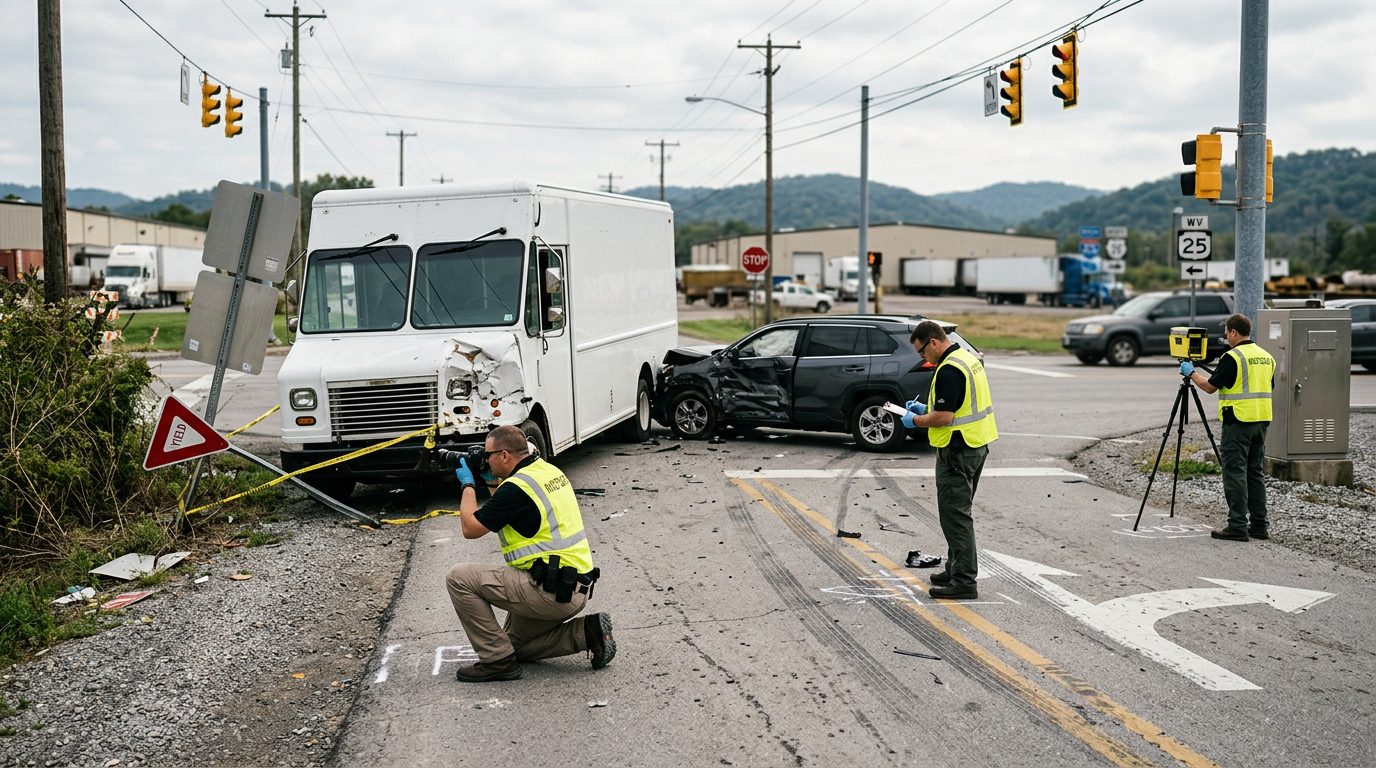
Wrongful death · Truck crashes · West Virginia
Losing a Loved One in a Truck Crash: A Step-by-Step Guide
A plain-language guide for West Virginia families. Learn what often comes next and how the firm can help you understand your options.
Published November 6, 2026
A wrongful death truck crash claim in West Virginia is a civil case brought after someone dies because of another party’s wrongful act, neglect, or default. Most families face the same steps in the same order. Knowing that order can make a hard time a little clearer.
If you are reading this after a fatal crash, you may be grieving and handling many tasks at once. That is a heavy load. This guide explains each step in plain words, who usually acts at each stage, and what comes next.
What a Wrongful Death Claim Is and Who Can Bring One
A wrongful death claim is a civil lawsuit for damages after a death caused by another party’s wrongful act, neglect, or default. West Virginia law says a person or company may be liable for damages in that situation, even though the injured person has died. West Virginia Code § 55-7-5 sets out this rule.
A criminal case against a driver is generally a separate matter. A civil claim asks for money damages for the family. It does not decide whether anyone is charged with a crime.
The claim is brought by the personal representative of the deceased person’s estate. That person must be duly appointed. West Virginia Code § 55-7-6 sets this rule. Any money recovered is then divided among the people the jury or court identifies; if there are no such survivors, the damages are distributed in accordance with the decedent’s will or, if there is no will, in accordance with the laws of descent and distribution. That may include a surviving spouse, children, parents, brothers, sisters, or people who depended on the person financially.
If you are the one holding this process together, you don’t need to sort out every role on the first day.
If a truck crash took someone you love, you don't have to work through these steps alone. The firm can talk with you about your situation. Talk it through with Big Bubba — the first case review is free, confidential, and carries no obligation.

Step 1: Protect Information and Ask for Records Early
In the first days, the family can write down what they know and ask that key records be kept.
Who acts: The family. The personal representative takes over later.
What it needs: The responding agency and officer names, report numbers, witness names and phone numbers, the trucking company’s name from the truck or paperwork, and any photos someone took at the scene.
Trucking companies keep records that matter in these cases. These can include driver files, hours-of-service logs, dispatch messages, maintenance files, and post-accident test records. Under 49 C.F.R. § 391.51, a motor carrier keeps a driver qualification file for as long as the driver works there and for three years after.
Federal rules also let carriers keep records by any technology that accurately reflects the information and stays accessible. See 49 C.F.R. § 379.7.
A written preservation request asks the carrier, in writing, to keep these records. Whether one is needed in a given case depends on the facts.
Next: Get the crash report.
Step 2: Get the Crash Report
The crash report is usually requested from the agency that investigated the crash, such as the West Virginia State Police or a local police department.
Who acts: The family or the personal representative.
What it needs: The date, time, and location of the crash, plus names and a report number if you have them. The agency may require a request form and identification. Requirements vary by agency.
A typical report lists the parties and vehicles. It often includes a diagram, the officer’s narrative, and any citations. The report records what the officer observed and was told. It is not a final decision about who was at fault, so read it with that in mind.
Errors in names, times, or vehicle details are worth raising early. Those details can matter later when records are compared.
Next: Use the report to see which vehicles and companies are named. That information shapes the next step.
Step 3: Identify Who May Be Responsible
In a wrongful death truck crash, more than one party may share responsibility. The facts decide who is involved.
Who acts: The family and the firm, working from the records.
What it needs: The crash report, the names of the vehicle owners and carriers, and any paperwork that shows who loaded or maintained the truck.
Parties that may be involved include the driver, the motor carrier, the vehicle owner, a cargo loader, or a maintenance contractor. Some truck accident cases involve questions about how a company screened and supervised its drivers, depending on the facts. McCormick v. West Virginia Department of Public Safety is one example.
Records often examined include hours-of-service logs, equipment maintenance, driver training, and drug and alcohol testing. Federal rules limit driving time. Except as otherwise provided in § 395.1, a driver of a property-carrying commercial motor vehicle may not drive after a period of 14 consecutive hours after coming on duty following 10 consecutive hours off duty. See 49 C.F.R. § 395.3.
Some insurers may dispute a claim. Family members may get calls from insurance representatives. It helps to take notes and ask for details in writing.
Next: Appoint the personal representative.
Step 4: Appoint a Personal Representative
A wrongful death claim is generally filed by a personal representative who has been appointed for the deceased person’s estate.
Who acts: The family, through the probate process.
What it needs: Documents the court asks for, such as a death certificate and any will. The court also needs to know who the heirs are.
The appointment usually runs through probate. The exact steps depend on whether there is a will and on the family’s situation. If the representative was appointed in another state, West Virginia Code § 55-7-6 requires the representative to post bond, at the time of filing of the complaint, with a corporate surety authorized to do business in this state, in the sum of $100, which the circuit court may increase or decrease for good cause.
The representative acts for the people the law names as beneficiaries. Each family member should know who is included and why. That clears up confusion later.
Next: Watch the filing deadline.
Step 5: Watch the Filing Deadline
West Virginia generally allows two years from the date of death to file a wrongful death action, and exceptions may apply (W. Va. Code § 55-7-6).
Who acts: The personal representative, with the family’s help.
The date of death, since the wrongful death filing period runs from the death under W. Va. Code § 55-7-6(d), subject to the provisions of section eighteen, article two, chapter fifty-five. W. Va. Code § 55-7-6 reads: “The provisions of this section shall not apply to actions brought for the death of any person occurring prior to July 1, 1988.”
The filing period is subject to section eighteen, article two, chapter fifty-five, which may change how it is counted.
If a government vehicle or agency may be involved, a different statute applies. Under West Virginia Code § 29-12a-6, a lawsuit against a political subdivision for damages for injury, death, or loss to persons or property allegedly caused by an act or omission in connection with a governmental or proprietary function shall be brought within two years after the cause of action arose or after the injury, death or loss was discovered or reasonably should have been discovered, whichever last occurs, or within any applicable shorter period the code provides. For a minor who was under the age of ten at the time of the injury, the action shall be commenced within that two-year period or before the minor’s twelfth birthday, whichever provides the longer period. These limitation periods are tolled for any period during which the political subdivision or its representative has committed fraud or collusion by concealing or misrepresenting material facts about the injury. It may also set a shorter period that applies.
Missing a deadline may prevent a claim from going forward. That is why early review matters.
Next: Gather proof of losses.
Not sure what your next step is?
Talk it through with Big Bubba — the first case review is free, confidential, and carries no obligation.
Step 6: Gather Proof of Losses and Family Impact
A claim may address losses such as medical care, funeral expenses, lost income, and the loss of the person’s help and companionship.
Who acts: The family, with the personal representative.
What it needs: Bills, pay stubs, tax returns, receipts, and a written list of what the person did for the family each day.
West Virginia law lists damages a jury may consider. These include sorrow, mental anguish, and solace, which may cover companionship, comfort, guidance, and advice. The law also lists reasonably expected loss of income and of services, care, and assistance the person provided. See West Virginia Code § 55-7-6.
The same statute covers expenses for care, treatment, and hospitalization from the injury. It also covers reasonable funeral expenses.
Start the daily contributions list early. Include driving, childcare, repairs, and help with bills. Families often forget these details once the first weeks pass.
Which categories apply depends on who the beneficiaries are and what the family can document.
Next: Understand how fault is decided.
Step 7: Understand How Fault Is Decided
Under W. Va. Code § 55-7-13a, comparative fault means the degree to which a person’s fault was a proximate cause of an alleged personal injury, death, or damage to property, expressed as a percentage. Under W. Va. Code § 55-7-13c(c), recovery is barred when the plaintiff’s fault is greater than the combined fault of all others, and under § 55-7-13a, the liability of each person who proximately caused the damages, including plaintiffs, defendants and nonparties, is allocated in direct proportion to that person’s percentage of fault.
Who acts: The firm and the personal representative review fault together, using the records.
What it needs: The crash report, witness statements, vehicle data, and carrier records.
Under West Virginia Code § 55-7-13c, fault charged to the plaintiff does not bar recovery unless it is greater than the combined fault of everyone else. If it is less, the recovery is reduced in proportion. Liability for compensatory damages is several only, meaning each defendant pays its own share, except that joint liability may be imposed on two or more defendants who consciously conspire and deliberately pursue a common plan or design to commit a tortious act or omission. Under West Virginia Code § 55-7-13c, a defendant whose driving under the influence is a proximate cause of the plaintiff’s damages is jointly and severally liable.
A defendant may also name a nonparty as partly at fault. West Virginia Code § 55-7-13d sets a window for that notice. Under W. Va. Code § 55-7-13d, fault of a nonparty is considered if the plaintiff entered into a settlement agreement with the nonparty or if a defending party gives notice no later than one hundred eighty days after service of process upon said defendant that a nonparty was wholly or partially at fault.
Federal rules also set timing for post-crash alcohol tests. If a test is not given within two hours, the employer must keep a record of the reasons. See 49 C.F.R. § 382.303.
Each case turns on its own facts.
Next: Review the steps in order.

What Happens Next
The steps run in order. Protect information, get the crash report, identify the parties, appoint a personal representative, track the deadline, gather proof, and review fault.
A family may be reading this during one of the hardest weeks of their lives. Not everyone is ready to act yet. You can take these steps in your own time.
If a truck crash took someone you love, you can call the firm about your case or request a free case review through our contact page. We handle truck accident and wrongful death claims. You can ask questions about each step.
Common Questions
Who starts a wrongful death truck crash claim in West Virginia?
The claim is generally brought by the personal representative of the deceased person’s estate, once appointed. West Virginia Code § 55-7-6 sets that rule.
Does a criminal case have to finish before a civil claim?
A criminal case and a civil claim are generally separate matters. Each one follows its own process.
What records should the family ask a trucking company to keep?
Driver qualification files must be kept while the driver works for the carrier and for three years after. See 49 C.F.R. § 391.51. Other records, such as logs and dispatch messages, may need a written request.