
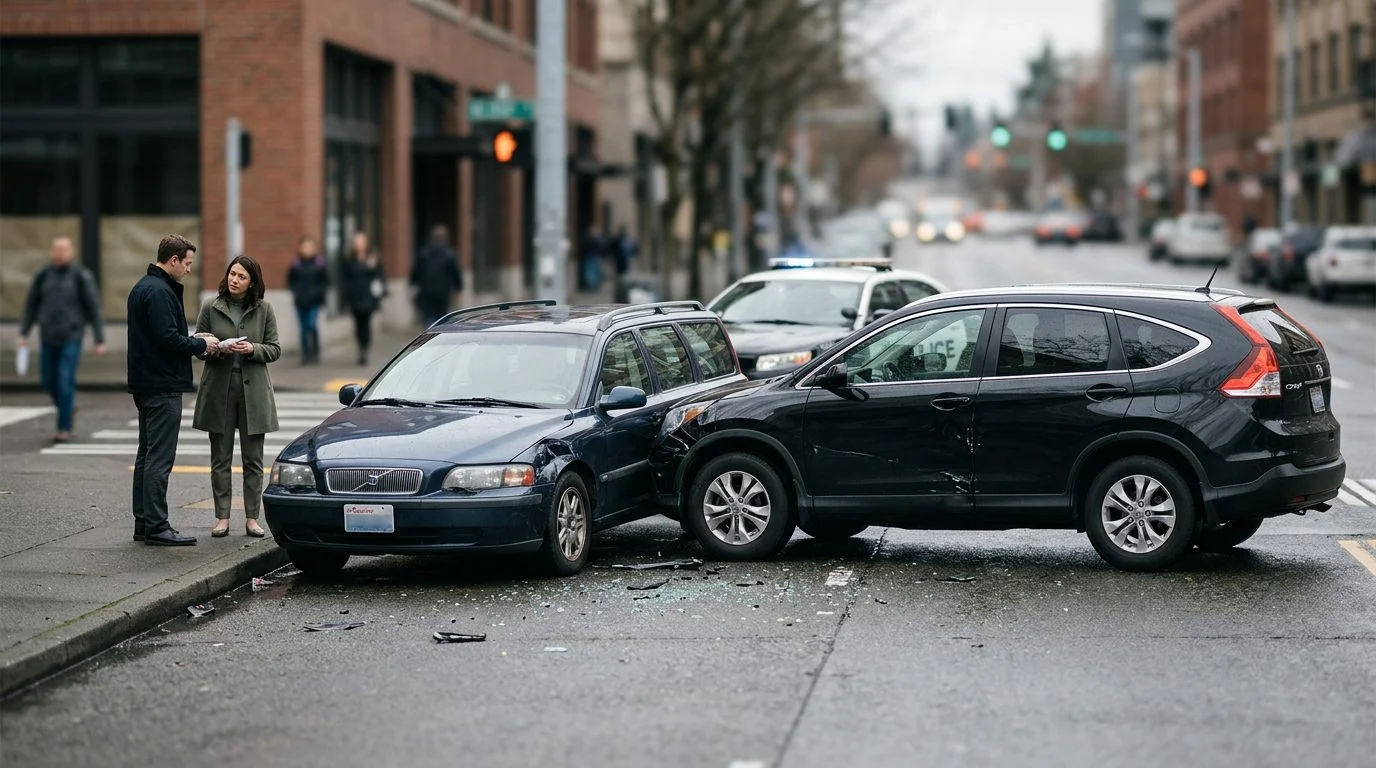
Understanding Auto Negligence
What Is Auto Negligence? Four Elements Explained
Learn how negligence is proven in car and truck crash cases across West Virginia.
Published October 05, 2026
What Is Auto Negligence? Four Legal Elements Explained
Auto negligence is when a driver fails to exercise reasonable care while driving, and that failure causes harm to another person. It’s the legal foundation for holding a driver responsible for a crash and the injuries or deaths that result. Negligence isn’t the same as an accident—an accident can happen without negligence, and negligence can occur even in a minor crash.

If you or a family member were hurt in a crash and you're trying to understand whether the other driver was at fault, reach out to tell us what happened. Talk it through with our team — the first case review is free, confidential, and carries no obligation.
What does auto negligence mean?
Auto negligence means a driver broke a legal duty to drive safely, and that breach caused injury or loss to someone else. In West Virginia, every person behind the wheel has a responsibility to operate their vehicle with reasonable care and to follow traffic laws. When a driver ignores that responsibility and someone gets hurt, negligence may have occurred, but the carelessness must also have caused the harm, and West Virginia predicates recovery on principles of comparative fault.
The key distinction: an accident is simply an unforeseeable event; negligence is carelessness or recklessness that causes harm. A driver might swerve to avoid a deer and hit another car—that’s an accident. A driver texting while driving drifts into another lane and causes a collision—that’s negligence.
What are the four elements of negligence?
To prove auto negligence, all four legal elements must be present. If even one is missing, the negligence claim fails. Here’s what must be established:
Element 1: Duty of Care
Every driver on a West Virginia road has a legal obligation to operate their vehicle safely and obey traffic laws. This duty extends to pedestrians, cyclists, passengers, and other drivers. The duty requires a driver to pay attention, maintain control of the vehicle, follow speed limits, signal turns, and avoid dangerous maneuvers.
Element 2: Breach of Duty
The driver violated that duty through reckless, careless, or illegal conduct. Common breaches include:
- Speeding or driving too fast for conditions
- Texting, talking on a phone, or other distracted driving
- Driving under the influence of alcohol or drugs
- Running red lights or stop signs
- Failing to yield the right of way
- Reckless lane changes or improper passing
- Falling asleep at the wheel
- Aggressive driving or road rage
- Failure to maintain the vehicle (bad brakes, bald tires)
Element 3: Causation
The driver’s breach directly caused the crash and the injuries that followed. This is called the “but for” test: but for the negligent conduct, the crash would not have happened. Causation also requires showing that the breach caused the specific injuries claimed—not just that an accident occurred, but that this driver’s conduct led to this harm.
Element 4: Damages
The injured person suffered real, measurable harm. Damages include:
- Economic losses: medical expenses, rehabilitation costs, lost wages, and future earning capacity
- Non-economic losses: pain and suffering, emotional distress, and loss of enjoyment of life
- In wrongful death cases: the loss of the deceased’s financial support and companionship
Gross negligence vs. ordinary negligence
Most car accident cases involve ordinary negligence—the failure to exercise reasonable care. Gross negligence is more extreme. It’s conduct that shows a reckless disregard for the safety of others, such as extreme speeding, driving under the influence, or street racing.
The distinction can matter because the legal consequences may differ between the two. In ordinary negligence cases, the focus is on compensating the injured person for their losses.
Not sure what your next step is?
Talk it through with our team — the first case review is free, confidential, and carries no obligation.
How comparative negligence works in West Virginia
West Virginia follows a modified comparative negligence rule. Under W. Va. Code § 55-7-13c, an injured person can still recover damages even if they were partially at fault for the crash—as long as their fault does not exceed 50%.
Here’s how it works: if you were 30% at fault and the other driver was 70% at fault, you can recover 70% of your damages. If you were 50% at fault, you can still recover 50% of your damages. But if you’re found to be more than 50% at fault, you cannot recover anything.
Under this rule, once your share of fault passes the halfway point, recovery is barred entirely. The percentage of fault assigned to each party directly affects the final settlement or judgment amount.
Collecting evidence to prove negligence
Proving all four elements requires evidence. Here’s what matters:
- Police reports document the officer’s findings about how the crash occurred and may cite traffic violations
- Witness statements provide independent accounts of what happened before, during, and after the crash
- Photographs and video of the crash scene, vehicle damage, and road conditions help establish what occurred
- Medical records connect the injuries to the crash and document the harm suffered
- Cell phone records, traffic camera footage, and vehicle data recorders can show distracted driving or excessive speed
- Expert testimony may be needed to explain how the crash happened and why the defendant’s conduct was negligent
The strength of this evidence directly affects whether negligence can be proven and the value of your claim.
Why negligence matters to your claim
Establishing negligence is the foundation of a car accident claim. Without it, there is no basis for recovery. Understanding the four elements helps you recognize whether you have a valid claim and what information to preserve after a crash.

Have questions about what happened?
Ask our team directly. The first conversation is free, confidential, and there is no obligation to continue.
Frequently asked questions
What’s the difference between negligence and an accident?
An accident is an unforeseeable event that occurs without anyone’s fault. Negligence is carelessness or recklessness that causes harm. A crash can be an accident without negligence, or it can involve negligence.
Can I recover damages if I was partly at fault?
Yes, in West Virginia. As long as you’re not more than 50% at fault, you can recover damages reduced by your percentage of fault (W. Va. Code § 55-7-13c).
What counts as a breach of duty?
Any conduct that violates traffic laws or fails to meet the standard of reasonable care—speeding, distracted driving, running a red light, driving under the influence, or failing to yield.
Do I need an expert to prove negligence?
Not always, but expert testimony is often valuable in complex cases to explain how the crash occurred and why the defendant’s conduct was negligent.
What if the other driver was cited by police?
A traffic citation is strong evidence of a breach of duty, but negligence still requires proof of all four elements—duty, breach, causation, and damages.
If you or a family member were hurt in a crash and you’re trying to understand whether the other driver was at fault, reach out to tell us what happened. We can review your situation at no cost through a free case review.
Related practice areas
- Wrongful Death Claims After a Crash in West Virginia
- Brain Injury Claim After Commercial Vehicle Accident WV