
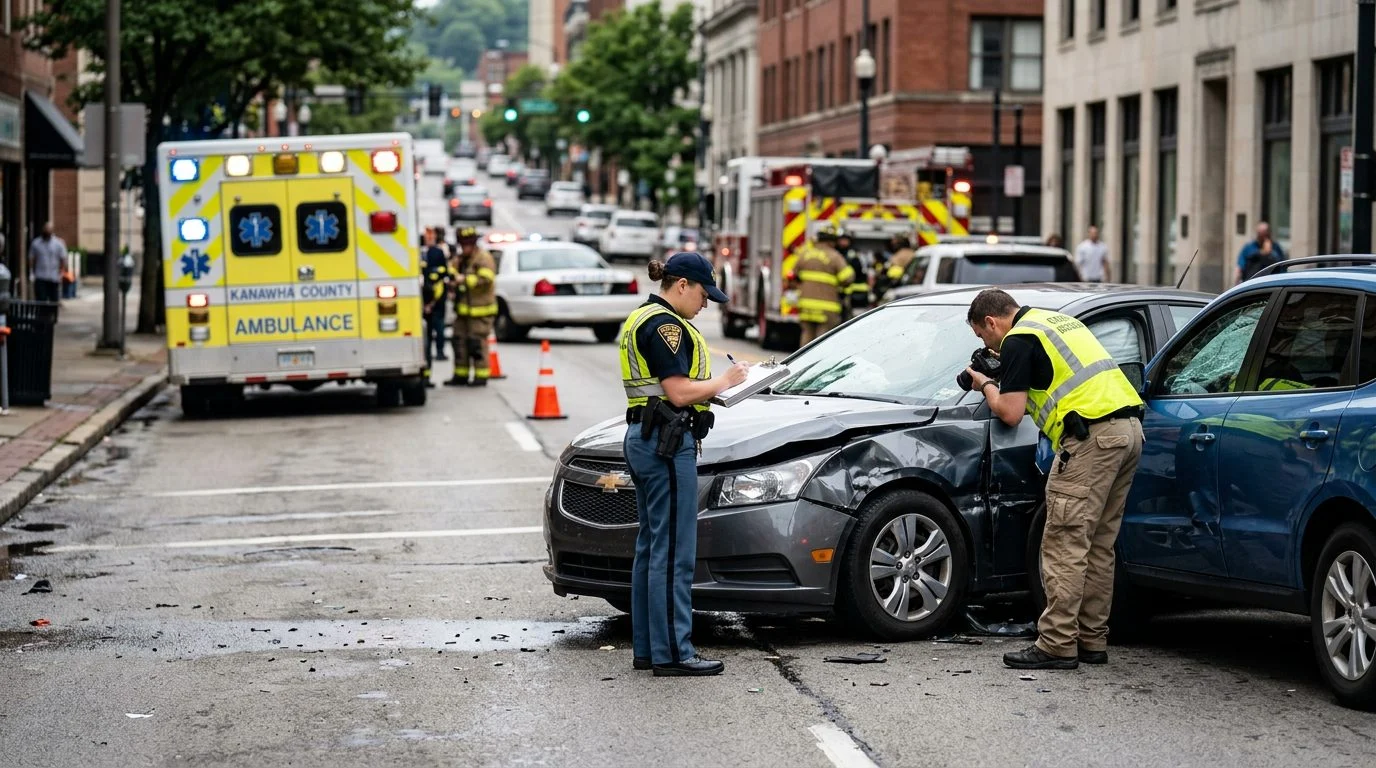
West Virginia Car Accident Claims
How Fault Works in a West Virginia Car Accident
Learn how fault generally shapes who may be responsible for injuries after a crash, and why the facts of each crash matter. Exceptions may apply.
Published October 13, 2026
Understanding West Virginia car accident fault liability starts with one question: who caused the crash? Under West Virginia law, fault generally shapes who may be responsible for injuries and losses. This page explains how those rules generally work. Exceptions may apply depending on the facts of each crash.
What Fault Means in a West Virginia Car Accident Claim
Fault generally means a person’s act or failure to act caused the crash or the harm from it. The state defines fault to include negligence, which is careless conduct under the law. The definitions in W. Va. Code § 55-7-13b explain how terms such as “compensatory damages,” “defendant,” “fault,” and “plaintiff” are used in that article.
Speeding, running a red light, or driving while distracted can be relevant to fault. Whether any of these happened in a specific crash depends on the facts.
A crash alone does not establish fault. Police reports, insurers, and courts each look at the evidence. A court decides fault only if a case reaches that point. Several people may share responsibility for one crash, so fault is often a question of degree.
For a broader view of the claim process, read car accident claims in West Virginia.
Not sure what your next step is?
Talk it through with our team — the first case review is free, confidential, and carries no obligation.
Is West Virginia a No-Fault State?
West Virginia is generally treated as a fault-based state for injury claims. Responsibility for injuries generally follows who caused the crash. The state’s comparative fault statute says recovery in a personal injury action is generally predicated on comparative fault. W. Va. Code § 55-7-13a defines “comparative fault” as the degree to which a person’s fault was a proximate cause of an alleged personal injury, death, or property damage, expressed as a percentage.
The term “no-fault” describes a different approach. Some insurance policies include coverage that pays certain costs regardless of who caused a crash. Whether a policy includes that kind of coverage depends on its terms and on the facts of the claim.
Insurance coverage is not the same as legal fault. A person’s own policy may respond in some situations and not others. Always check the actual policy language, because exceptions may apply.
How Comparative Negligence Generally Works in West Virginia
West Virginia generally uses a modified comparative negligence rule (W. Va. Code § 55-7-13c). Comparative negligence means shared fault. Each person’s share of fault is expressed as a percentage, and those percentages generally total 100 percent for a single incident.
Under W. Va. Code § 55-7-13c, a plaintiff’s own fault generally does not bar recovery unless it is greater than the combined fault of all other persons responsible for the damages. If the plaintiff’s fault is smaller than that combined fault, recovery is generally reduced by the plaintiff’s share. Exceptions may apply depending on the facts.
Many people worry that any share of fault ends a claim. The percentages and the facts decide the result in each situation.
Percentages are not automatic. They depend on the evidence presented. In a case that reaches trial, the judge or jury assigns them. The same facts may be weighed differently by different decision makers.
Who May Be Liable After a Crash
More than one person or company may be potentially liable after a crash, depending on the facts. Under W. Va. Code § 55-7-13c, a defendant’s liability for compensatory damages is generally several only, not joint. That means each defendant is generally responsible for its own percentage of fault.
Joint liability is generally limited to defendants who consciously conspire to commit a wrongful act. The same section also lists certain circumstances, such as some impaired-driving cases, where a defendant may be jointly and severally liable. Whether those circumstances apply depends on the facts.
A defendant may also name a nonparty it believes was at fault. Under W. Va. Code § 55-7-13d, that notice generally must be given no later than one hundred eighty days after service of process.
Commercial vehicle cases can involve more parties. Under W. Va. Code § 55-7-32, an “employer defendant” can include the vehicle’s owner, the operator’s employer, or a person who holds legal control over the vehicle. That statute also limits certain noneconomic damages in some cases, with listed exceptions. Whether any employer or company is liable depends on the facts.
Big Bubba Injury Law can describe the legal process for identifying potentially responsible parties. It does not promise that every responsible party will be found.
Have questions about what happened?
Ask our team directly. The first conversation is free, confidential, and there is no obligation to continue.
Evidence That May Be Relevant to Fault
Evidence can be relevant to fault, but no single item settles it. Depending on the facts, the following may matter: the police or crash report, photographs of vehicles and the roadway, vehicle damage patterns, and names and statements of witnesses. Traffic camera or dash camera footage may also be relevant if it exists.
Medical records can matter too, especially when they describe how an injury happened. In some cases, phone records or electronic vehicle data may be relevant. Whether any of these exist, and whether they matter, depends on the crash.
Acting early may help in some cases. Photos, footage, and witness memories can change or become harder to obtain over time. Preserving what you have is generally a sensible step.
For immediate steps after a crash, read what to do first after an accident.
Fault Questions After a Hit-and-Run or Uninsured Crash
When the other driver leaves the scene or has no insurance, fault questions still matter. The options generally depend on available coverage and the policy terms. Under W. Va. Code § 33-6-31, motor vehicle policies generally must include an endorsement or provisions that pay the insured sums the insured is legally entitled to recover from an uninsured motor vehicle’s owner or operator. The limits and terms depend on the policy.
The same statute describes notice requirements for hit-and-run situations. An insured may be required to notify the insurer within sixty days after the accident that a claim exists against an unidentified person. Whether this requirement applies, and any exceptions, depend on the policy and the facts.
Criminal consequences for leaving a crash scene are set by separate law. This page does not describe penalties. A civil claim and a criminal case are generally separate matters.
For related reading, see Erin’s law in West Virginia.
Insurance Claims and Being Told You Were at Fault
An insurer’s fault assessment is generally not the same as a court’s finding of fault. A fault decision in a claim file is not a final legal ruling unless it is adopted in litigation. Fault is ultimately a question of the facts and the applicable law.
You may ask an insurer what information supports its fault assessment. The answer depends on the claim, the policy, and the facts. Keep copies of any letters, reports, and statements you receive.
West Virginia law also sets limits on certain claims against insurers. Under W. Va. Code § 33-11-4a, a third-party claimant generally may not bring a private cause of action for an unfair claims settlement practice. The sole remedy stated in that section is an administrative complaint with the Insurance Commissioner. The same section says a good faith disagreement over the value or liability of a claim is not an unfair claims settlement practice.

Want to know where you stand?
Tell us what happened and our team will walk you through the options available to you, at no cost.
When Fault Is Disputed
Fault and liability generally depend on the facts, the evidence, and West Virginia law. Exceptions may apply, so each situation needs its own review. A crash where fault is unclear, or where you were told you were partly at fault, is a common reason people look for answers.
A free case review is a confidential first conversation with no obligation to continue. During that review, the firm can look at the crash facts, the fault reported so far, and the possible parties. The review does not promise any result.
Big Bubba Injury Law handles car accidents, truck and commercial vehicle crashes, catastrophic injuries, traumatic brain injury, spinal cord injury, and wrongful death. A lawyer at the firm handles each case. We serve injury victims across West Virginia, including Charleston, Huntington, Morgantown, and Wheeling.
Is West Virginia a no-fault state for car accidents?
West Virginia is generally treated as a fault-based state for injury claims. Exceptions may apply, and insurance terms depend on each policy.
What is modified comparative negligence?
Under W. Va. Code § 55-7-13c, a person’s recovery is generally barred only if their fault is greater than the combined fault of others (W. Va. Code § 55-7-13c). A case in which the plaintiff’s fault equals the combined fault of others is generally not barred, and exceptions may apply depending on the facts. Any recovery is generally reduced by the person’s own share, and exceptions may apply.
Can an employer be liable in a truck accident?
It may be possible in some cases. Whether an employer or other company may be liable depends on the facts and the relationship involved.
Related practice areas
- Car Accidents in West Virginia
- ELD Logs Truck Crash West Virginia: Plain Guide
- Semi Truck Accident Injuries West Virginia | Big Bubba