
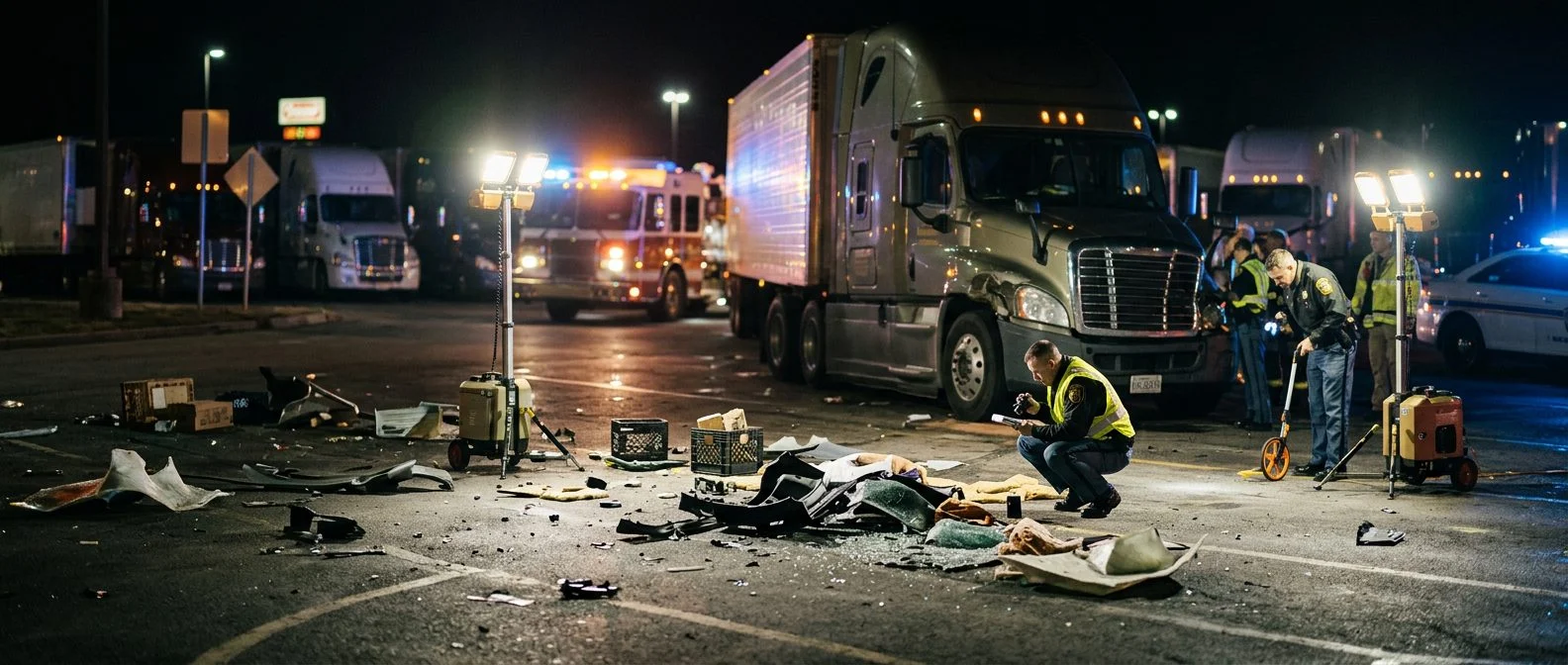
Truck Crash Claims Across West Virginia
Truck Crash Evidence in West Virginia: What to Keep
Commercial trucks generate records that can disappear quickly. Here is what to preserve after a crash, and how the firm can help you sort it out.
Published October 25, 2026
Evidence after a truck crash can disappear quickly, so start with what is most likely to be lost. Photograph the scene, collect witness names, and ask that the trucking company’s records be kept. This guide explains which evidence matters most, why timing counts, and what you can keep yourself. For more background, see our truck accident claims overview.
Why Evidence After a Truck Crash Can Disappear Quickly
Evidence after a truck crash can disappear quickly because it sits at the scene and inside the trucking company. The road changes within hours. Skid marks fade, debris gets cleared, and witnesses drive away.
The company’s files follow their own schedules. Federal rules require regulated companies to keep records for set minimum periods. After those periods, records may be destroyed at the discretion of each company’s management, under 49 C.F.R. § 379.3. A record that exists today may not exist a year from now.
Some electronic data can also be overwritten during routine operation. You don’t need to know the legal theory behind a claim to start protecting what you can. Start with what is in front of you.
If your truck crash left you hurt and you're worried that scene evidence or trucking records could be lost, we invite you to reach out for a free case review. Talk it through with Big Bubba — the first case review is free, confidential, and carries no obligation.

Photos and Video From the Crash Scene and Your Vehicle
Take photos of the scene and the truck as soon as it’s safe, and save the original files. Original files keep their date and time information, which helps show when each photo was taken.
Take wide shots first. Capture the road, lane positions, skid marks, debris, weather, and traffic signs or signals. Then take close shots of anything that shows how the crash happened.
Photograph the truck’s company name, DOT number, license plate, and trailer number. Photograph the damage to both vehicles. Also photograph your injuries, and repeat those photos over the next few days so changes show.
Watch for the load. The West Virginia Division of Motor Vehicles warns that unsecured vehicle cargo can cause serious or catastrophic crashes and injuries. If you saw a shifted or loose load, photograph it and write down where it was.
Back up your photos to a second place, such as a cloud account or another device. Hold off on repairing or selling your vehicle until someone has documented its condition.
Witness Names, Contact Details, and Nearby Video
Write down every witness’s name and phone number while the details are fresh. Note what each person says they saw, even if it seems small.
Include other drivers and passengers who were nearby. Note anyone who left the scene before police arrived, because those names may still matter later.
Ask nearby businesses, homes, and traffic camera operators whether they recorded the crash. Ask them to keep any footage. Recordings are often overwritten on a schedule, so a quick request matters.
Record the exact location, the time, and the direction each vehicle was traveling. Draw a simple sketch of the road or intersection. A short written timeline, made the same day, helps you keep these details straight.
The Police Crash Report and Your Own Notes
Ask the responding agency for the crash report number and a copy of the report once it is ready. Keep the number somewhere safe.
Read the report for errors. Check the vehicle details, direction of travel, lane, time, and the names of everyone involved. Look for missing witnesses too.
Write down any corrections you need. Keep a copy of every version you receive, and note the date you got it.
Make your own written timeline the same day if you can. Include where you were going, what you saw and heard, and what the driver or others said. A police report is a starting point, and your notes and photos can fill gaps it leaves out.
Medical Records That Connect Your Injuries to the Crash
Medical records are often the main link between the crash and your injuries, so keep every one. Keep every appointment too.
Gaps in treatment can be used to question how serious an injury was. If a doctor tells you to return, go back. If you miss a visit, write down why.
Keep emergency, imaging, surgery, rehabilitation, and other doctor records, along with discharge instructions. Ask each provider for copies of anything you don’t have.
For a traumatic brain injury or a spinal cord injury, keep a running log. Note headaches, memory or sleep changes, balance or mobility problems, and limits on work. Tell every provider exactly how the injury happened.
Keep bills, receipts, and records of time missed from work. Write down travel to and from appointments.
Trucking Company Records, Electronic Data, and Preservation Letters
A preservation letter is a written demand that a trucking company keep relevant evidence and not destroy or change it. A lawyer can send a letter of representation early in a claim.
Relevant company records can include electronic control module (ECM) data, electronic logging device (ELD) records, driver logs, dispatch messages, maintenance and inspection records, and driver qualification files. Driver qualification files can show what the company checked before it hired a driver.
Federal rules protect the original data. A motor carrier must not alter or erase, or permit or require alteration or erasure of, the original hours-of-service information, the source data streams used to provide it, or information contained in any ELD that uses the original information and HOS source data, under 49 C.F.R. § 395.30.
Under 49 C.F.R. § 382.303, for a required post-accident alcohol test, if the test is not administered within two hours following the accident, the employer must prepare and maintain on file a record stating the reasons it was not promptly administered; if it is not administered within eight hours, the employer must stop attempting the alcohol test and keep the same record. For a required controlled substances test, if it is not administered within 32 hours, the employer must stop attempting the test and keep a record stating the reasons it was not promptly administered.
Digital copies count, too. Federal rules allow records to be kept by any technology that accurately reflects the information and stays accessible, under 49 C.F.R. § 379.7.
Not sure what your next step is?
Talk it through with Big Bubba — the first case review is free, confidential, and carries no obligation.
What You Can Keep Yourself and What to Gather Early
Keep a dated journal, the damaged items from the crash, and every letter or statement connected to it. These three steps create a simple file you can hand over when needed.
Keep a dated journal of pain, symptoms, and missed activities. Also log every conversation with an insurer or the trucking company, with the date, the person, and what was said.
Keep damaged clothing and personal items in a safe place. Save phone photos and text messages about the crash.
Save letters, claim numbers, and any statement you have signed. Keep copies of everything.
Timing matters with insurers. Under W. Va. Code § 55-7-11a, within twenty days of a personal injury, no person may negotiate a settlement, seek a release, or seek a statement for use in negotiating a settlement or release from you while you are an inpatient in any hospital or partially or totally unable to engage in your usual trade, profession or occupation; the only exception is that a person acting or intending to act for and on behalf of you may obtain a statement from you upon your express request; nothing prevents a person who may be liable for damages from making an advance payment of all or part of that liability, which is credited against damages later found due.
West Virginia generally allows two years to bring a personal injury claim, under W. Va. Code § 55-2-12.

What to Know After a Truck Crash
You can talk through your truck crash with the firm before deciding what to do next. A lawyer can help you follow the steps above.
Who can bring a wrongful death claim in West Virginia?
A wrongful death action is brought by the decedent’s personal representative. It must be started within two years after the death, subject to the provisions of section eighteen, article two, chapter fifty-five, under W. Va. Code § 55-7-6. W. Va. Code § 55-7-6 reads: “The provisions of this section shall not apply to actions brought for the death of any person occurring prior to July 1, 1988.”
What is a spoliation letter?
A spoliation letter is a written demand that a party keep relevant evidence and not destroy or change it. It is often sent early, before records are lost.
We serve truck crash victims across West Virginia, including the Charleston, Huntington and Morgantown areas. If you were hurt in a recent truck crash, or lost a family member in one, and you’re worried that scene evidence or trucking records could be lost, request a free case review. The review is confidential and comes without any obligation to continue.