
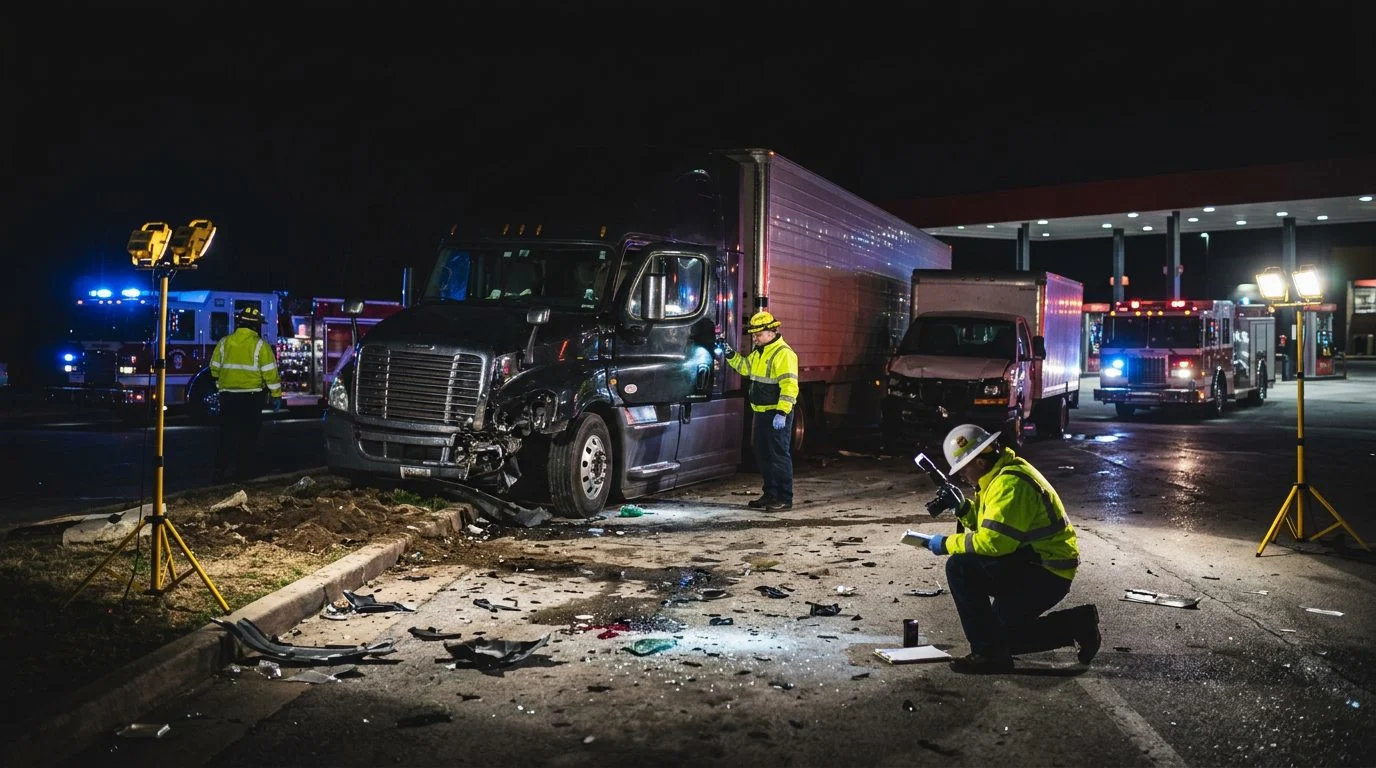
Truck Crash Claims in West Virginia
Truck Crash in West Virginia? Learn Who May Be Named in a Claim
A plain-language guide to the parties that may be involved, and how to take the next step toward understanding your options.
Published November 9, 2026
If you’re asking who can be sued after a truck crash in West Virginia, you’re not alone in wondering. More than one party can be named, not only the driver. The truck driver is one possible defendant. The trucking company, other businesses tied to the truck, and sometimes a parts maker may also be named, depending on the facts.
Who Can Be Sued After a Commercial Truck Crash in West Virginia?
Several parties may be named, because a commercial truck is often run by many businesses at once. A single rig on a West Virginia highway can tie together a driver, the company that employs or leases the driver, a shop that maintained the truck, a shipper that loaded the cargo, and a maker of a failed part. Each may have a different role in how the crash happened. Only some of them may matter in a given case. Crash reports and early records may show which businesses were involved, but not always why the crash happened. Carriers, insurers, and shippers each keep their own paperwork, so a claim often starts by sorting out who did what. We handle truck accident claims across West Virginia. The sections below explain each role, the state rules that can affect it, and the deadlines that may limit a claim.
If a commercial truck left you hurt or took a family member's life, you can request a free case review to see who may be responsible and what claim may apply. Talk it through with Big Bubba — the first case review is free, confidential, and carries no obligation.
The Truck Driver
The driver whose actions caused the crash is often a named defendant in a negligence claim. Whether a driver was careless depends on the facts of each crash. Common examples include distraction, fatigue, speeding, following too closely, impaired driving, and failing to keep a proper lookout. Federal rules also bar a driver from operating a commercial truck when fatigue, illness, or any other cause has impaired, or is so likely to impair, the driver’s ability or alertness as to make operation unsafe. The only exception is a case of grave emergency where compliance would increase the hazard, and then the driver may continue only to the nearest place where that hazard is removed. The federal driver fatigue rule sets that standard. A driver’s personal liability can matter even when the company is also responsible, because a claim can name more than one party. West Virginia generally divides fault among defendants, so each one may pay only its own share. The West Virginia fault allocation statute also lists exceptions, including driving under the influence, which can make a defendant jointly liable. The driver’s personal auto policy and the company’s commercial coverage may both be relevant. Coverage limits are a question that takes records to answer.
The Trucking Company and the Employer
A trucking company that employs the driver may be named for the driver’s work-related negligence. W. Va. Code § 55-7-32 defines an “employer defendant” in certain commercial truck cases as the truck’s owner, the driver’s employer, or anyone else who owns, leases, rents, or holds or exercises legal control over the truck or its driver. Leasing and owner-operator arrangements can change who controls the truck, so the paperwork matters. Federal rules also require a carrier to check a new driver’s motor vehicle record for the prior three years within 30 days of hire, under 49 C.F.R. § 391.23.
Other Businesses That May Be Named
Maintenance shops, cargo loaders, and sometimes freight brokers may be named when their work or decisions played a part in the crash. Faulty repairs can lead to a brake, tire, or steering failure. A shop that worked on the truck may be a possible defendant if its work contributed to that failure. Federal rules require cargo to be firmly secured, so improper loading can contribute to a rollover or a shifted load. A broker who arranges the trip may also be named. A broker’s role in each crash still depends on its own facts. Finding out who did what often means reviewing records the trucking side controls, such as dispatch logs and maintenance files.
Vehicle and Parts Manufacturers
It turns on whether a defect existed, and that usually takes an investigation of the failed part itself. West Virginia limits product claims against sellers. The West Virginia product liability limit generally requires conditions such as a seller’s actual knowledge of the defect, or its substantial control over a product’s design, manufacture, or warnings. Multiple defendants can mean multiple insurance policies to review. Some insurers may dispute a claim, so it helps to preserve the failed part and any repair records.
Who Can Bring a Wrongful Death Claim Against Them
A wrongful death claim after a truck crash is brought by the decedent’s personal representative, for the benefit of the people the West Virginia wrongful death statute names. The West Virginia wrongful death statute describes who files and how damages are shared. The jury or court may direct how damages are divided among the surviving spouse and children, including adopted children and stepchildren, brothers, sisters, parents, and any persons who were financially dependent upon the decedent at the time of his or her death or would otherwise be equitably entitled to share in such distribution, after making provision for the funeral, hospital, medical and other expenses specified in subdivision (2), subsection (c) of the West Virginia wrongful death statute. Damages can include sorrow, mental anguish, and loss of companionship. The jury’s verdict shall include, but may not be limited to, damages for reasonably expected loss of income and of the services, protection, care and assistance the decedent provided, expenses for care, treatment and hospitalization incident to the injury resulting in death, and reasonable funeral expenses. If an injured person dies later from the crash, the claim generally does not end at death. W. Va. Code § 55-7-8 says the action may be revived in the name of the personal representative. The same potential defendants described above may be named in a wrongful death claim. Who serves as the personal representative, and who the beneficiaries are, depends on the family’s situation.
Not sure what your next step is?
Talk it through with Big Bubba — the first case review is free, confidential, and carries no obligation.
Time Limits and Why Early Evidence Matters
West Virginia generally allows two years to file a personal injury lawsuit, and exceptions may apply. The personal actions statute sets a two-year period for personal injury claims. A wrongful death action generally must begin within two years after the death, subject to other provisions of state law, under W. Va. Code § 55-7-6. W. Va. Code § 55-7-6 reads: “The provisions of this section shall not apply to actions brought for the death of any person occurring prior to July 1, 1988.” Deadlines can differ by claim and by party, so the timing should be checked early. Evidence can also disappear. Trucking companies keep logs, dispatch messages, inspection records, and maintenance files. Some trucks carry event data recorders, which may preserve pre-crash and crash information. The NHTSA guidance on event data recorders explains what these devices may record. Federal drug and alcohol testing rules may require testing after some crashes, which can create additional records. The FMCSA testing requirements describe when that testing applies. Photos, the vehicles’ final positions, witness contact details, and the police report can also help show who may be responsible. Waiting can make these records harder to obtain.

Reaching Out to the Firm About Your Case
If you were hurt in a truck crash, or you lost someone in one, the next step is finding out who may be responsible. Sorting out the driver, the company, the parts, and the deadlines can feel overwhelming while you’re still recovering or grieving. For a broader look at the process, read our page on truck accident claims in West Virginia. When you’re ready, you can request a free case review with the firm, so we can look at the parties and dates in your crash.