
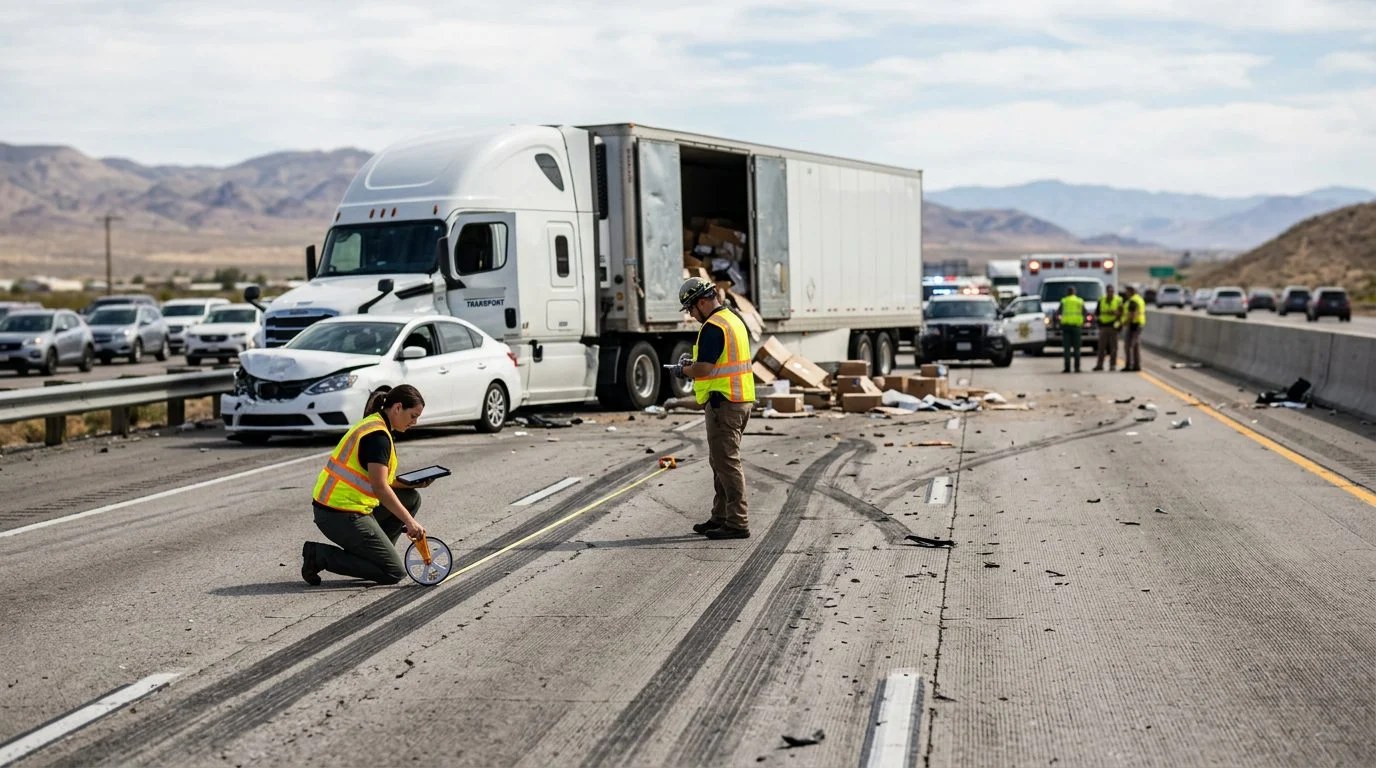
Commercial Vehicle Accidents
Broken Bones from Commercial Vehicle Accidents
If you have suffered a broken bone in a commercial vehicle accident, you can reach out to us to discuss your legal options. We serve West Virginia injury victims.
Published October 08, 2026
Broken Bones from Commercial Vehicle Accidents in West Virginia
When a commercial vehicle collides with your car or strikes you directly, the force involved can be severe, and the resulting injuries depend on the facts of each case. Because commercial vehicles are generally much heavier than passenger cars, collisions with them can cause serious injuries, including broken bones.

If you have suffered a broken bone in a commercial vehicle accident, you can reach out to us to discuss your legal options. Talk it through with our team — the first case review is free, confidential, and carries no obligation.
How Commercial Vehicle Accidents Cause Broken Bones
Commercial vehicles are generally much heavier than passenger cars, and their weight and speed can increase the force involved in a crash. A tractor-trailer traveling at highway speed can generate crushing, twisting, and shearing forces that may cause bones to shatter, though the type of injury depends on the facts of each case. Impact fractures occur when the vehicle strikes you head-on or from the side. Crushing injuries happen when the vehicle rolls over you or pins you against another object. In some cases, rollover crashes on curves or during emergency maneuvers may break multiple bones as the vehicle flips and the cab or cargo compartment collapses, depending on the facts of each case.
Commercial vehicle accidents may cause fractures that are less likely in lower-speed passenger car collisions, depending on the facts of each case: shattered pelvises, multiple rib fractures with lung damage, broken spines, and compound fractures where bone pierces the skin. Some fractures are obvious immediately; others—stress fractures, hairline cracks, and fractures deep within the pelvis—may not show up on initial X-rays and only become apparent days or weeks later when swelling subsides or when imaging is repeated.
Types of Bone Injuries in Commercial Vehicle Accidents
Bone fractures fall into several categories, and the severity of each type depends on the facts of each case.
Simple (closed) fractures are breaks where the bone cracks but doesn’t break through the skin. These generally require immobilization and may require surgery, depending on the facts of each case. The infection risk is generally lower than with open fractures.
Compound (open) fractures occur when the broken bone tears through the skin. These may carry a higher risk of infection than closed fractures, may require emergency surgery to clean the wound and stabilize the bone, and may result in longer hospitalization and recovery, depending on the facts of each case. Open fractures can lead to permanent scarring, nerve damage, and chronic pain.
Comminuted fractures are shattering breaks where the bone breaks into three or more fragments. These are often seen in high-impact commercial vehicle collisions and generally require surgical fixation with plates, rods, or screws, though the treatment depends on the specific injury. Recovery is often lengthy, and complications such as nonunion (bone fails to heal) or malunion (bone heals in a crooked position) can occur, with the likelihood depending on the individual and the specifics of the injury.
Stress fractures and hairline cracks result from the intense but brief force of impact. They may not be visible on the first X-ray but can cause severe pain and disability if left untreated.
Multiple fractures and polytrauma situations occur when a single commercial vehicle accident breaks multiple bones across different body areas. A person may suffer a broken arm, broken ribs, a fractured pelvis, and a spinal fracture all at once. These cases are medically complex and often involve damage to internal organs, blood vessels, and nerves.
Common fracture locations in commercial vehicle accidents include the arms and hands (from bracing for impact), legs and ankles (from crushing or pinning), ribs and chest (from steering wheel or seatbelt force, or from the vehicle itself), pelvis (from side-impact or rollover), and spine (from any high-impact scenario).
Medical Treatment and Recovery
Immediate care after a commercial vehicle accident focuses on stabilizing fractures and ruling out life-threatening injuries. Emergency room doctors generally order imaging such as X-rays, CT scans, and sometimes MRI, depending on the injury, to help identify fractures and assess soft-tissue damage.
Treatment depends on the fracture type and severity. Simple fractures are generally immobilized with a cast or splint for a period that depends on the bone, your age, and other individual factors. Compound fractures and comminuted fractures generally require surgery, a procedure often called internal fixation, in which surgeons use plates, screws, rods, or wires to hold the bone pieces in place while they heal. Whether surgery is needed depends on the facts of each injury, and exceptions may apply. Surgery itself carries risks: infection, blood clots, and nerve or blood vessel damage.
Recovery timelines vary widely. Physical therapy generally begins once the fracture is stable enough to move, and the length of rehabilitation varies with the injury. During this time, you may be unable to work, drive, or care for yourself.
Long-term complications can occur after some fractures, depending on the injury and the individual. Nonunion occurs when the bone fails to heal and may require a second surgery. Malunion generally occurs when the bone heals in a misaligned position, which can lead to chronic pain, reduced range of motion, and, in some cases, permanent disability. Arthritis can develop in joints affected by fractures. Nerve damage from the initial injury or from surgery can cause numbness, tingling, or chronic pain that persists for years.
Not sure what your next step is?
Talk it through with our team — the first case review is free, confidential, and carries no obligation.
Financial Impact of Broken Bones from Commercial Vehicle Accidents
The costs of a broken bone injury extend far beyond the initial emergency room visit.
Medical bills include emergency care, surgery, hospitalization, imaging, anesthesia, and surgeon fees. Follow-up care—orthopedic visits, physical therapy, imaging to monitor healing—can add to these costs over time.
Lost wages may begin soon after an injury if you are unable to work. Depending on your job and the fracture’s severity, you may be unable to earn income for weeks or months.
Out-of-pocket expenses accumulate: home modifications to accommodate crutches or a wheelchair, transportation costs if you can’t drive, in-home care or personal assistance, medications for pain or infection prevention, and medical equipment like crutches, walkers, or braces.
Settling before the full scope of complications becomes clear can be a concern, because some effects of a fracture may not appear until later. A settlement that seems adequate for immediate medical bills may leave you short when you realize you can’t return to your previous job or when chronic pain develops months later.
Legal Responsibility in Commercial Vehicle Accidents
Determining who is liable in a commercial vehicle accident is more complex than in a typical car crash because multiple parties may share responsibility.
The commercial driver may generally be liable if they were negligent, depending on the facts of each case: speeding, driving while fatigued, texting, or violating traffic laws. Federal hours-of-service regulations generally limit commercial drivers to 11 hours of driving within a 14-hour window, with 60- or 70-hour weekly limits, though exceptions may apply. A driver who violates these rules and causes a crash may generally be considered negligent, though whether negligence exists depends on the facts of each case and exceptions may apply.
The trucking company or vehicle owner may be liable in some cases for negligent hiring, inadequate training, failure to maintain the vehicle, or knowingly allowing a fatigued or unqualified driver to operate the vehicle, depending on the facts of each case. Companies generally must comply with Federal Motor Carrier Safety Regulations, which cover vehicle maintenance, driver qualifications, and safety practices, though whether and how these apply depends on the carrier and vehicle, and exceptions may apply. Violations of these regulations may generally be evidence of negligence, though whether negligence is established depends on the facts of each case.
West Virginia applies comparative fault principles in personal injury cases (W. Va. Code § 55-7-13c). Generally, how fault is divided among the parties can affect whether and how much you may recover, and exceptions may apply depending on the facts of each case. Identifying all liable parties and their degree of fault generally involves investigation, depending on the facts of each case: accident reconstruction, driver records, vehicle maintenance logs, and regulatory compliance history.
What to Do After a Commercial Vehicle Accident with Broken Bones
Seek immediate medical attention. Even if you think your injuries are minor, get evaluated at an emergency room. Some fractures don’t show symptoms immediately, and a medical record created at the scene may be relevant evidence, depending on the facts of each case.
Document the accident scene if you’re able: take photos of vehicle damage, your injuries, the road conditions, and any visible debris. Note the commercial vehicle’s company name, license plate, and driver information.
Report the incident to police and insurance. A police report creates an official record. Report the accident to your own insurance company, but be careful what you say to the other driver’s insurer—avoid admitting fault or discussing settlement.
Keep detailed records of all medical treatment: doctor visits, hospital stays, surgery, physical therapy, imaging, medications, and out-of-pocket expenses. Save receipts and bills.
Avoid discussing fault or accepting settlement offers with the insurance adjuster without understanding the full extent of your injuries. Early settlement offers can arrive before the full extent of your injuries is known, so it is generally wise to review any offer carefully before accepting it.
Consider speaking with a lawyer before accepting any offer. Commercial vehicle accident cases involve federal regulations, multiple liable parties, and complex insurance coverage. A lawyer can help you understand your rights and review whether any settlement addresses long-term complications.
Have questions about what happened?
Ask our team directly. The first conversation is free, confidential, and there is no obligation to continue.
Why You May Need Legal Help
Commercial vehicle accident cases are not routine. Insurance companies may have adjusters, engineers, and lawyers working on their side of a claim. A lawyer can help you understand your options as you work through the claim.
Bone injuries can have long-term effects that aren’t visible at first. Chronic pain, arthritis, permanent disability, and reduced earning capacity may develop months or years after the accident. A quick settlement based on immediate medical bills may not account for these future losses.
Commercial vehicle cases involve multiple liable parties and complex federal regulations. Identifying all responsible parties, proving negligence, and calculating fair compensation requires investigation and legal knowledge that most injured people don’t have.
Settlement requests may come quickly, sometimes before complications appear or before you have had time to review your situation. A lawyer can negotiate on your behalf and help you review any offer before you decide whether to accept it.
Frequently Asked Questions
What’s the difference between a simple fracture and a compound fracture?
A simple fracture is a break where the bone stays under the skin; a compound fracture is a break where the bone pierces the skin, creating infection risk and usually requiring surgery.
How long does it take to recover from a broken bone caused by a commercial vehicle accident?
Recovery time depends on the fracture type, its location, and the individual, so it generally varies from case to case.
Can I get compensation for a broken bone from a commercial vehicle accident in West Virginia?
Generally, if someone else’s negligence caused the accident, you may be able to seek compensation for losses such as medical bills, lost wages, pain and suffering, and permanent disability, but the amount depends on the specific circumstances, the liable parties involved, and any exceptions that may apply.
What should I do if the insurance company offers me a settlement right away?
Don’t accept it immediately. Consult with a lawyer before accepting the offer so you can review whether it addresses all of your losses, including long-term complications that may not be apparent yet.
Who can be held liable for injuries in a commercial vehicle accident?
Depending on the facts of each case, liability may fall on the driver, the trucking company, the vehicle owner, maintenance contractors, shippers, or sometimes manufacturers.