
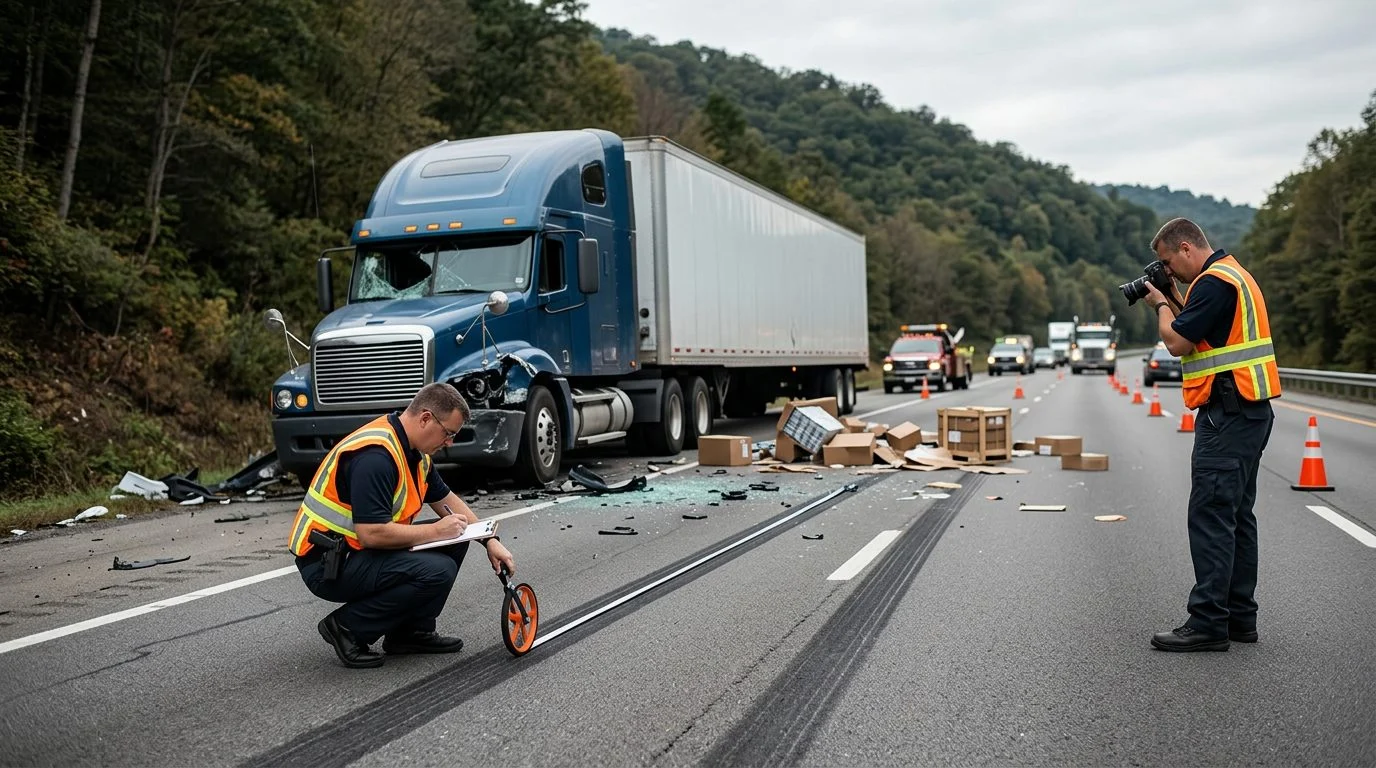
Commercial Vehicle Accidents | West Virginia
Hurt in a Commercial Vehicle Crash? Start With a Free Case Review
Big Bubba Injury Law represents people seriously hurt in crashes involving commercial vehicles, and families who have lost someone, across West Virginia.
Published October 10, 2026
Big Bubba is a commercial vehicle accidents law firm serving West Virginia. A crash with a tractor-trailer, bus, or delivery truck can involve federal trucking rules and more than one responsible party. Generally, these cases differ from a standard car accident claim. This page explains how they generally work so you can decide your next step with clear facts.
What Commercial Vehicle Accidents Are and Who This Page Is For
A commercial vehicle accident involves a vehicle used for work, such as a tractor-trailer, 18-wheeler, box truck, delivery van, bus, or logging truck. These vehicles are much heavier than passenger cars. A crash can cause serious or catastrophic injuries, even at moderate speeds.
Generally, crashes with commercial vehicles can fall under federal trucking rules and state law, not only ordinary traffic law. That is one reason these cases often look different from a standard car accident claim.
This page is written for three groups:
- Drivers and passengers hurt in a crash with a commercial vehicle
- Pedestrians and cyclists struck by a truck or bus
- Families handling a wrongful death after a commercial vehicle crash
If that describes you, you can request a free case review and tell us what happened.

If you were hurt in a commercial vehicle crash, or lost someone to one, you can request a free case review or reach out to tell us what happened. Talk it through with our team — the first case review is free, confidential, and carries no obligation.
What Our Commercial Vehicle Accident Work Covers
We handle personal injury and wrongful death claims that arise from commercial vehicle crashes in West Virginia. Case types include tractor-trailer and 18-wheeler crashes, commercial bus crashes, box truck and delivery vehicle crashes, and logging or dump truck crashes.
Injury types in scope include catastrophic injuries, traumatic brain injury, spinal cord injury, and wrongful death.
Which losses apply depends on the facts of each case, and exceptions may apply.
In a wrongful death case, the action is generally brought by the personal representative of the deceased person’s estate. The statute lists categories of damages, including sorrow and mental anguish, lost income and services, medical care, and reasonable funeral expenses. See W. Va. Code § 55-7-6.
Our role includes investigating the crash, handling communications with insurers, and pursuing the claim through negotiation or a lawsuit when needed. We do not estimate what any claim is worth.
Why Commercial Crashes Often Involve More Than One Party
A commercial crash can involve several parties, depending on the facts. These may include the driver, the motor carrier or employer, a leasing company, a maintenance contractor, a cargo loader, or an equipment maker.
West Virginia law defines an “employer defendant” broadly. It can include the vehicle’s owner, the operator’s employer, and an entity that leases or controls the vehicle or driver. See W. Va. Code § 55-7-32. Whether any of these parties may be liable generally depends on the facts of each crash, and exceptions may apply.
West Virginia courts have recognized certain employer-based claims.
Records can matter. These records are sources of information. They are not proof that any party was at fault.
How a Commercial Vehicle Case Generally Works
A commercial vehicle case generally moves through four stages. Timing varies with the facts.
1. Free case review. You tell us what happened. Bring the crash report, photos, medical records, and any letters from insurers or the trucking company. We explain the possible next steps.
2. Preservation requests. Logs, dashcam video, and vehicle data may be kept only for set periods. Practices vary, so early requests can matter.
3. Investigation and medical documentation. We gather police reports, witness information, and treatment records. Medical records show how injuries are evaluated and treated over time, and that picture shapes the claim.
4. Claim presentation and resolution. Many claims resolve through negotiation. Others go to a lawsuit. How long each stage takes depends on the injuries, the number of parties, the evidence, and other facts. We cannot predict that timing.
Not sure what your next step is?
Talk it through with our team — the first case review is free, confidential, and carries no obligation.
Deadlines, Fault Rules, and Evidence Issues to Know
Generally, West Virginia personal injury claims must be brought within two years after the right to sue accrues. See W. Va. Code § 55-2-12. Exceptions may apply, so don’t assume a date applies to your case.
For wrongful death, the general rule is two years from the death, subject to provisions the statute notes. See W. Va. Code § 55-7-6. Ask about your specific date during your free case review.
West Virginia generally uses modified comparative fault (shared fault). Under W. Va. Code § 55-7-13c, your fault generally does not bar recovery unless it is greater than the combined fault of all other responsible persons. If it is less, recovery is reduced in proportion to your share. Exceptions may apply.
Settlement timing has limits too. Under W. Va. Code § 55-7-11a, generally no one may negotiate a settlement with an injured person within twenty days of the injury while that person is in the hospital or unable to work. Under the statute, a settlement, release of liability or statement entered into, obtained or made in violation may generally be disavowed by the injured person at any time within one hundred eighty days from the date of the personal injury, subject to the statute’s conditions and any exceptions that may apply.
How Big Bubba Approaches Commercial Vehicle Claims
Big Bubba is a West Virginia personal injury firm. We serve injury victims in all 55 West Virginia counties, including Charleston, Huntington, Morgantown, Wheeling, Martinsburg, Parkersburg, Beckley, Clarksburg, Fairmont, and Weirton.
Our approach has four parts:
- Plain-language explanations of each step and the choices it raises
- Clear updates about what usually comes next, with timing described as variable
- Close attention to the records and facts that commercial cases depend on
- Prompt attention to deadlines and evidence preservation
We do not promise any result, and every case depends on its own facts. What we offer is a clear process and representation from the start.
If you were hurt in a commercial vehicle crash, or lost someone to one, you can request a free case review or reach out to tell us what happened.
Frequently Asked Questions About Commercial Vehicle Accident Claims
Do I have to talk to the trucking company’s insurer?
A recorded statement can affect your claim, so ask first. A free case review can explain how these calls generally work, and exceptions may apply.
Does fault decide my claim?
Fault generally matters. West Virginia’s modified comparative fault rule can reduce recovery by your share of fault, and how it applies depends on the facts (W. Va. Code § 55-7-13c).
How long does a commercial vehicle case take?
Timing is variable. It depends on injuries, the number of parties, the evidence, and whether the claim settles. We cannot predict it.
Will my case go to court?
Many claims resolve without a trial, but not all do. That depends on the facts.
What should I bring to a free case review with a commercial vehicle accidents law firm in West Virginia?
Bring the crash report, photos, medical records, and any insurer or trucking company letters you have. If you’re missing items, we can help you gather them.
Have questions about what happened?
Ask our team directly. The first conversation is free, confidential, and there is no obligation to continue.
Related practice areas
- Commercial Vehicle Accidents in West Virginia: Your Rights & Next Steps