
West Virginia Injury Law | Commercial Vehicle Crashes
Comparative Fault After a Commercial Vehicle Crash in West Virginia
After a truck or commercial vehicle crash, questions about who shares responsibility can be complicated. Learn how comparative fault generally works, and reach out to Big Bubba Injury Law for a free case review (W. Va. Code § 55-7-13c).
Published October 13, 2026
Under West Virginia law, comparative fault generally refers to the degree to which a person’s fault was a proximate cause of an injury or death (W. Va. Code § 55-7-13a). Under West Virginia’s modified comparative fault rule, an injured person’s recovery is generally reduced by their own share of fault. It is generally barred only when their fault is greater than the combined fault of everyone else responsible. This page explains how that works in a commercial vehicle accident in West Virginia. It is general education, and exceptions may apply depending on the facts.
What Comparative Fault Means After a Commercial Vehicle Crash
Comparative fault is the share of blame each person carries for a crash and the harm it caused. Under W. Va. Code § 55-7-13a, comparative fault means the degree to which a person’s fault was a proximate cause (a direct, legally important cause) of an injury, death, or property damage. That degree is stated as a percentage.
In a truck crash, more than one party can be considered. The truck driver, the company that employs the driver, another driver, or the vehicle’s owner may each be looked at. Who is considered, and how much responsibility each carries, generally depends on the facts of that crash.
Commercial vehicle cases can involve more parties and more paperwork than a typical car crash. That can make the question of blame more layered. Fault is not assumed. It is examined based on what each person did, or did not do, before and during the crash.
If you were hurt, you may be wondering how your own part in the crash could affect a claim. That is a common question, and the rest of this page addresses it.
Not sure what your next step is?
Talk it through with our team — the first case review is free, confidential, and carries no obligation.
How West Virginia’s Modified Comparative Fault Standard Generally Works
West Virginia generally uses a modified comparative fault system (W. Va. Code § 55-7-13c). That means an injured person’s own share of fault can reduce a recovery and, in some cases, bar it.
Under W. Va. Code § 55-7-13c, a plaintiff’s fault generally does not bar recovery unless it is greater than the combined fault of all other persons responsible for the damages. If the plaintiff’s fault is less than that combined fault, recovery is generally reduced in proportion to the plaintiff’s share.
Read that way, a plaintiff whose share of fault is equal to the combined share of everyone else is generally not barred, because the bar applies only when fault is greater than the others’ combined fault. Recovery may still be reduced. Exceptions may apply, so treat this as a general reading, not a prediction.
Nonparties can matter, too. Under § 55-7-13d, in assessing percentages of fault, the trier of fact generally considers the fault of all persons who contributed to the alleged damages, regardless of whether the person was or could have been named as a party to the suit, though exceptions and procedural requirements may apply depending on the facts.
An Illustrative Example of Shared Fault in a Truck Crash
A made-up example shows how shared percentages work. The numbers below are for illustration only, and no dollar values are involved.
Imagine a passenger car moving left while a semi-truck passes a slower vehicle. The car moves over with little room, and the truck driver may not have seen it in time. Suppose a reviewer assigns 30 percent of the fault to the car driver and 70 percent to the truck driver.
In this example, the car driver’s share generally would not bar recovery under the rule above, because it is not greater than the combined share of the others, though exceptions may apply depending on the facts. Any recovery would generally be reduced in proportion to the car driver’s share of fault (W. Va. Code § 55-7-13c).
Now change only the split. If the car driver were assigned 60 percent and the truck driver 40 percent, the car driver’s fault would be greater than the others’ combined fault. Under the general rule, that would bar recovery.
The same crash can be assessed differently with different evidence. A dashcam video, a witness account, or the crash report might lead a reviewer to see the crash another way. Real outcomes depend on the facts of each case, and exceptions may apply.
How Fault Is Generally Examined in Commercial Truck Crashes
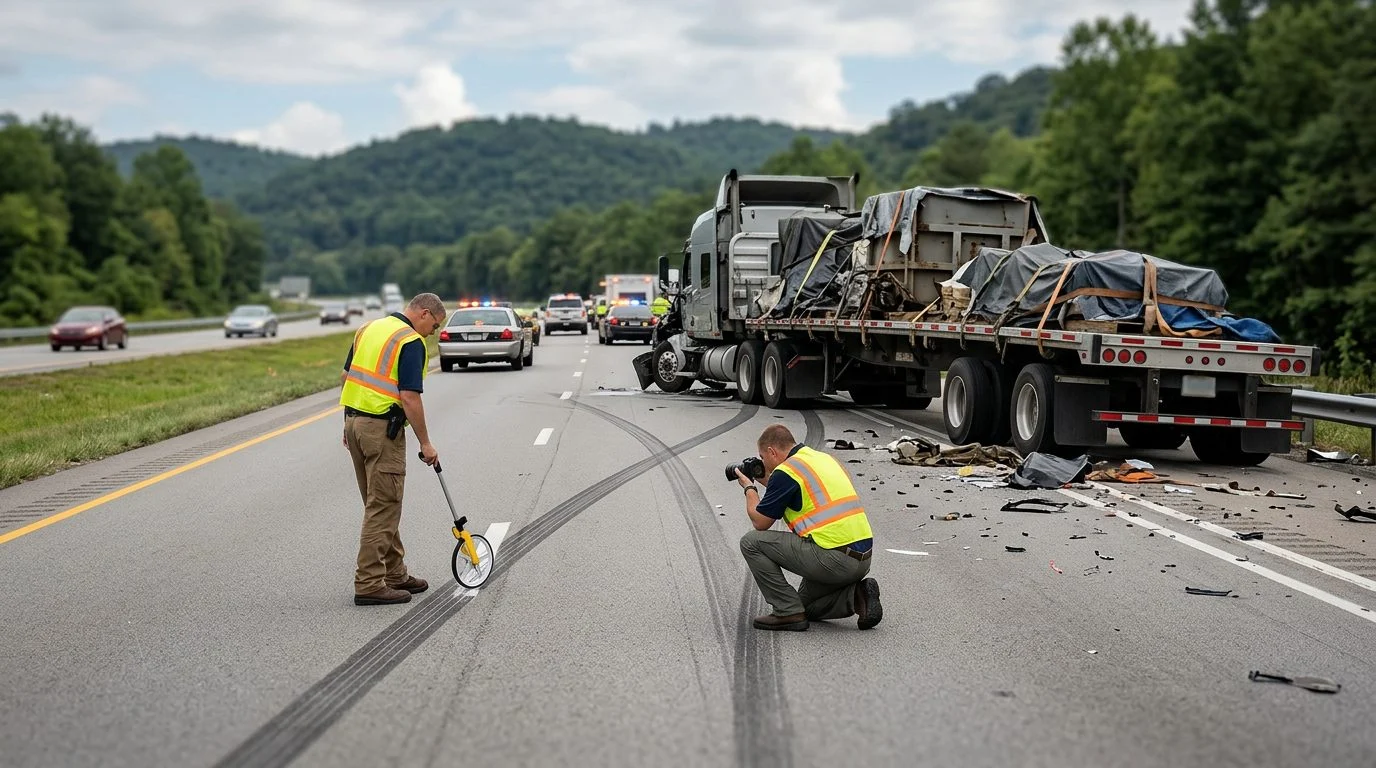
Fault is generally examined by looking at evidence of what each party did before and during the crash.
Evidence commonly reviewed in these cases includes the police crash report, witness statements, photographs, vehicle damage, and road and weather conditions. Each item may or may not be relevant, depending on the facts. No single item decides a case on its own.
Commercial trucks can also create records. Federal rules generally require motor carriers to make sure drivers record their duty status for each 24-hour period, either electronically or on a manual grid. Under 49 C.F.R. § 395.8, a motor carrier subject to that rule generally must require each driver it uses to record the driver’s duty status for each 24-hour period, though exceptions may apply. Whether those records exist, or matter in a given crash, depends on the facts.
Federal rules also generally place on the motor carrier the duty to require drivers to observe the rules that apply to them. Under federal motor carrier rules, when a duty is prescribed for a driver or a prohibition is imposed on the driver, it is generally the motor carrier’s duty to require observance of that duty or prohibition.
In complex crashes, accident reconstruction professionals may be brought in to study how the collision happened. Whether they are needed depends on the case.
Have questions about what happened?
Ask our team directly. The first conversation is free, confidential, and there is no obligation to continue.
How Other States’ Rules Can Differ from West Virginia
A rule from one state should not be assumed to apply in another.
The rules described on this page are drawn from the West Virginia statutes cited here. A crash in another state, or one involving a driver or company from another state, can raise different questions. Which state’s rules apply can depend on where the crash happened, where the parties are located, and where a claim is brought.
Rules in other states may differ from West Virginia’s. That assumption can lead to the wrong expectations. Reviewing which rules may apply to your own facts can be a helpful early step.
If a crash happened near a state line, write down where it happened, where each vehicle was headed, and where the people involved live. Those details may be relevant to which rules apply, depending on the facts.
Laws also change over time, so the date of the crash is one more fact to keep in mind.
How Several Liability Can Affect Multiple Defendants
Generally, West Virginia applies several liability. That means each defendant is usually responsible only for its own share of fault.
Under § 55-7-13c, liability for compensatory damages is generally several only, not joint. Joint liability can apply in limited cases, such as when defendants consciously conspire to commit a tortious act. Exceptions also exist, such as for a driver under the influence whose conduct is a proximate cause of the damages.
In a truck crash, who may be liable depends on the facts. Under § 55-7-13d, a person may generally be held liable for fault assigned to an agent or servant. That makes the employment relationship a key fact.
A separate West Virginia statute, § 55-7-32, may also bear on some commercial vehicle cases. It has its own conditions and exceptions, and whether it applies generally depends on the facts.
Common Questions About Comparative Fault and Negligence
Generally, West Virginia’s bar applies only when a plaintiff’s fault is greater than the combined fault of others (W. Va. Code § 55-7-13c).
What is the 50 percent rule of comparative negligence?
Under West Virginia’s comparative fault statute, fault chargeable to the plaintiff generally does not bar recovery unless the plaintiff’s fault is greater than the combined fault of all other persons responsible for the total amount of damages, if any, though exceptions may apply depending on the facts. Exceptions may apply.
Can I still recover if I was partly at fault?
Generally, being partly at fault does not by itself end a claim under West Virginia’s modified rule, but recovery is generally barred if your fault is greater than the combined fault of everyone else, and any recovery is generally reduced by your share; exceptions may apply depending on the facts (W. Va. Code § 55-7-13c). It can reduce what is recoverable, depending on the facts.
Can a trucking company be responsible for its driver’s negligence?
It depends on the facts, including the employment relationship and who owns or controls the truck. Generally, a person may be held liable for fault assigned to an agent or servant.
Do trucking companies have to track driver hours?
Federal rules generally require motor carriers to make drivers record their duty status for each 24-hour period. Whether those records matter in a crash depends on the facts.

Want to know where you stand?
Tell us what happened and our team will walk you through the options available to you, at no cost.
If You Are Trying to Make Sense of Fault After a Truck Crash
If you’re reading this after a truck or commercial vehicle crash, the question of who was at fault may feel unsettled.
You might be dealing with medical care, missed work, and calls from insurance representatives while you try to make sense of the rules. You might also be reading for a parent, spouse, or child who was hurt or killed. That is a lot to carry.
Questions about shared blame are generally fact-dependent. A conversation can help identify which facts matter in a particular crash, such as the crash report, witness accounts, and any records the trucking company kept. Nothing on this page predicts how your situation will turn out.
Related practice areas
- Commercial Vehicle Accidents in West Virginia: Your Rights & Next Steps
- Can I Sue a Truck Company for a Commercial Vehicle Accident?
- Commercial Vehicle Accidents in Charleston
- Wrongful Death from a Commercial Truck Accident in West Virginia
- Spinal Cord Injury From a Commercial Vehicle Crash in West Virginia
- Commercial Vehicle Accident Settlement in West Virginia: What to Expect
- Common Injuries from Commercial Truck Accidents
- Commercial Vehicle Accidents in Huntington