
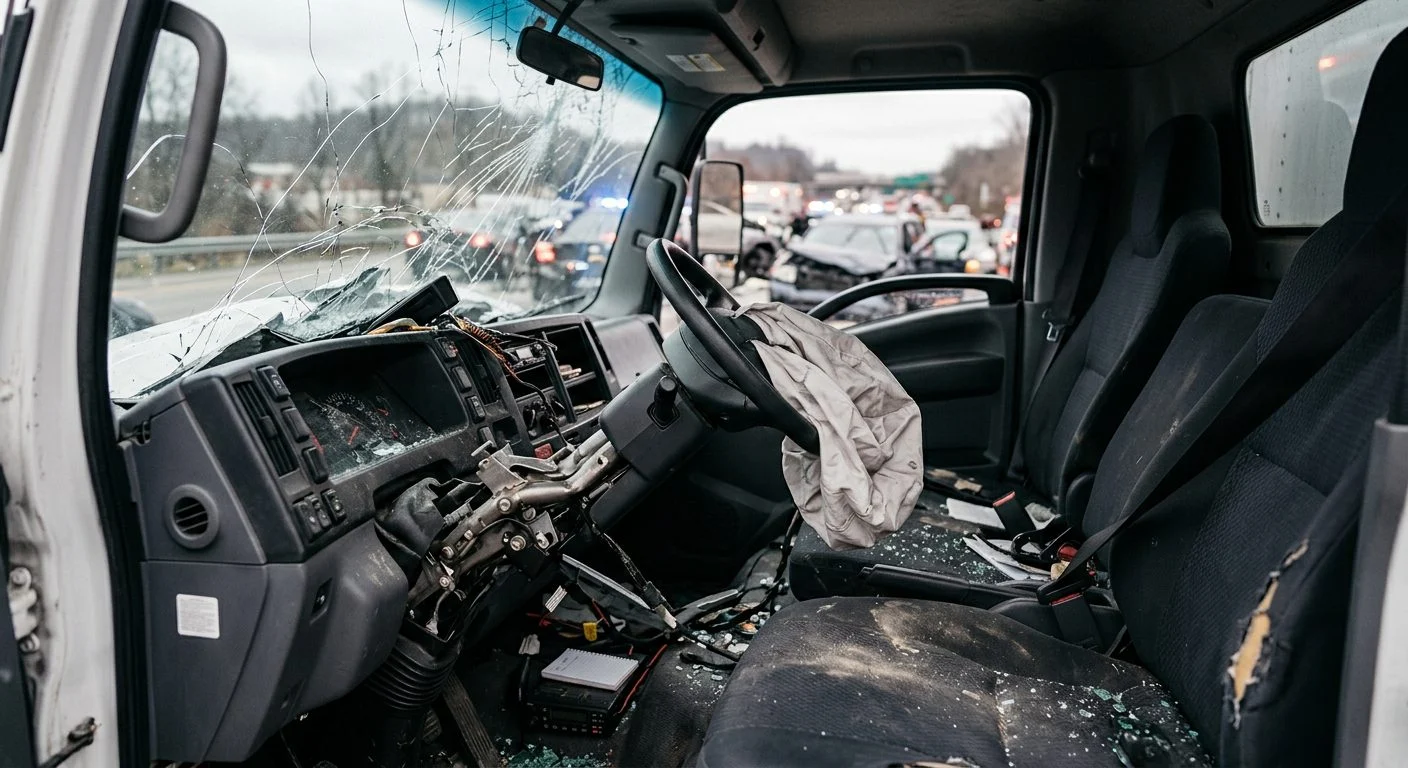
Commercial Vehicle Accidents
Hit by a truck or commercial vehicle in West Virginia? Know your rights.
When a crash involves a commercial truck or fleet vehicle, the stakes can be higher, and the legal issues may be more involved depending on the facts. Big Bubba handles serious injury and wrongful death cases. Let's talk about what happened.
Published October 01, 2026
Commercial Vehicle Accidents in West Virginia: Your Rights & Next Steps
A commercial vehicle accident is a collision involving a truck, van, or fleet vehicle used for business purposes—and it’s rarely a simple matter. When a delivery truck, work van, box truck, or semi-trailer hits your car, the stakes are high: commercial vehicles weigh far more than passenger cars, creating extreme impact forces that often cause catastrophic injuries. Liability is also more complex, because multiple parties—the driver, the employer, the maintenance contractor, or the company itself—may bear responsibility.
If you’ve been hit by a commercial vehicle in West Virginia, understanding what happens next and when to seek legal help is critical. This guide walks you through liability, injury types, documentation, and your path to compensation.
Not sure what your next step is?
Talk it through with our team — the first case review is free, confidential, and carries no obligation.
What Is a Commercial Vehicle Accident?
A commercial vehicle accident is any collision involving a vehicle operated for business purposes—delivery trucks, work vans, box trucks, commercial fleets, service vehicles, and semi-trucks.
What sets these crashes apart from personal vehicle accidents is the regulatory framework and the liability structure. Commercial vehicle operators are subject to Federal Motor Carrier Safety Administration (FMCSA) regulations governing hours of service, driver qualifications, vehicle maintenance, and cargo securing. When a commercial vehicle hits your car, you’re not just dealing with one driver’s insurance—you’re often dealing with an employer’s commercial liability policy, federal regulatory violations, and multiple liable parties.
In a catastrophic-injury case, the commercial classification matters because it can open additional avenues for recovery. A company may be held liable not only for the driver’s negligence but also for negligent hiring, inadequate training, or failure to maintain the vehicle, and a federal safety rule violation may support recovery under W. Va. Code § 55-7-9 only for harm caused by that violation.
What Happens When a Commercial Vehicle Hits Your Car?
The immediate aftermath of a commercial vehicle collision determines what evidence survives and what your claim will rest on.
At the scene: Your first priority is safety. Move to a safe location if possible, activate hazard lights, and call emergency services. A police report matters: after a crash that causes injury, death, or apparent property damage of $1,000 or more, West Virginia law generally requires the driver to notify police immediately by the quickest means available, though exceptions may apply depending on the facts. Medical attention should come next, even if injuries feel minor. Symptoms like headache, neck pain, or dizziness often develop hours or days after impact.
Documentation is your foundation. Take photographs of vehicle damage, road conditions, traffic signs, weather, and the commercial vehicle’s markings (company name, logo, license plate). Write down the driver’s name, company name, vehicle identification number (VIN), insurance details, and the contact information of any witnesses. This evidence can be important to your liability investigation, though how it applies depends on the facts of your case.
Insurance notification comes next. The commercial vehicle operator may carry its own liability coverage, and the limits that apply depend on the specific policies involved. The employer may also carry separate commercial general liability coverage. You’ll notify your own insurer, but do not accept a settlement offer without legal review.
Understanding Liability in Commercial Vehicle Accidents
Liability in a commercial vehicle accident may involve more than one party, depending on the facts. Multiple parties may bear responsibility.
Driver liability is the starting point: the operator’s negligence, traffic violation, or reckless conduct. But in some commercial vehicle cases, liability may extend beyond the driver, depending on the facts of each case.
Employer liability is where the law recognizes vicarious liability—the legal doctrine that an employer is generally responsible for the negligent actions of an employee driver acting within the scope of employment, though exceptions may apply depending on the facts. Under West Virginia law, if a delivery driver or truck operator causes a crash while performing job duties, the employer may generally be liable even if the company itself did nothing wrong, though exceptions may apply depending on the facts.
Negligent hiring or retention may create additional employer liability, depending on the facts of each case. If the company knew or should have known the driver was unfit—due to a poor driving record, lack of proper licensing, or previous accidents—the company may be sued for negligent hiring or retention, though whether liability exists generally depends on the facts of each case.
Maintenance liability arises when mechanical failure contributed to the crash. Brake failure, tire blowouts, steering problems, or defective equipment can make the employer or maintenance contractor liable.
Federal hours-of-service rules limit how long a driver can operate without rest. Violations of these rules, improper cargo securing, overloading, or failure to maintain required safety equipment may be relevant to your claim, depending on the facts of your case.
In practice, a single commercial vehicle accident may involve the driver, the employer, a maintenance contractor, and possibly a third-party shipper or freight broker. Depending on the facts, a lawyer may identify all potentially liable parties and pursue recovery from each.
What Causes Commercial Truck Accidents?
Commercial vehicle crashes result from a combination of driver error, regulatory violations, mechanical failure, and operational negligence.
Driver error includes speeding, distracted driving, fatigue, and improper lane changes. Fatigue may be a contributing factor in some commercial vehicle crashes, depending on the facts of each case.
Hours-of-service violations are a federal safety issue. FMCSA regulations limit driving hours and require rest breaks. When companies ignore these rules to meet deadlines, drivers may become fatigued, which may increase crash risk depending on the circumstances.
Inadequate training means drivers lack proper instruction in vehicle handling, cargo securing, or emergency procedures. Employers have a legal duty to ensure drivers are trained and qualified.
Vehicle maintenance failures are preventable. Brake failure, tire blowouts, and steering problems can sometimes result from deferred maintenance. Companies that skip inspections or repairs create hazards.
Overloading or improper cargo securing affects how the vehicle handles, brakes, and responds to emergency maneuvers. An overloaded truck may have difficulty stopping quickly and may be more prone to rollover, depending on the circumstances.
Road and weather conditions demand extra caution. Commercial vehicles generally require longer stopping distances than passenger cars. Speeding in rain, snow, or on curves may contribute to loss of control, depending on the circumstances.
Aggressive or reckless operation—tailgating, unsafe passing, speeding in residential areas—reflects driver negligence or company pressure to move faster.
Injuries from Commercial Vehicle Collisions
Commercial vehicles weigh significantly more than passenger cars. A fully loaded semi-truck generally weighs far more than a passenger car. The impact forces in a collision can be severe, and injuries may be serious, depending on the circumstances of each crash.
Traumatic brain injury (TBI) results from sudden deceleration or direct impact. The National Institute of Neurological Disorders and Stroke (NINDS) describes TBI as ranging from mild concussion to severe diffuse axonal injury. Symptoms include loss of consciousness, memory loss, cognitive changes, mood disturbances, and chronic headache. Long-term effects can include difficulty concentrating, personality changes, and permanent disability.
Spinal cord injury (SCI) generally occurs when impact damages the spinal cord, and its effects depend on the individual case. The National Spinal Cord Injury Statistical Center (NSCISC) reports that SCI can result in partial or complete paralysis, chronic pain, loss of bladder and bowel control, and permanent loss of function.
Fractures and crush injuries are common: broken bones, internal bleeding, organ damage, and hemorrhage. These injuries may require emergency surgery and extended hospitalization, depending on the individual case.
Soft tissue injuries—whiplash, back strain, neck strain—are often underestimated but can cause chronic pain and disability lasting months or years.
Psychological trauma is real. Surviving a serious commercial vehicle collision can cause post-traumatic stress disorder (PTSD), anxiety, and depression.
Medical documentation is essential. Seek evaluation immediately, even if symptoms seem minor. Medical records establish injury severity and directly support your compensation claim.
Have questions about what happened?
Ask our team directly. The first conversation is free, confidential, and there is no obligation to continue.
What to Do Immediately After a Commercial Vehicle Accident
Your actions in the first minutes and hours after a collision shape your entire claim.
Safety first. Move to a safe location if possible. Activate hazard lights. Check for injuries and call 911 if anyone is hurt.
Call emergency services. Request a police report. The report creates an official record of the accident, driver statements, and scene conditions.
Document the scene. Take photos of vehicle damage, road conditions, traffic signs, weather, the commercial vehicle’s company markings, and the overall scene. Get the names and phone numbers of all witnesses.
Gather information. Write down the driver’s name, company name, vehicle identification number, insurance details, and contact information for the other driver and witnesses.
Seek medical attention. Even if you feel fine, get evaluated. Some injuries—concussion, internal bleeding, spinal cord injury—develop over hours or days. Medical records can serve as important evidence of your injuries.
Preserve evidence. Keep all medical records, repair estimates, photographs, police reports, and written communications. Do not discard anything.
Avoid statements. Do not admit fault or discuss the accident with the other driver or their insurance company. Statements you make may be used against you in a claim, depending on the circumstances. Let your attorney handle all communication.
Insurance and Commercial Vehicle Accidents
The commercial vehicle operator may carry its own liability insurance, and the limits that apply depend on the specific policies involved. The employer may also carry separate commercial general liability coverage, creating multiple potential sources of recovery.
In some cases, an insurance company may question the extent of your injuries or your medical treatment, or may argue that you were partially at fault. You are not obligated to accept an initial settlement offer.
Insurance companies will request medical records, repair estimates, accident reports, and detailed statements. An attorney can handle these requests and negotiations, protecting your interests and pressing for fair compensation.
Compensation in Commercial Vehicle Accident Claims
Compensation in a commercial vehicle accident claim covers several categories of damages.
Medical expenses include emergency care, hospitalization, surgery, rehabilitation, physical therapy, and ongoing treatment. If your injury is permanent, future medical care may also be recoverable, depending on the facts of your case and applicable law.
Lost wages cover income lost during recovery and ongoing disability. If your injury prevents you from returning to work, you may be able to seek compensation for lost earning capacity, depending on the facts of your case and applicable law.
Pain and suffering compensates for physical pain, emotional distress, loss of enjoyment of life, and reduced quality of life.
Permanent disability applies when injuries result in lasting impairment or loss of function. Spinal cord injury, traumatic brain injury, and amputation often qualify.
Property damage covers vehicle repair or replacement.
Wrongful death claims can be brought if the accident results in a fatality; the action is filed by the personal representative of the person who died.
Compensation depends on injury severity, quality of medical evidence, documentation of lost income, and strength of liability. An attorney can investigate the damages involved in a claim, though what may be recoverable depends on the facts of each case.
When Do You Need a Lawyer for a Commercial Vehicle Accident?
You should consult an attorney if your accident involves serious injury, multiple liable parties, insurance disputes, or catastrophic harm.
Serious injuries—traumatic brain injury, spinal cord injury, fractures, permanent disability—warrant legal representation. Serious injury claims can involve disputes over liability and damages, and a legal advocate may help you navigate them.
Multiple liable parties create complexity. If the driver, employer, maintenance contractor, and others share responsibility, your attorney may identify each potentially liable party and evaluate possible avenues of recovery, depending on the facts of your case.
Insurance disputes arise when the insurer denies your claim or offers inadequate compensation. An attorney negotiates on your behalf and, if necessary, prepares for litigation.
Catastrophic injuries—permanent paralysis, severe brain damage, disfigurement—may call for careful legal advocacy. These cases can involve serious personal and financial consequences, and the stakes may be high.
Wrongful death claims demand immediate legal consultation. Family members have rights, and the statute of limitations generally sets a time limit for filing, though exceptions may apply.
Regulatory violations may be relevant to your claim, because under W. Va. Code § 55-7-9 a person injured by a statutory violation may recover damages sustained by reason of that violation. If the driver violated hours-of-service rules, the company failed to maintain the vehicle, or safety equipment was missing, your attorney may use these violations as evidence relevant to negligence, though the violation must still be connected to how the accident happened.
How an Attorney Helps Your Commercial Vehicle Accident Case
An attorney can bring investigation, knowledge of applicable regulations, and negotiation skills to your case.
Investigation includes gathering evidence, reviewing police reports, obtaining vehicle maintenance records, analyzing dispatch logs, and consulting medical experts. We work to identify what may have caused the crash and who may be responsible, depending on the facts of your case.
Liability analysis applies West Virginia law and federal trucking regulations to establish negligence. We determine whether the driver, employer, maintenance contractor, or others are liable.
Medical coordination involves working with your healthcare providers to document injury severity, treatment, and long-term prognosis. Medical evidence can be an important part of how a claim is evaluated, though outcomes depend on the facts of each case.
Insurance negotiation can be one stage in resolving a claim, though how any case resolves depends on its facts. Your attorney communicates with adjusters, presents evidence, and pursues fair settlement. If the insurer refuses, we prepare for trial.
Federal regulations matter in commercial vehicle cases. These cases can involve FMCSA regulations, hours-of-service rules, and maintenance requirements. Violations of these rules may be relevant evidence of negligence, depending on the facts of each case.
Litigation preparation means if settlement fails, we prepare your case for trial. We file motions, conduct discovery, retain expert witnesses, and build a compelling case for a jury.
Want to know where you stand?
Tell us what happened and our team will walk you through the options available to you, at no cost.
Frequently Asked Questions About Commercial Vehicle Accidents
Can I sue the trucking company directly?
Generally, yes. Under West Virginia law, an employer is generally liable for an employee’s negligence while the employee is acting within the scope of employment, though exceptions may apply depending on the facts. Generally, you may be able to pursue the company even if the driver was the one who caused the crash, though exceptions may apply depending on the facts.
What if I was partially at fault?
West Virginia recognizes comparative negligence (W. Va. Code § 55-7-13c). Under W. Va. Code § 55-7-13c, you may generally recover damages even if you are partially at fault, provided your fault is not greater than the combined fault of all other parties, though exceptions may apply depending on the facts. An attorney evaluates your degree of fault and your recovery options.
How long do I have to file a claim?
West Virginia’s statute of limitations for personal injury claims generally allows two years after the right to bring the action accrued (W. Va. Code § 55-2-12). Generally, a claim filed after that two-year period may be barred, though exceptions may apply depending on the facts. Do not delay—contact an attorney immediately.
What if the driver was an independent contractor?
Liability may still attach to the company depending on the facts and the contractor’s relationship to the business. An attorney analyzes the employment relationship and identifies all liable parties.
Are there federal regulations that apply?
Yes. Commercial vehicles are subject to FMCSA regulations governing hours of service, driver qualifications, vehicle maintenance, and cargo securing. A violation of these regulations can be prima facie evidence of negligence if the injury proximately flows from the violation and is the kind of injury the regulation was meant to prevent.
Why Big Bubba Handles Commercial Vehicle Accident Claims
We represent West Virginia residents and workers seriously injured in commercial vehicle collisions. We handle delivery truck accidents, work van crashes, semi-truck collisions, and fleet vehicle incidents. We also represent families in wrongful death cases.
Our approach is comprehensive. We investigate liability, identify all responsible parties, coordinate medical care, and negotiate with insurers. We serve injury victims across West Virginia, and these cases can involve federal trucking law. No attorney fee unless we win; clients remain responsible for case costs. You may still be responsible for court costs and case expenses.
If a commercial vehicle collision left you or a family member seriously injured—or if you’re unsure whether you have a claim—reach out to discuss what happened. People in your situation can contact us. Request a free case review today.
Vicarious liability: You can sue the company
Under West Virginia law, employers may generally be responsible for employee negligence, though exceptions may apply depending on the facts. If a commercial driver caused the crash while working, you may generally be able to pursue the trucking company directly, even if the driver was at fault, though exceptions may apply depending on the facts.
What you should know about commercial vehicle crashes
Comparative negligence applies
West Virginia recognizes comparative negligence (W. Va. Code § 55-7-13c). You may recover damages even if you share some fault for the crash. The strength of your case depends on the facts—and a thorough investigation.
Multiple parties may be liable
Beyond the driver and employer, liability may extend to maintenance contractors, cargo loaders, or third parties whose negligence contributed to the crash. Identifying all responsible parties requires careful case review.
Catastrophic injuries demand serious representation
Commercial vehicle crashes often cause traumatic brain injury, spinal cord damage, and permanent disability. These cases are complex and require focused legal attention to secure fair compensation.
Wrongful death claims protect your family
If a loved one was killed in a commercial vehicle accident, your family may have legal rights. Wrongful death cases are handled with the care and diligence your family deserves.
Why Big Bubba handles your commercial vehicle case
Focus on serious injury and wrongful death
We focus exclusively on car accidents, truck accidents, commercial vehicle crashes, catastrophic injuries, traumatic brain injury, spinal cord injury, and wrongful death. That focus lets us concentrate on the law and the facts that matter in these cases.
Investigation and evidence gathering
Commercial vehicle crashes involve driver logs, maintenance records, dispatch communications, and insurance policies. We know what evidence to pursue and how to use it.
West Virginia representation
We represent people seriously hurt in crashes across West Virginia.
Empathetic, plain-language guidance
Serious injury and loss are traumatic. We explain your rights and options clearly, so you can make informed decisions about your case.