
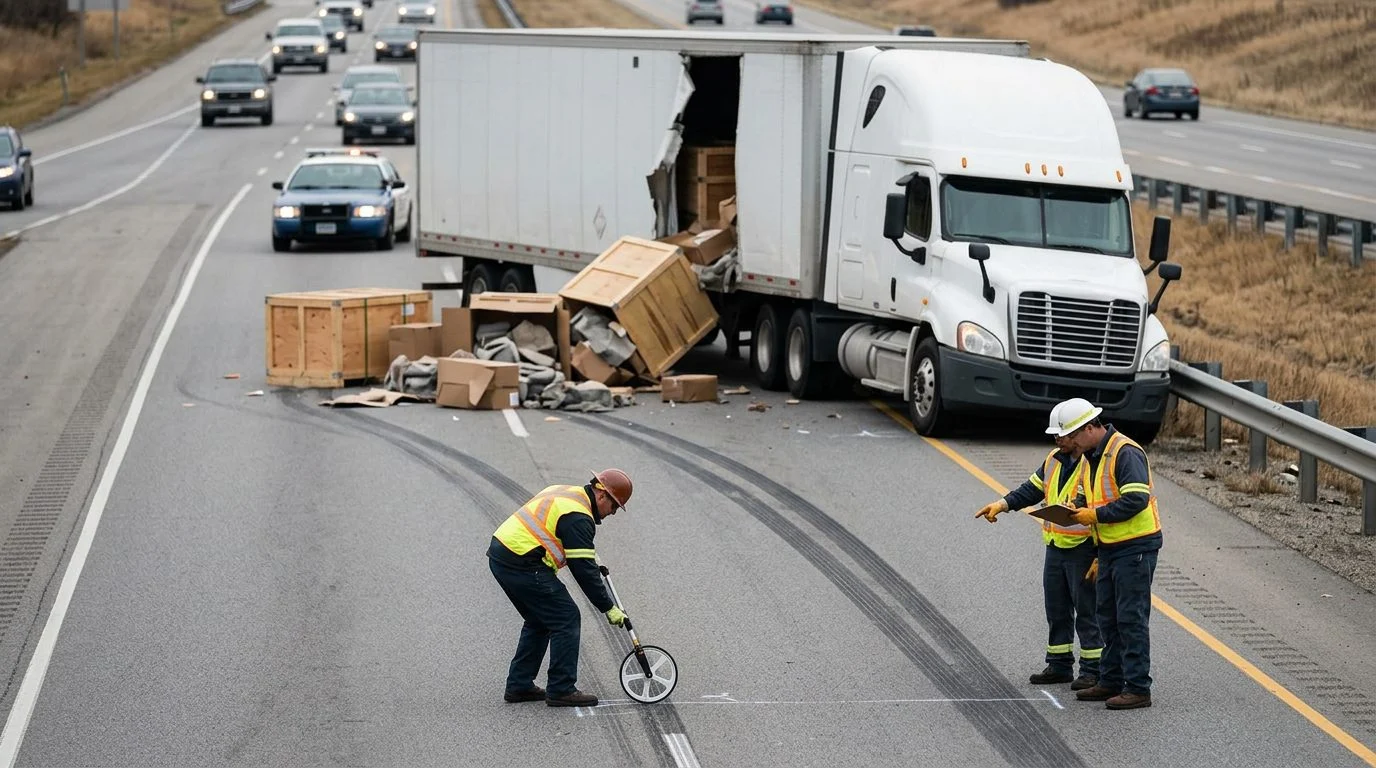
Commercial Truck Accidents
What Happens If a Commercial Truck Hits You
Understanding your rights after a serious collision with a commercial vehicle in West Virginia
Published October 08, 2026
When a commercial truck collides with your vehicle, the immediate aftermath is chaotic—but the steps you take in the first hours and days matter enormously. The process that follows involves police investigation, medical documentation, insurance claims, and often complex questions about who is responsible. Understanding what typically happens can help you protect yourself and your legal rights.
The immediate aftermath: what happens right after impact
Your first priority is safety and medical attention, then documenting what occurred.
If you can move safely, get yourself and your passengers out of traffic. Turn on hazard lights and move to the roadside if possible. Call 911 immediately—even if injuries seem minor. Adrenaline and shock can mask serious harm; paramedics will assess everyone at the scene.
Wait for police to arrive and file an accident report. This official record becomes a critical document in any later claim or lawsuit. While waiting, take photos and video of the truck, your vehicle, the accident scene, road conditions, and any visible injuries. Get the truck driver’s name, phone number, and address. Ask for the trucking company name, the truck’s license plate, and the driver’s commercial license number. Write down the name and contact information of the insurance company listed on the truck’s insurance card.
Talk to anyone who witnessed the collision. Get their names, phone numbers, and what they saw. Witnesses often disappear; their statements become invaluable later.
Do not admit fault or apologize for the accident. Stick to facts: “The truck was in my lane” or “The light was red.” Insurance adjusters and opposing attorneys will use your words against you.

Not sure what your next step is?
Talk it through with our team — the first case review is free, confidential, and carries no obligation.
Medical attention and injury documentation
Seek medical care immediately, even if you feel fine.
Commercial truck collisions often cause injuries that don’t show up right away. Traumatic brain injury, for example, can develop after impact without obvious symptoms at first. You may experience headache, confusion, memory problems, or sensitivity to light or sound hours or days later. Spinal cord injuries can result in partial or complete loss of function below the injury site, and early medical evaluation is essential to document the injury and begin appropriate care.
Keep every medical record: emergency room visit notes, X-rays, MRI results, doctor’s diagnoses, prescriptions, and follow-up appointments. These records prove the link between the collision and your injuries—a foundation for any claim.
The investigation: who looks into the accident
Police, insurance companies, and sometimes federal regulators all investigate commercial truck accidents.
The police report documents the scene, the parties involved, and the officer’s initial assessment of fault. This report is public and becomes evidence in your case.
The trucking company’s insurance company will also investigate. Their goal is to minimize what they pay. They’ll interview the driver, review the accident report, examine the truck’s condition, and look for reasons to deny or reduce your claim.
Your own insurance company may investigate too, depending on your policy.
Commercial truck accidents are more complex than car accidents because federal regulations govern commercial vehicles. Fatigue may be a factor in some commercial truck accidents. Investigators also examine the truck’s maintenance records, weight compliance, and whether the company followed Federal Motor Carrier Safety Regulations. Under W. Va. Code § 55-7-9, a person injured by the violation of a statute may recover the damages they sustained by reason of that violation, unless the statute expressly makes a penalty in lieu of such damages. How this applies depends on the facts of each case, and exceptions may apply.
Do truck drivers pay for damages?
Commercial truck drivers and their employers carry insurance to cover damages, but liability isn’t always simple.
The truck driver may be at fault, but so may the trucking company. Generally, a company can be liable if it hired an unsafe driver, failed to maintain the vehicle, violated safety regulations, or pressured the driver to exceed hours-of-service limits, though liability depends on the facts of each case. Multiple parties can share responsibility.
Insurance coverage limits vary from one policy to the next, but catastrophic injuries from a commercial truck collision can cost far more than the available coverage. When damages exceed insurance limits, you may have claims against the driver’s personal assets or the company itself.
Have questions about what happened?
Ask our team directly. The first conversation is free, confidential, and there is no obligation to continue.
How long does a commercial vehicle accident stay on your record?
Police accident reports are generally public records and may remain accessible for a period of time, but how they affect you depends on the outcome of your case.
Exceptions may apply. Insurance companies generally keep accident records for a period of time, and a collision on your driving record may affect your insurance rates, though how long any effect lasts depends on the insurer and the circumstances. The truck driver’s accident history is part of the company’s safety record, which federal regulators monitor.
What matters most is whether you’re found liable. If the truck driver was at fault and you recover damages, the accident doesn’t harm your record—it documents that someone else caused the harm.
Insurance claims and settlement negotiations
Filing a claim with the truck company’s insurance is generally the first step in the process, and exceptions may apply depending on the facts of your case.
Report the accident to the truck company’s insurer promptly, since reporting deadlines can vary with the facts of your case, and exceptions may apply. Provide the police report, your medical records, photos, and a detailed account of the collision.
Insurance adjusters will contact you. They may offer a quick settlement—often a fraction of your actual damages. Don’t accept the first offer. Medical bills, lost wages, ongoing treatment, and pain and suffering all factor into what you’re owed. If your injuries are serious or ongoing, you don’t yet know the full cost of your care.
If the insurance company denies your claim or the offer stalls, that’s a sign you need legal help.
Can I sue for being hit by a semi-truck?
Depending on the facts of your case, you may be able to file a personal injury lawsuit against the truck driver, the trucking company, or other parties, though exceptions may apply.
Generally, West Virginia law allows injured people to seek damages for categories such as medical expenses, lost income, pain and suffering, and permanent disability, though the specifics depend on the facts of each case. In wrongful death cases, family members can recover damages for the loss of the deceased.
Car accident claims generally turn on whether another party was careless and whether that carelessness caused your injuries.
A lawsuit can take time, and how long it takes depends on the facts of each case, including its complexity and whether it settles or goes to trial. But, depending on the facts of your case, a lawsuit is one option for pursuing compensation, separate from relying only on what an insurance adjuster offers.
When to seek legal help
Serious injuries, disputed liability, insurance denials, or multiple parties involved are all signs you need an attorney.
If you’ve suffered a traumatic brain injury, spinal cord injury, or other catastrophic harm, don’t rely on the insurance company to value your case fairly. If the truck driver or company disputes fault, you’ll need evidence and legal strategy. If your claim is denied or stalls, an attorney can investigate and push back.
An attorney handles communication with insurance companies, preserves evidence, obtains medical and expert testimony, and negotiates or litigates on your behalf. You won’t face the process alone.

Want to know where you stand?
Tell us what happened and our team will walk you through the options available to you, at no cost.
Frequently asked questions
How quickly should I see a doctor after a commercial truck accident?
Seek medical attention immediately or within 24 hours—even if you feel okay. Serious injuries like traumatic brain injury often develop after impact, and early documentation is critical.
What if the truck driver was violating hours-of-service rules?
Violations of federal driving-time limits can generally be relevant evidence of negligence and may strengthen your case, though whether they establish negligence depends on the facts and exceptions may apply. Your attorney can subpoena the driver’s logbook and records.
Can I sue the trucking company even if the driver was at fault?
Generally, yes, though exceptions may apply depending on the facts of your case. Companies are often liable for their drivers’ negligence and for their own failures—poor hiring, inadequate training, failure to maintain vehicles, or pressure to violate safety rules.
How long do I have to file a lawsuit in West Virginia?
West Virginia law generally sets a two-year deadline from when the right to bring a personal injury claim accrued (W. Va. Code § 55-2-12), though exceptions may apply depending on the facts of your case. Don’t wait—evidence fades and witnesses become harder to locate.