
West Virginia Car Accident Guide
Get Your West Virginia Car Crash Report
Learn which agency to contact, what details to have ready, and how to correct mistakes so your paperwork is in order.
Published November 15, 2026
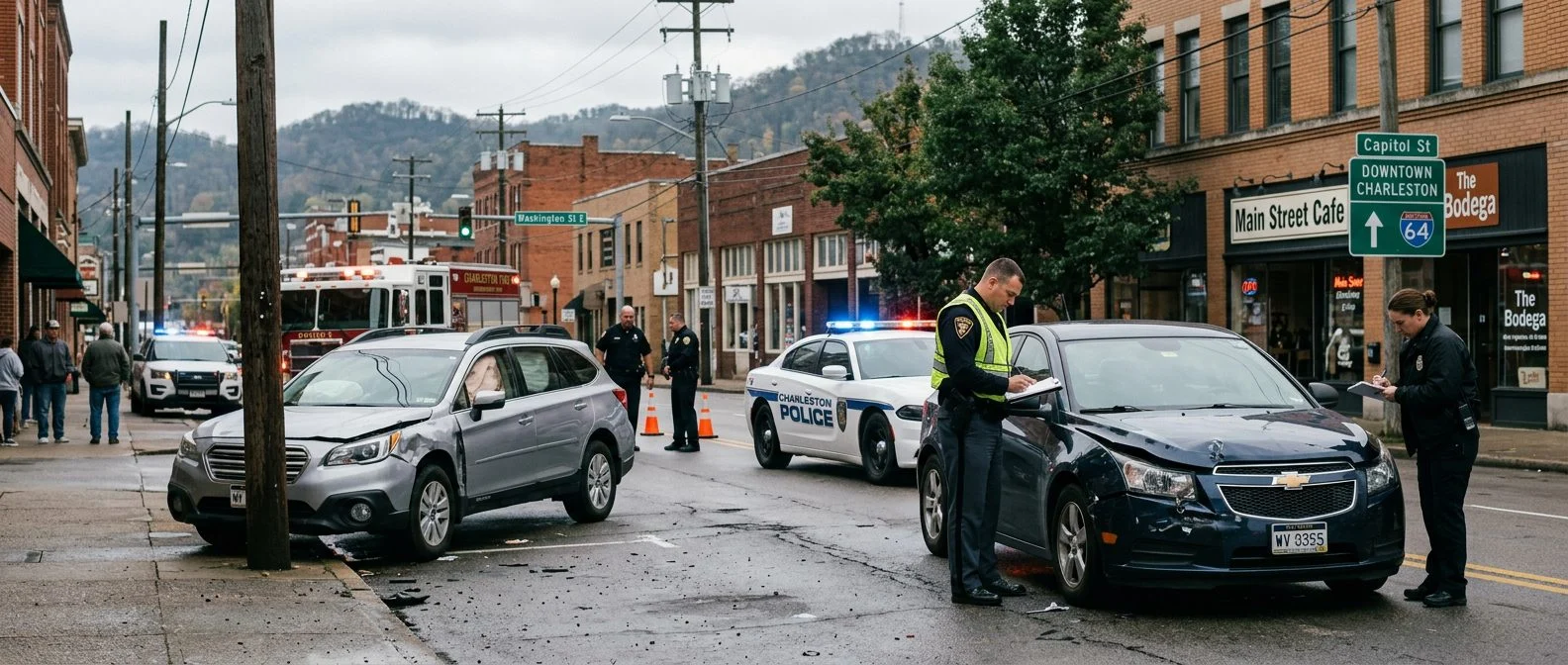
If you were hurt in a car accident in West Virginia, you may need the official crash report. You can get it from the agency that investigated the crash, online, by mail, or in person.
This guide covers which agency to contact, what details to gather, how to fix errors, and how the report fits with your medical records. If you were hurt in a car accident in West Virginia, the steps below explain how to request the crash report.
What a Crash Report Is and Why It Matters After a West Virginia Crash
A crash report is the official record an investigating officer creates after a crash. West Virginia law requires it to include enough detail to disclose the cause, the conditions at the time, and the people and vehicles involved (W. Va. Code § 17c-4-9).
Expect the report to list the date, time, and location, the drivers and vehicles, any witnesses, and the officer’s observations. These details can matter to an insurance claim or a lawsuit, depending on the facts. Officers may also note road conditions and visible damage, which shape the first official picture of what happened.
The report records what the officer saw and what people told the officer. It is not the final word on fault.
If you're recovering from a crash or helping a family after one, you don't have to sort out the records alone. We can talk through your situation in a free case review. Talk it through with Big Bubba — the first case review is free, confidential, and carries no obligation.

Find Out Which Agency Responded to Your Crash
The responding agency is usually the West Virginia State Police, a county sheriff’s department, or a municipal police department. Which one depends on where the crash happened. Crashes on interstates, county roads, and city streets can each fall under a different office.
Drivers have a duty to report certain crashes. If a crash caused injury or death, or total property damage of $1,000 or more, the driver must immediately notify the local police department when the crash is inside a city. Otherwise, the driver must notify the county sheriff or the nearest State Police office (W. Va. Code § 17c-4-6).
Next, check your paperwork for the agency name. The officer’s exchange-of-information slip, a card the officer left, or your insurance claim forms often show it. Look for any report or case number too. A city may by ordinance require drivers involved in a crash to file a separate report with a designated city department, and those reports are kept for that department’s confidential use (W. Va. Code § 17c-4-15).
If you still can’t tell who has the file, call the sheriff’s office or State Police office for the county where the crash happened. Staff there can tell you which agency handled the crash.
How to Request a West Virginia Crash Report Online
Start on the responding agency’s official website if it offers an online request option. Use the agency’s own site, and check it before you enter anything.
Gather these details first:
- The date and approximate time of the crash
- The location, such as the road, intersection, or nearest mile marker
- The names of the drivers involved
- The report or case number, if one was given
- The year, make, and model of each vehicle
After a crash resulting in injury, death, or damage to a vehicle, drivers must, if physically able to do so, give the person struck or the driver or occupant of any vehicle collided with their name, a valid phone number, the year, make, and model of their vehicle, and the last four digits of its vehicle identification number. They must also provide proof of insurance (W. Va. Code § 17c-4-3). They must also share proof of insurance (W. Va. Code § 17c-4-3). If you wrote those details down, add them to your request.
Agencies may charge a copy fee. Check the current amount and accepted payment methods on the agency’s website before you submit. Dates, locations, and case numbers tend to help the agency find the right file faster than a name alone.
Requesting a Crash Report by Mail or In Person
You can also request the report by mail or in person at the records office of the responding agency. Both routes take the same details listed above.
Timing is set by law. For a crash occurring on the public streets or highways of this state resulting in bodily injury, death, or total property damage to an apparent extent of $1,000 or more, the investigating officer must prepare the report within 24 hours after completing the investigation, either electronically or in writing. If the officer cannot finish the investigation within 10 days, a preliminary report goes to the Division of Highways on the 10th day, and the final report follows within 24 hours of completion (W. Va. Code § 17c-4-7).
To request in person, visit the records office during business hours. Bring a photo ID and the details listed above, and ask the office what else it needs. Call ahead to confirm its hours and whether it handles report requests.
To request by mail, write a clear letter with the same details, your return address, and the payment method the agency accepts. Check the agency’s website for the mailing address and payment rules before you send anything.
Keep a copy of your request and any receipt. If you don’t hear back within a reasonable time, call the agency and confirm it received your request.
What to Do If Your Crash Report Contains an Error
If your crash report has an error, contact the responding agency and ask how it accepts corrections or supplements. Errors such as a wrong street name, missing vehicle details, or an incorrect description of the crash can happen.
Write down each error, along with the page and line where it appears, so you can point to it exactly. Keep a record of every call, letter, and email you send to the agency.
The process varies by agency. Ask what documentation it wants and how it handles changes to a report. The agency decides what changes it makes to its file.
Write your own account of the crash, dated and signed, and keep it apart from the report. A common mistake is waiting months to write it down. Notes made soon after a crash are generally easier to recall in detail. Your account is not a substitute for the report, but it is a record that is yours.
Keeping Medical Records and Other Crash Records Together
Keep your crash report and medical records together, because each one documents a different part of what happened. The report covers the crash itself. Medical records cover the injuries and the treatment that followed.
Medical records are requested separately, through the treating provider. Start early, since records can take time to arrive. Keep dates in order, since a timeline is easier to follow on paper.
Other records may help too. These include photos of the scene and vehicles, witness contact details, and vehicle repair estimates. Whether any of them matters depends on the facts.
If someone died in the crash, the rules differ. A wrongful death action is brought in the name of the deceased person’s duly appointed personal representative. West Virginia generally requires it within two years after the death, and exceptions may apply (W. Va. Code § 55-7-6).
If a commercial truck or other commercial vehicle was involved, federal regulations may also be relevant alongside West Virginia law. Federal regulations for commercial vehicles are codified in Title 49 of the Code of Federal Regulations.
Not sure what your next step is?
Talk it through with Big Bubba — the first case review is free, confidential, and carries no obligation.

Is West Virginia a No-Fault State for Car Accidents?
West Virginia applies comparative fault, so who was at fault matters to a claim. Under the state’s comparative fault law, each person’s share of liability follows that person’s percentage of fault (W. Va. Code § 55-7-13a).
Insurance coverage, claims, and deadlines can depend on the facts of each crash. West Virginia generally allows two years to bring a personal injury action, and exceptions may apply (W. Va. Code § 55-2-12).
If you’re dealing with a crash now, whether you’re recovering from injuries or helping a family after a death, you don’t have to sort out the records alone. We serve injury victims across West Virginia, including Charleston, Huntington, and Morgantown. You can request a free case review to talk through your situation and the records you’re gathering. The review is confidential and carries no obligation to continue.