
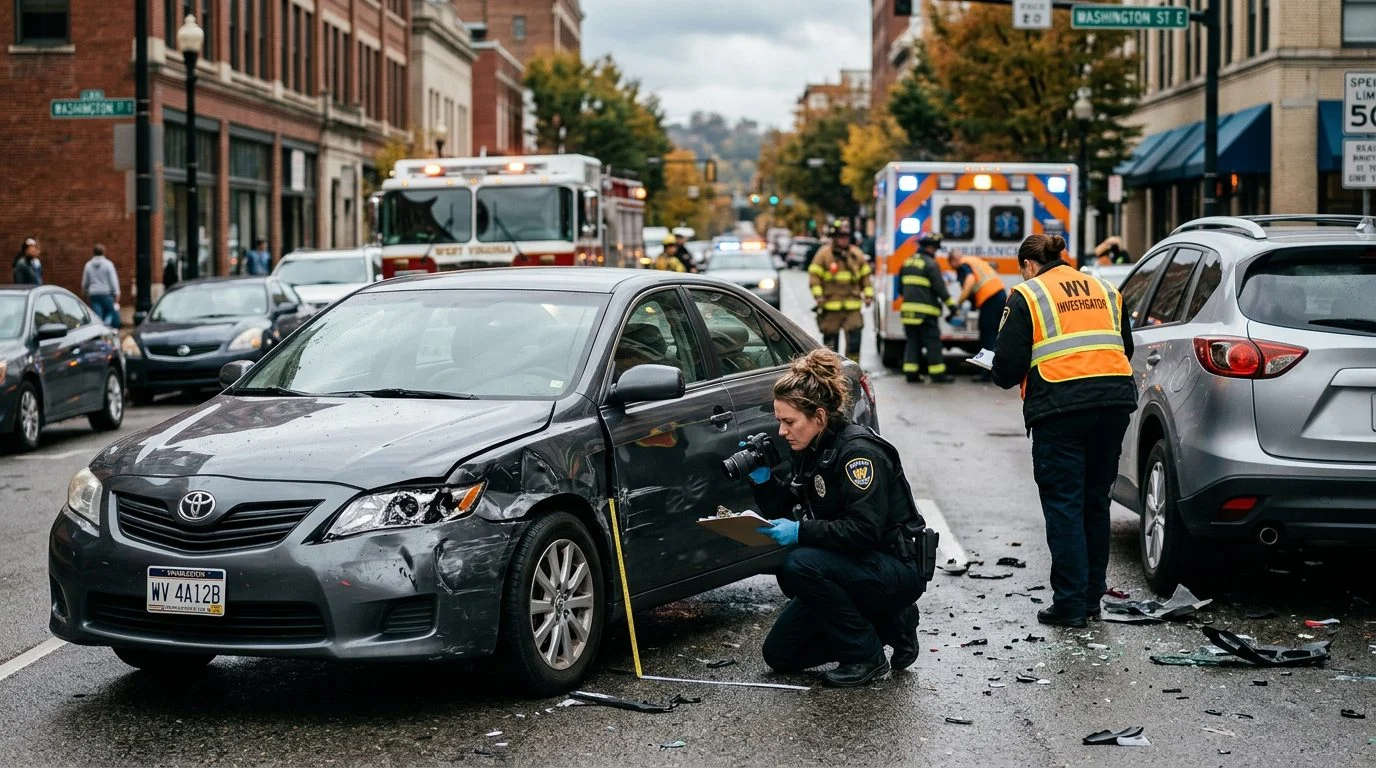
Car Accident Claims in West Virginia
Worried About Being Sued After a Car Accident?
Learn how claims against drivers work in West Virginia, what the papers you receive mean, and how to respond with a clear plan.
Published November 9, 2026
Getting a demand letter or court papers after a crash can be frightening, especially if you don’t think the crash was your fault. Here is what you need to know.
Short Answer: Yes, a Driver Can Be Sued After a Crash in West Virginia
A driver can be sued after a car accident in West Virginia, usually when another person claims that driver’s negligence caused injury or property damage. Being named in a claim does not, by itself, prove the driver was at fault. Fault depends on how the crash happened, and each case turns on its own facts. This page explains who can bring a claim, how fault is divided, how insurance responds, when an employer may be named, and how long a claim generally has to be filed.
Not sure what your next step is?
Talk it through with Big Bubba — the first case review is free, confidential, and carries no obligation.

Who Can Bring a Claim Against a Driver
Injured drivers, passengers, pedestrians, and cyclists may bring a claim against a driver they believe caused a crash. A passenger may pursue a claim against the driver of the vehicle they were riding in, and may have claims against more than one driver if both share fault. Vehicle owners and property owners may also bring claims for damage to a car, a fence, or other property.
When a crash causes a death, the family may pursue a wrongful death claim. Under W. Va. Code § 55-7-6, the action is brought by the deceased person’s personal representative, who has been duly appointed. The firm handles wrongful death claims as well as car accident claims, so families can get help with that process directly.
Common reasons a lawsuit follows a crash include serious injury, disputed fault, a driver who was distracted or impaired, and disagreement over medical bills or repair costs. Many people assume the police report settles who was at fault. It does not. A crash report is one piece of evidence, alongside photographs, witness statements, and vehicle damage.
How Fault Is Decided in West Virginia
West Virginia uses a modified comparative fault rule, which means an injured person’s own share of fault can reduce what they recover (W. Va. Code § 55-7-13c).
Shared blame is common in disputed crashes. Fault can also be assigned to a nonparty, such as another driver who was not named in the suit. Under W. Va. Code § 55-7-13d, a defending party may have a nonparty’s fault considered if it gives notice no later than one hundred eighty days after service of process upon that defendant, stating that the nonparty was wholly or partially at fault. W. Va. Code § 55-7-13d addresses how that fault is considered.
Some exceptions apply.
In rear-end crashes, fault is usually decided by looking at following distance, braking, and the traffic conditions at the time. Photos, vehicle damage, and witness accounts may help show what happened, depending on the facts.
How Insurance Responds When a Driver Is Sued
West Virginia requires drivers to carry liability insurance. W. Va. Code § 17d-4-2 defines proof of financial responsibility. Since January 1, 2016, the minimums are $25,000 for bodily injury or death of one person in one accident, $50,000 for two or more people in one accident, and $25,000 for property damage, though a policy in effect on December 31, 2015 that meets the older minimums shall continue to provide adequate proof of financial responsibility until the policy expires or is renewed.
Those are minimums, not the full picture. W. Va. Code § 33-6-31 requires liability policies to cover the named insured and other people who drive the car with consent, for negligent operation, except a bailee for hire and any persons specifically excluded by a restrictive endorsement attached to the policy. That means a policy may protect more than the owner.
A liability insurer may provide a defense and pay covered damages up to the policy limits. W. Va. Code § 33-6-31 reads: “unless it contains an endorsement or provisions undertaking to pay the insured all sums which he or she is legally entitled to recover as damages from the owner or operator of an uninsured motor vehicle, within limits which shall be no less than the requirements of section two, article four, chapter seventeen-d of this code, as amended from time to time: Provided, That such policy or contract shall provide an option to the insured with appropriately adjusted premiums to pay the insured all sums which he or she shall be legally entitled to recover as damages from the owner or operator of an uninsured motor vehicle up to an amount of $100,000 because of bodily injury to or death of one person.” W. Va. Code § 33-6-31 concerns uninsured and underinsured motorist coverage. W. Va. Code § 33-6-31 reads: “unless it contains an endorsement or provisions undertaking to pay the insured all sums which he or she is legally entitled to recover as damages from the owner or operator of an uninsured motor vehicle, within limits which shall be no less than the requirements of section two, article four, chapter seventeen-d of this code, as amended from time to time: Provided, That such policy or contract shall provide an option to the insured with appropriately adjusted premiums to pay the insured all sums which he or she shall be legally entitled to recover as damages from the owner or operator of an uninsured motor vehicle up to an amount of $100,000 because of bodily injury to or death of one person.” Under that section, a policy may not be issued unless it includes an endorsement or provisions to pay the insured the sums they are legally entitled to recover as damages from the owner or operator of an uninsured motor vehicle. W. Va. Code § 33-6-31 reads: “unless it contains an endorsement or provisions undertaking to pay the insured all sums which he or she is legally entitled to recover as damages from the owner or operator of an uninsured motor vehicle, within limits which shall be no less than the requirements of section two, article four, chapter seventeen-d of this code, as amended from time to time: Provided, That such policy or contract shall provide an option to the insured with appropriately adjusted premiums to pay the insured all sums which he or she shall be legally entitled to recover as damages from the owner or operator of an uninsured motor vehicle up to an amount of $100,000 because of bodily injury to or death of one person.” The section also requires the policy to insure the named insured and anyone using the vehicle with the consent, expressed or implied, of the named insured or his or her spouse (except a bailee for hire and any persons specifically excluded by a restrictive endorsement attached to the policy) against liability for death, bodily injury, or loss or damage within the coverage of the policy that results from negligence in the operation or use of the vehicle. This is why many people ask about their coverage early.
Some insurers may dispute a claim or reserve their rights while they investigate coverage. Keep copies of every letter, note the dates you received them, and find your policy limits before you answer questions about the crash.
When Employers and Commercial Vehicles Are Involved
When a driver was working, the employer may be named in a claim alongside the driver. West Virginia recognizes respondeat superior, which can make an employer liable for an employee’s negligence within the scope of the job.
Employers may also face direct claims. A negligent hiring case shows how that claim has been framed.
Commercial trucks and vans fall under federal safety rules. The Federal Motor Carrier Safety Regulations set out requirements for commercial motor vehicles, and those rules can matter when a crash involves a company truck. West Virginia law also limits certain noneconomic damages against some employers of commercial motor vehicles. Under W. Va. Code § 55-7-32, that limit depends on conditions, including the employer’s insurance and the driver’s conduct, and exceptions may apply.
Deadlines: How Long Someone Has to File
West Virginia generally allows two years to file a personal injury lawsuit, and exceptions may apply. W. Va. Code § 55-2-12 sets two years for personal injury claims and two years for damage to property. The clock generally starts when the right to sue accrues, which is not always the same day as the crash.
Wrongful death claims follow their own timing. Under W. Va. Code § 55-7-6, a wrongful death action generally must be commenced within two years after the death, subject to other provisions of state law. W. Va. Code § 55-7-6 reads: “The provisions of this section shall not apply to actions brought for the death of any person occurring prior to July 1, 1988.”
A claim filed after the deadline may be dismissed. Because the start date matters, don’t assume you have the full time from the crash without checking. A lawyer can explain how these rules apply to a specific crash.
Not sure what your next step is?
Talk it through with Big Bubba — the first case review is free, confidential, and carries no obligation.

If You Have Received a Demand Letter or Lawsuit Papers
A demand letter is a written request for payment. It is not a court filing. Lawsuit papers, usually a complaint and summons, are filed in court and carry response deadlines.
Don’t ignore court papers. Missed responses can have serious consequences, so note the date you received them and keep every page. If your vehicle was totaled, the same two-year property rules may apply to vehicle loss, and related questions about value are covered separately.
Can a passenger sue the driver?
Generally, yes. A passenger may bring a claim against a driver, and fault decides how much, if anything, is recovered.
Is a demand letter the same as a lawsuit?
No. A demand letter asks for payment, while a lawsuit is filed in court and served with a summons.
If you were seriously hurt in a crash in West Virginia, or you are a family member facing a wrongful death, you don’t have to sort out the deadlines and insurance questions alone. If you were the one hurt in a West Virginia crash and another driver may have been at fault, you can call the firm about your injury claim or tell us what happened.