
Truck Accident Claims
Can You Sue a Truck Driver in West Virginia?
When a commercial truck crash leaves you seriously hurt, you may have a claim against the driver, the company, or both. Here's what you need to know.
Published October 05, 2026
Yes, you may be able to sue a truck driver if their negligence or recklessness caused your injuries, depending on the facts. In West Virginia, truck drivers and the companies that employ them can be held legally responsible for harm caused by their actions or failures to act. Understanding who you can sue—and why—is the first step toward protecting your rights after a serious crash.
Yes, you can sue a truck driver—here’s what that means
A truck driver can be held liable for injuries or deaths caused by their negligence, recklessness, or violation of trucking regulations. Suing a truck driver is often part of a larger claim that may also involve the trucking company, the truck owner, or other parties. West Virginia law allows injured people to pursue compensation when a truck driver’s actions caused harm.
In practice, the truck driver is usually covered by the trucking company’s insurance or their own commercial liability insurance. This means the financial responsibility often falls on the company, not the individual driver. Still, naming the driver as a defendant in your lawsuit is important—it establishes who caused the crash and strengthens your claim against the company.
Not sure what your next step is?
Talk it through with our team — the first case review is free, confidential, and carries no obligation.
What makes a truck driver liable?
Under West Virginia’s comparative fault rules, a truck driver may be found liable when their conduct was a proximate cause of the harm, and fault may be divided among the parties (W. Va. Code § 55-7-13c). Common examples include:
- Negligent driving: speeding, distracted driving, fatigue, improper lane changes, or following too closely
- Recklessness: driving while impaired or intoxicated
- Violations of federal or state trucking regulations: Federal Motor Carrier Safety Regulations govern hours of service, vehicle maintenance, cargo loading, and driver qualifications. Under W. Va. Code § 55-7-9, a person injured by a violation of a statute may recover damages from the offender, unless a penalty is expressly stated to be in lieu of those damages.
- Failure to maintain the truck: not reporting known mechanical problems or ignoring safety issues
- Hours-of-service violations: driving beyond legal limits without proper rest, which increases fatigue and error
Can truck drivers be sued?
Yes, truck drivers can be sued. However, in most cases you’ll pursue both the driver and the trucking company because that’s where the insurance and assets are located. A truck driver’s personal assets are often insufficient to cover serious injuries or death, so the company’s liability insurance is where compensation comes from.
When you sue a truck driver, you’re typically also suing the company that employs or contracts with that driver. The company may be liable under several legal theories:
- Vicarious liability: the company is responsible for the driver’s negligent actions simply because the driver was acting within the scope of employment
- Negligent hiring: the company hired a driver with a poor safety record or history of violations
- Negligent training or supervision: the company failed to train the driver properly or failed to supervise their conduct
- Negligent maintenance: the company failed to maintain the truck, and that failure caused or contributed to the crash
Suing the truck driver versus the trucking company
You can pursue both the driver and the company, and in most cases you should. Here’s why:
Direct driver negligence means the driver’s own careless or reckless actions caused the crash—speeding, running a red light, or driving while fatigued. You can sue the driver directly for these actions.
Trucking company liability exists even if the company itself didn’t cause the crash. The company can be held responsible for negligent hiring (hiring an unqualified or unsafe driver), negligent training (failing to teach safe practices), negligent supervision (failing to monitor the driver’s conduct), or negligent maintenance (failing to keep the truck in safe condition).
Vicarious liability means the company is responsible for the driver’s actions simply because the driver was working for the company at the time of the crash. This is often the strongest theory of liability against the company.
Pursuing both the driver and the company gives you the best chance at full compensation. The company has deeper insurance coverage and more assets than the driver alone.
Have questions about what happened?
Ask our team directly. The first conversation is free, confidential, and there is no obligation to continue.
Other parties who might share liability
Depending on the facts of your crash, other parties may also be liable:
- The truck owner (if different from the company that employs the driver)
- The cargo loader or shipper (if improper loading caused the crash or made the truck unstable)
- The truck manufacturer (if a defective part caused or contributed to the accident)
- A maintenance company (if poor maintenance led to equipment failure)
- Another driver whose actions contributed to the crash
Identifying all liable parties expands your potential sources of compensation and increases the likelihood of full recovery.
How negligence is proven in a truck accident case
Proving a truck driver’s negligence requires evidence. Common sources include:
- The truck’s electronic data recorder (black box), which records speed, braking, acceleration, and other operational data
- The driver’s logbook and hours-of-service records, which show whether the driver complied with federal rest and driving-hour limits
- Witness statements from people who saw the crash
- Police report and accident reconstruction, which analyze how the crash occurred
- The driver’s and company’s safety records, training records, and maintenance logs
- Medical records documenting your injuries and treatment
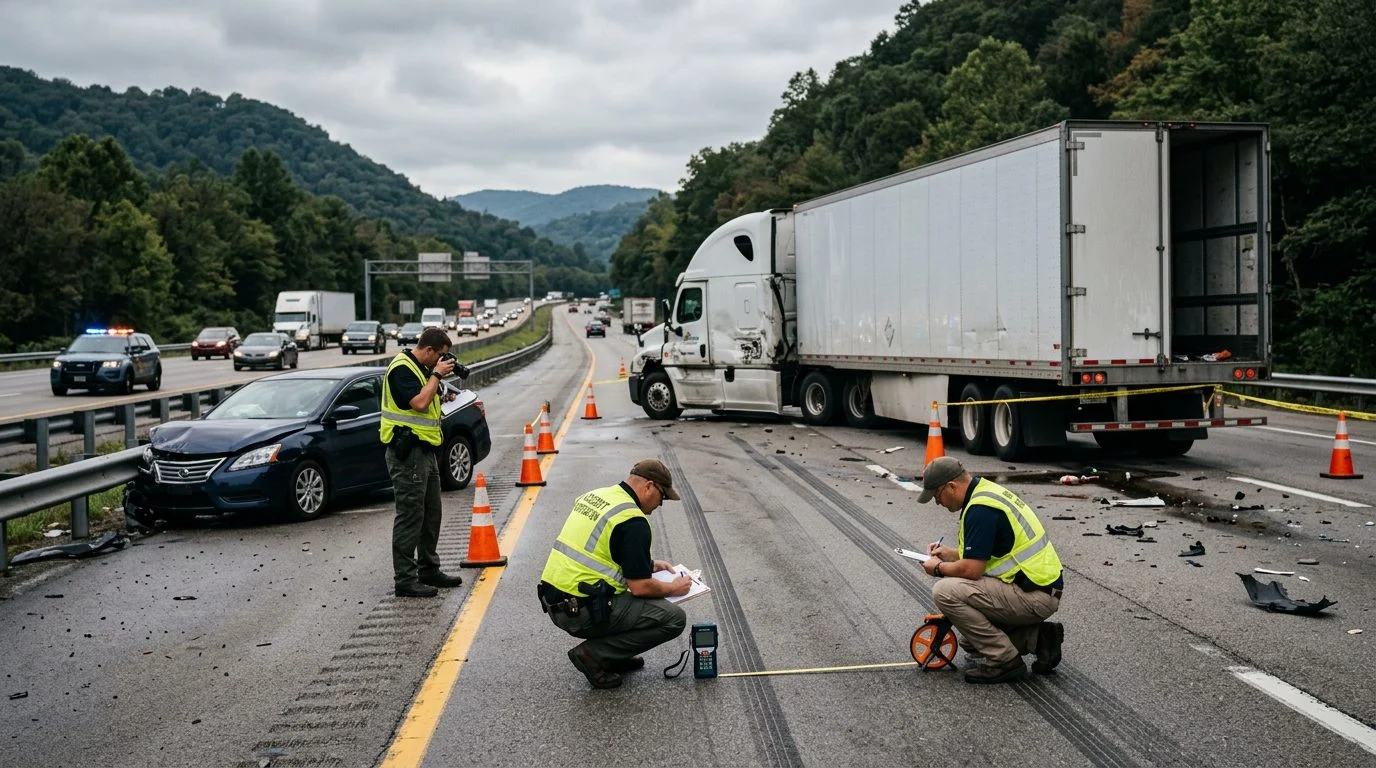
- Skid marks, vehicle damage, debris field, and road conditions from the crash scene
This evidence is gathered through investigation, police reports, and the legal discovery process (where both sides exchange documents and information). A lawyer can help you obtain and interpret this evidence.
Deadlines and time limits for suing a truck driver
West Virginia has a strict deadline for filing a lawsuit. Under West Virginia law, you generally have two years from when your right to sue accrued to file a personal-injury lawsuit. This deadline applies whether you’re suing the driver, the company, or both.
Missing this deadline may bar your claim, meaning you may lose the right to pursue compensation. Acting promptly—consulting with a lawyer early—protects your right to file suit and preserves evidence while memories are fresh and records are still available.
Insurance claims versus lawsuits
Many truck accident claims are resolved through insurance without going to trial. An insurance claim is often faster and less costly than a lawsuit. The trucking company’s insurance company will investigate the crash and may offer a settlement.
If the insurance company denies your claim or offers too little to cover your injuries, you can file a lawsuit. A lawyer can help you decide whether to pursue an insurance claim first, file a lawsuit, or pursue both strategies.
Want to know where you stand?
Tell us what happened and our team will walk you through the options available to you, at no cost.
West Virginia’s comparative fault rule
West Virginia follows a modified comparative fault rule. You can recover damages even if you are partially at fault for the crash—as long as you are no more than 50% at fault. If you are found to be more than 50% at fault, you cannot recover anything.
This rule means that even if the truck driver wasn’t entirely at fault, you may still have a valid claim. Your recovery may be reduced by your percentage of fault, and under W. Va. Code § 55-7-13c, each defendant is generally liable only for its share of compensatory damages, in direct proportion to its percentage of fault.
FAQ
Can I sue a truck driver directly, or only the company?
You can sue the driver directly for their negligence, and you can also sue the company for negligent hiring, training, supervision, or maintenance. Pursuing both gives you the strongest claim.
How long do I have to sue a truck driver in West Virginia?
You generally have two years from when your right to sue accrued to file a lawsuit (W. Va. Code § 55-2-12). This deadline is strict and cannot be extended in most cases.
What if the truck driver doesn’t have insurance?
The trucking company usually carries commercial liability insurance that covers the driver’s actions. If the company is underinsured, you may pursue the driver’s personal assets or other liable parties.
Can I recover damages if I was partially at fault?
Yes, as long as you are no more than 50% at fault. Your recovery will be reduced by your percentage of fault (W. Va. Code § 55-7-13c).
What damages can I recover from a truck driver?
Damages may include medical expenses, lost wages, pain and suffering, disability, and in wrongful death cases, funeral costs and loss of companionship.
If a truck driver’s negligence caused your crash and injuries, you may have a claim, and filing deadlines matter (W. Va. Code § 55-2-12). Reach out to discuss what happened, and we’ll help you understand your options.
Related practice areas
- Truck Accident Claims in West Virginia | Big Bubba Legal
- When Should I Hire a Truck Accident Lawyer? | WV