
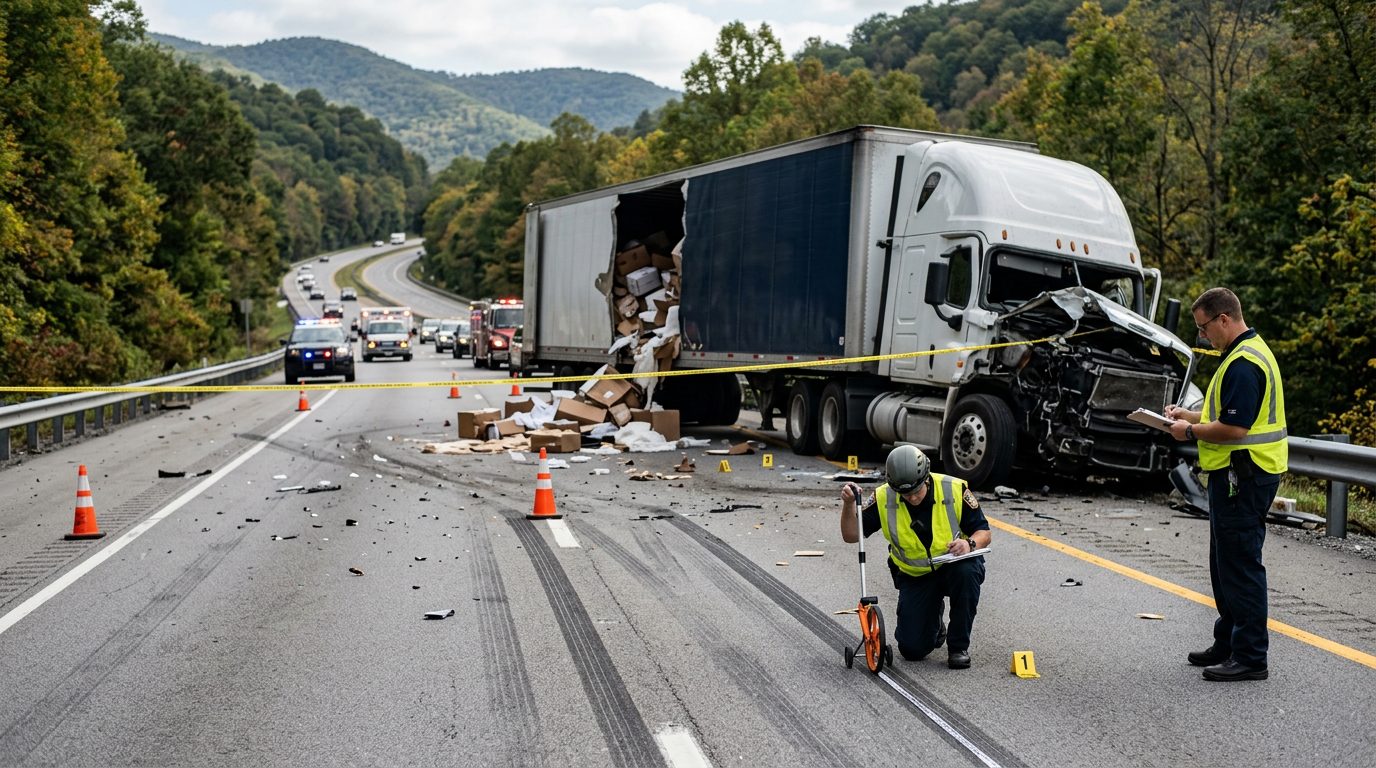
Catastrophic Injuries
Catastrophic Injuries from Commercial Truck Accidents in West Virginia
When a commercial truck crash leaves you or a loved one with life-altering injuries, you need a firm ready to fight for fair compensation. We serve injury victims across West Virginia.
Published October 08, 2026
Catastrophic Injuries from Commercial Truck Accidents in West Virginia
When a commercial truck collides with a passenger vehicle, the result is often catastrophic injury. The sheer weight and force involved mean that victims of commercial truck accidents frequently suffer traumatic brain injuries, spinal cord damage, permanent paralysis, and other life-altering harm. Understanding what these injuries mean—and what may have caused them—is the first step toward recovery and protecting your family’s future.

Not sure what your next step is?
Talk it through with our team — the first case review is free, confidential, and carries no obligation.
What Makes Commercial Truck Accidents Different
Commercial trucks weigh 20,000 to 80,000 pounds or more, compared to passenger vehicles at 3,000 to 4,000 pounds. This 20-to-30-fold weight difference creates vastly greater impact forces in collisions. When a semi-truck or tractor-trailer strikes a car, the physics of the crash overwhelm the safety systems designed for vehicle-to-vehicle impacts of similar mass.
The types of commercial vehicles involved matter too. Tractor-trailers, tanker trucks carrying hazardous materials, logging trucks, flatbeds, and dump trucks all pose unique hazards. A tanker truck accident, for example, may involve not only the collision itself but also fire, chemical exposure, or explosions. A logging truck may shed its load across the roadway, creating secondary collisions. These scenarios produce injuries far more severe than typical car accidents.
The result: catastrophic injuries—permanent, life-altering damage—occur far more often in commercial truck crashes than in collisions between passenger vehicles.
Traumatic Brain Injury from Truck Accidents
Traumatic brain injury (TBI) occurs when a sudden blow or jolt to the head damages brain tissue. In a commercial truck accident, head trauma can happen even when the victim is wearing a seatbelt. The force of impact may cause the brain to move inside the skull, tearing nerve fibers and damaging brain cells.
Immediate Symptoms
Right after the injury, a person may lose consciousness, feel confused, suffer severe headaches, or experience nausea and vomiting. Some victims have no memory of the accident itself. These early signs can be obvious—but not always. Some people feel “fine” immediately after impact, only to develop serious symptoms hours or days later.
Long-Term Effects
The real challenge with traumatic brain injury is what happens next. Survivors often face:
- Cognitive changes: difficulty concentrating, memory loss, trouble with problem-solving
- Personality and emotional changes: irritability, depression, anxiety, emotional instability
- Physical symptoms: chronic headaches, dizziness, sleep disturbances, sensitivity to light or noise
- Behavioral changes: impulsivity, aggression, or withdrawal
These effects can persist for months or years. Some people recover substantially; others live with permanent limitations. A person who was a sharp accountant before the crash may struggle to balance a checkbook afterward. A parent may find it hard to remember their child’s schedule. A worker may no longer be able to perform their job.
Severity Levels
Doctors classify TBI as mild, moderate, or severe based on loss of consciousness, memory loss, and imaging findings. Even “mild” TBI—often called a concussion—can have lasting effects. Moderate and severe TBI typically require weeks or months of rehabilitation and may result in permanent disability.
Spinal Cord Injury and Paralysis
The spinal cord is a bundle of nerves that carries signals from the brain to the rest of the body. When a commercial truck accident causes severe trauma to the spine—through crushing, severing, or bruising—those nerve signals may be interrupted. The result can be partial or total loss of sensation and movement below the injury site.
Complete vs. Incomplete Injury
A complete spinal cord injury means the nerve fibers are fully severed or so severely damaged that no signals cross the injury site. The person loses all sensation and motor function below that level permanently.
An incomplete injury means some nerve fibers remain intact. Recovery is possible, and the extent varies widely. Some people regain significant function; others experience only modest improvement.
Tetraplegia and Paraplegia
Tetraplegia (also called quadriplegia) occurs when the injury is in the neck (cervical spine). It results in paralysis of all four limbs, the trunk, and often the ability to breathe without a ventilator.
Paraplegia occurs when the injury is in the mid-back or lower back (thoracic or lumbar spine). It results in paralysis of the legs and lower body but leaves arm and hand function intact.
Both conditions mean permanent dependence on wheelchairs, assistive devices, and often round-the-clock care.
Chronic Pain and Secondary Complications
Many spinal cord injury survivors experience chronic pain—nerve pain that persists long after the initial injury heals. They may also face:
- Muscle spasticity (involuntary muscle contractions)
- Bladder and bowel dysfunction
- Sexual dysfunction
- Pressure sores (if mobility is limited)
- Respiratory complications
- Infections
These secondary problems require ongoing medical management and can worsen quality of life significantly.
Have questions about what happened?
Ask our team directly. The first conversation is free, confidential, and there is no obligation to continue.
Other Catastrophic Injuries in Commercial Truck Crashes
Traumatic brain injury and spinal cord injury are the most common catastrophic outcomes, but commercial truck accidents cause other severe, life-altering harm:
- Severe burns: Tanker trucks carrying fuel or hazardous materials may rupture and ignite, causing third-degree burns over large areas of the body.
- Crush injuries and amputation: A person trapped under a truck or between vehicles may lose limbs or suffer organ damage that requires amputation.
- Internal bleeding and organ damage: Blunt force trauma can rupture the liver, spleen, kidneys, or other organs, requiring emergency surgery and leaving lasting complications.
- Multiple fractures: Complex fractures of the pelvis, femur, or spine may require multiple surgeries and leave the person with chronic pain or permanent mobility loss.
- Facial and disfiguring injuries: Severe lacerations, burns, or fractures to the face may require reconstructive surgery and leave visible scarring.
The Cost of Catastrophic Injury: Medical and Life Care
A catastrophic injury from a commercial truck accident is not just a medical event—it is a financial and logistical crisis.
Immediate costs include emergency transport, emergency surgery, and intensive care hospitalization. A severe spinal cord injury or traumatic brain injury may require weeks in the hospital and months in a rehabilitation facility.
Ongoing medical care includes physical therapy, occupational therapy, neuropsychological testing, medications, and regular doctor visits. Many catastrophic injury survivors need this care for life.
Long-term care and support may include:
- In-home nursing or attendant care (often 24/7 for severe injuries)
- Adaptive equipment: wheelchairs, lifts, specialized beds
- Home modifications: ramps, accessible bathrooms, widened doorways
- Specialized transportation
- Medications and medical supplies
Lost income is another devastating cost. A person who cannot work loses not only current wages but also the ability to earn for decades. If the injury occurs at age 35, the lost earning capacity over a 30-year career can be substantial.
The total lifetime cost of caring for a person with a severe spinal cord injury or traumatic brain injury can reach into the millions of dollars. These costs don’t disappear. They compound over time, and families often face impossible choices about care, housing, and financial survival.
Liability in Commercial Truck Accident Cases
When a commercial truck causes a catastrophic injury, more than one party may be responsible.
The truck driver may be liable if they were speeding, fatigued, distracted, impaired, or otherwise operating the truck negligently.
The trucking company may be liable under several theories:
- Negligent hiring: The company failed to properly investigate the driver’s background or qualifications before hiring them.
- Negligent retention: The company knew or should have known the driver was unfit but kept them employed anyway.
- Negligent supervision: The company failed to properly train or supervise the driver.
- Negligent entrustment: The company allowed an unfit driver to operate the truck.
Other parties may include maintenance contractors who failed to repair brakes or other safety equipment, cargo loaders who overloaded the truck, or brokers who negligently selected an unsafe carrier.
Federal regulations require truck drivers to be at least 21 years old, physically qualified, and hold a valid commercial motor vehicle license. They also prohibit carriers from requiring a driver to operate while fatigued or impaired. Motor carriers must systematically inspect, repair, and maintain all vehicles, with records kept for at least one year. Violations of these regulations often point to negligence.
In West Virginia, an injured person can recover damages even if they share some fault for the accident, as long as their own fault is not greater than the combined fault of all other parties. Under this modified comparative fault rule, your fault does not bar recovery unless it is greater than the combined fault of all other persons responsible for the damages, and any recovery is reduced in proportion to your degree of fault.
Want to know where you stand?
Tell us what happened and our team will walk you through the options available to you, at no cost.
When to Reach Out for Legal Guidance
If you or a family member has suffered a catastrophic injury in a commercial truck accident, you may be facing overwhelming medical decisions, mounting bills, and uncertainty about the future. You may also be unsure who is responsible or what your legal rights are.
This is the time to reach out. An experienced legal team can:
- Investigate the accident and identify all liable parties
- Obtain and review medical records, accident reports, and truck maintenance logs
- Work with medical experts to document the injury and its long-term impact
- Handle communication with insurance companies
- Help you understand your options and what recovery might look like
You don’t have to make these decisions alone while you or your loved one is healing. The sooner you reach out, the sooner you can focus on recovery while someone else handles the legal and financial details.
Frequently Asked Questions
What is the deadline to file a lawsuit after a commercial truck accident in West Virginia?
In West Virginia, you generally have two years from when the right to bring your claim accrued to file a personal injury lawsuit. Waiting too long may bar your claim, although exceptions may apply.
Can I sue the trucking company directly, or only the driver?
You can pursue claims against both the driver and the trucking company. The company may be liable for the driver’s negligence under theories like negligent hiring, retention, or supervision, even if the driver was also at fault.
What if I was partially at fault for the accident?
West Virginia’s modified comparative fault rule allows you to recover damages even if you share some fault, as long as your fault is not greater than the combined fault of all other responsible parties (W. Va. Code § 55-7-13c). If your fault is less than the combined fault of all other responsible persons, your recovery will be reduced in proportion to your degree of fault.
What damages can I recover in a catastrophic injury case?
The types of damages available depend on the facts of each case. Each case is unique, and the amount depends on the severity of the injury and its impact on your life.
How long does recovery from a traumatic brain injury take?
Recovery varies widely. Some people show improvement for months or even years after injury. Others reach a plateau where further recovery is unlikely. Your medical team can provide a more specific timeline based on your particular injury.
If you or a family member has suffered a catastrophic injury in a commercial truck accident and you’re trying to understand what comes next, reach out to discuss your situation. You may have a claim, and you deserve to know your options.
Related practice areas
- Truck Accident Claims in West Virginia | Big Bubba Legal
- Can You Sue a Truck Driver? Liability After a West Virginia Truck Crash
- Can I Afford a Truck Accident Lawyer? Understanding Fees and Costs
- Truck Accident Injuries: Broken Bones & Internal Damage