
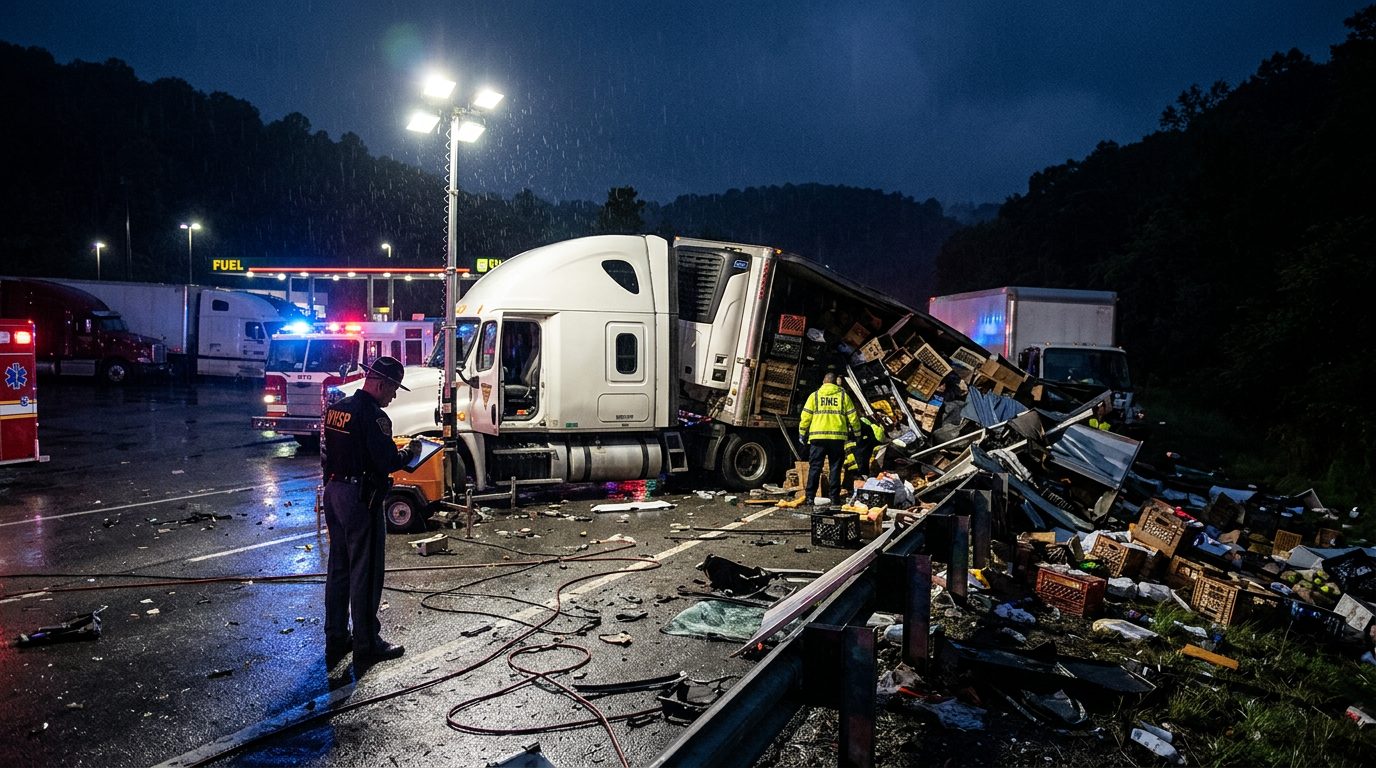
West Virginia | Falling cargo truck crashes
When a Load Falls, the Injuries Can Be Serious
How these crashes happen on West Virginia roads, who may share responsibility, and how the firm can help you understand your options.
Published November 25, 2026
If a load slid off a truck and hit your car, or came loose beside you on the highway, you may be wondering what comes next. Falling cargo crashes can cause serious injuries, and the cause often traces back to how the load was secured.
A falling cargo crash happens when freight shifts, breaks loose, or drops from a commercial truck onto the road or into traffic. Federal rules require cargo to be properly distributed and adequately secured so it cannot shift on or within, or fall from, the vehicle (49 C.F.R. § 392.9). This guide explains how these crashes happen, who may be involved, and what evidence to keep in West Virginia.
How Falling Cargo and Load Shift Crashes Happen
Most falling cargo crashes start with a load that was not held firmly in place. Loads can shift during sharp turns or hard braking. Straps and chains can fail. Items can slide off flatbeds and open trailers.
The harm does not always stay with the truck. A pallet, pipe, or machine part can strike a car, a motorcycle, or a pedestrian. Debris can cause a second crash behind it.
Federal cargo rules say each commercial motor vehicle must, when transporting cargo on public roads, be loaded and equipped, and the cargo secured, to prevent the cargo from leaking, spilling, blowing or falling from the vehicle, and cargo must be contained so it does not shift to an extent that adversely affects the vehicle’s stability or maneuverability (49 C.F.R. § 393.100). How the load moved and fell is a fact question. Investigators usually examine it closely.
Not sure what your next step is?
Talk it through with Big Bubba — the first case review is free, confidential, and carries no obligation.

Who May Be Responsible for a Falling Cargo Crash
More than one party may have a role in a falling cargo crash, depending on the facts. The driver, the motor carrier, the company that loaded the truck, and a freight broker may each be involved. The equipment owner may be too.
West Virginia law defines an “employer defendant” to include the owner of a commercial vehicle, the employer of its driver, and anyone who holds legal control over the vehicle or driver (W. Va. Code § 55-7-32). Who controlled the loading, the securing, and the driving often matters.
West Virginia generally divides fault by percentage among the people who caused the harm (W. Va. Code § 55-7-13c). Your own share of fault may reduce a recovery. Under that statute, it does not bar recovery unless it is greater than the combined fault of everyone else responsible. W. Va. Code § 55-7-13c reads: “(c) Any fault chargeable to the plaintiff shall not bar recovery by the plaintiff unless the plaintiff’s fault is greater than the combined fault of all other persons responsible for the total amount of damages, if any, to be awarded.”
Load Securement Rules and Why They Matter in a Claim
Federal securement rules set the standard for how cargo must be held. Cargo must be firmly immobilized or secured on or within a vehicle by structures of adequate strength, dunnage or dunnage bags, shoring bars, tiedowns, or a combination of these. This rule does not cover bulk commodities that lack structure or fixed shape, such as liquids, gases, grain, or sand. Items likely to roll need chocks, wedges, or a cradle (49 C.F.R. § 393.106).
Tiedowns must be in proper working order. Tiedowns must be in proper working order when used to perform that function, with no damaged or weakened components. Cracks or cuts that will adversely affect their performance, including reducing the working load limit, are damage of that kind (49 C.F.R. § 393.104). A tiedown’s working load limit is the lowest rating of any of its parts or anchor points (49 C.F.R. § 393.108).
The driver has duties too. The driver of a truck or truck tractor must check again after 3 hours of driving or 150 miles, whichever comes first, or after a change in duty status.
A securement problem may be relevant evidence, depending on the facts. It does not prove fault on its own. Investigators and attorneys review the cargo, the equipment, and the paperwork together.
Injuries These Crashes Can Cause
Falling cargo can cause head injuries, spinal cord injuries, crush injuries, broken bones, and internal injuries. A heavy object can strike a person with little warning, and the force may be hard to predict.
Some of these injuries are catastrophic. They can require long-term medical care, rehabilitation, and changes to daily life. The full extent of an injury is often not clear for some time after the crash.
Injury severity and recovery vary from person to person. Questions about your own prognosis belong with your treating medical team. Learn more about catastrophic injuries, traumatic brain injury, and spinal cord injury.
What to Photograph After a Falling Cargo Crash
Photograph the scene only when it is safe to do so. Start with the truck and trailer from several angles. Capture the cargo on the road or inside the vehicle.
Look closely at the tiedowns, straps, chains, and anchor points. Photograph any gaps, broken parts, or missing hardware in the load. These details can show how the cargo was held.
Record the road, lane markings, weather, skid marks, and debris. Note where each vehicle came to rest. Photograph your own vehicle and any visible injuries.
Write down the truck company’s name, the USDOT number, the trailer number, and the license plate. Photograph any markings on the truck or trailer. Keep original files with their date and time data. Do not edit them.
Records and Documents to Keep and Request
Keep your crash report, its report number, and the insurance information you receive at the scene. Save the names and contact details of witnesses. Keep every letter or message from the trucking company or an insurer.
West Virginia law requires the investigating officer to prepare a crash report when a crash occurring on the public streets or highways of this state causes injury, death, or total property damage to an apparent extent of $1,000 or more. The officer must submit it within 24 hours after finishing the investigation. If the investigation cannot be completed within 10 days of the crash, a preliminary report is due on the 10th day after the crash (W. Va. Code § 17c-4-7). Learn how to read one in our guide to the truck accident crash report in West Virginia.
A claim review may look at bills of lading, loading records, and driver logs. Except for a private motor carrier of passengers (nonbusiness), federal rules require a motor carrier subject to the rules to have each driver record duty status for each 24-hour period (49 C.F.R. § 395.8). A written request asking the carrier to preserve these records may be relevant, depending on the facts. Timing matters, so act early.
Not sure what your next step is?
Talk it through with Big Bubba — the first case review is free, confidential, and carries no obligation.
Medical Care and Documentation After the Crash
Get a medical evaluation soon after any crash. Pain or confusion may appear hours or days later, even when the first symptoms seemed minor. Follow the treating providers’ instructions.
Keep every visit record, test result, prescription, and bill. A clear medical history can matter later. Our medical visit checklist for truck accidents in West Virginia lists what to track.
Families of someone hurt in a crash can help too. Write down daily changes in the person’s condition, along with new limits on work, driving, or care needs.

Talking With the Firm About Your Falling Cargo Crash
A falling cargo crash often raises hard questions. Who loaded the truck? How was the cargo secured? Which companies were involved? Those questions can be reviewed in a conversation with the firm.
You may be facing a serious injury, caring for a loved one after a crash, or grieving a wrongful death. Decisions come quickly. Some insurers may dispute a claim, and you may be asked for a recorded statement.
Common Questions
Can more than one company be responsible for a falling load?
It may be possible, depending on the facts. The driver, carrier, loader, or broker may each have a role.
Does a securement violation prove who was at fault?
Not by itself. It may be relevant evidence, depending on the facts.
If a shifting load hurt you or someone you love, request a free case review at bigbubba.com/contact. Tell us what happened. We serve injury victims in Charleston, Huntington, Morgantown, and across West Virginia.