
Fatal Truck Crash Investigation | West Virginia
When a Truck Crash Takes a Life, Families Need Answers
Our firm helps West Virginia families understand what an investigation may involve and which questions are worth asking as they make decisions after a loss.
Published November 27, 2026
A loved one has died in a truck crash, and now you have questions. Who is investigating? When will you know what happened? A police investigation of a fatal truck crash in West Virginia may involve more than one agency, and the agency that leads the work holds the central file. Start by asking which agency responded, what the case number is, and who the assigned investigator is.
This guide walks through the questions families can ask, what an investigation may involve when a commercial truck is involved, and where a wrongful death claim fits alongside the police work. You don’t need every answer before you ask. Many families first hear about a crash from a news report, and those reports are often brief.
What Happens at the Scene of a Fatal Truck Crash in West Virginia
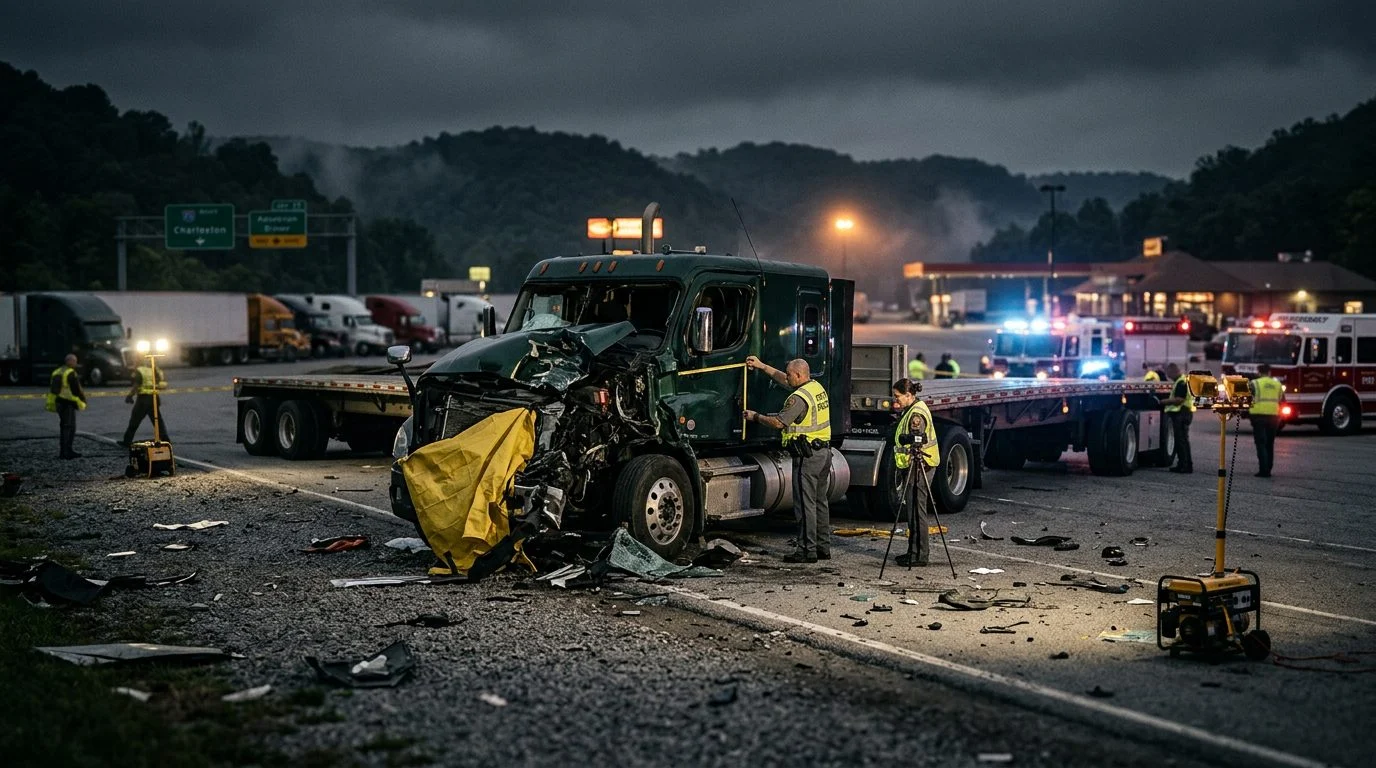
At the scene, responding officers generally work to secure the area, direct traffic, and record what they can see. They may note where each vehicle came to rest, the condition of the road, and any injuries.
Officers may also document skid marks, debris, and the position of the truck and trailer. These details can matter later. The state’s crash report format is meant to show the cause, the conditions at the time, and the vehicles and people involved (W. Va. Code § 17C-4-9).
A person may be pronounced dead at the scene. When that happens, the medical examiner or coroner process runs separately from the crash investigation. A coroner also has a reporting duty. State law requires coroners to report traffic crash deaths in writing to the Division of Highways by the tenth day of each month (W. Va. Code § 17C-4-11).
Rural roads and mountain highways can add challenges. Steep grades, sharp curves, and rollovers may make a scene harder to document, depending on the facts. Families are often not at the scene at all. They may learn what happened from a news story, and early reports can change as officers gather more information.
If you are still waiting for answers about how your loved one's crash happened, you can reach out to us for a free case review. Talk it through with Big Bubba — the first case review is free, confidential, and carries no obligation.

Which Agency Is Investigating and Why It Matters
The agency that responded and the agency leading the investigation are the first facts to confirm. Different agencies respond depending on where the crash happened and who has jurisdiction.
The West Virginia State Police may respond to crashes on many state roads and interstates. A county sheriff’s office may respond in areas outside city limits. A municipal police department may respond inside a city. Your loved one’s crash may involve more than one agency, so ask which one holds the lead file.
The investigating officer is the one who must prepare the crash report. State law generally requires that report within 24 hours after the investigation is complete for crashes occurring on the public streets or highways of this state resulting in bodily injury to, or death of, any person or total property damage to an apparent extent of $1,000 or more (W. Va. Code § 17C-4-7). Ask for the case or incident number, the investigator’s name, and the contact information for the records unit. Write these down in one place. You’ll need them for every later question.
Questions Families Can Ask the Investigating Agency
Four questions cover most of what families need to know at the start: whether the case is open, what vehicles were involved, what can be shared, and who to contact.
Is the investigation still open?
Ask whether a final report has been completed. If the investigation takes more than 10 days, state law generally calls for a preliminary report to the Division of Highways on the tenth day ([W.
Was a commercial vehicle or a second vehicle involved?
Ask whether the other driver left the scene. A driver in a crash involving injury or death generally must stop and stay at the scene, except to help the injured (W. Va. Code § 17C-4-1). If it was a hit-and-run, ask whether a vehicle is still being sought.
What can the agency share right now?
Agencies may hold back details while a case is active. Ask which parts are on hold and when you might be able to review them.
Who should the family contact, and how do you send new information?
If a witness saw the crash or a dash camera recorded it, give the investigator the witness’s name and the source of the footage. Send new information in writing and keep a copy.
What an Investigation May Involve When a Commercial Truck Is Involved
When a commercial truck is involved, an investigation can reach past the roadway into company records and driver testing.
Under federal rules at 49 C.F.R. Part 382, if an alcohol test is not given within two hours, the employer may need to keep a written record of why. If it is not given within eight hours, the employer must stop trying and keep that record too. Drug testing has its own 32-hour window, separate from the alcohol-testing timing described above.
Federal rules also generally require motor carriers to keep records of duty status and supporting documents for at least six months from the date they receive them (49 C.F.R. § 395.8). Those records can show how long a driver was on duty. The same section bars any driver or motor carrier from making a false report about duty status (49 C.F.R. § 395.8).
Investigators may look at the truck, its load, and its equipment. They may also request driver statements and licensing information, depending on the facts. The trucking company may hold dispatch, maintenance, or driver files that the police never see. Because some records have short retention periods, families often ask early what has been preserved.
How to Request a Crash Report and Related Records
You can ask the investigating agency for the crash report by giving its case or incident number, plus the date and location of the crash.
Expect that the report may not be ready right away. State law generally requires the investigating officer to prepare the report within 24 hours after completing the investigation, either electronically or in writing, for a crash on the public streets or highways resulting in bodily injury to, or death of, any person or total property damage to an apparent extent of $1,000 or more ([W. When the investigation takes longer, the final report comes later. The timing depends on the facts of the case.
The state also requires the investigating officer to share owner, operator, and insurance information within 24 hours of a crash, upon request, with the involved parties and their insurance agents ([W. Ask the agency how a family member can make that request.
A crash report is a summary. It may not contain every detail. Ask whether supplemental reports, photographs, or diagrams exist. A supplemental report can add facts the first report did not include.
Criminal Charges Versus a Civil Wrongful Death Claim
A defendant may ask a court to pause a civil claim while a related criminal case is pending when the defense rests on the claimant’s own felony, meaning the claimant (or, in a wrongful death case, the person who died) committed a felony and was hurt as a proximate result of that conduct, and exceptions may apply depending on the facts; and if the claimant was convicted of, or pleaded guilty or no contest to, a felony, the claim must be dismissed when the court determines as a matter of law that the claimant’s damages were suffered as a proximate result of that felonious conduct. The result of one does not automatically decide the other.
Prosecutors bring criminal charges. A civil wrongful death action is brought by the personal representative of the deceased person’s estate (W. Va. Code § 55-7-6). Criminal charges can follow their own process and timeline, and they can take a long time to resolve.
West Virginia law can treat leaving the scene as a felony when a crash proximately causes a death. That applies when the driver intentionally leaves, knows or has reason to believe someone was injured, and the death occurs within one year of the crash ([W.
A civil wrongful death verdict may include damages for sorrow, mental anguish, and solace. It may also include reasonably expected loss of income and services, medical and hospital expenses, and reasonable funeral expenses ([W. West Virginia law generally considers the fault of everyone who contributed to the damages, not only the driver, depending on the facts (W. Va. Code § 55-7-13d). The investigation file can be relevant to fault. It does not decide fault on its own.
Not sure what your next step is?
Talk it through with Big Bubba — the first case review is free, confidential, and carries no obligation.
Time Limits to Keep in Mind During an Investigation
West Virginia generally allows two years after the death to file a wrongful death action, and exceptions may apply (W. Va. Code § 55-7-6).
That two-year period runs from the death. It does not wait for the crash report. Families should not assume the police investigation will set the timeline. Investigations can take months, and a deadline may arrive before the file is complete.
The deadline and its consequences depend on the facts of each case, including who is involved and when the death occurred. Keep a dated log of questions, agency contacts, and records requests. A simple list can help you bring clear information to anyone you later decide to speak with. For more on the claim itself, see the firm’s wrongful death page.

Talking Through Your Questions Before You Decide What to Do Next
If you’re waiting on a police report while you grieve, you don’t have to sort out every question at once. Funeral plans, family calls, and unanswered questions about the crash can all arrive together.
We handle truck accident and wrongful death claims for families across West Virginia. We serve Charleston injury victims, Huntington injury victims, and Morgantown injury victims too. You can read more about truck accident claims in West Virginia on our site.
When you’re ready, bring the agency name, the case number, and your written questions to a free case review with the firm. You can talk through what you know at your own pace, and there is no obligation to move forward.
If you’re still waiting for answers about how your loved one’s crash happened, reach out to us to request a free case review.