
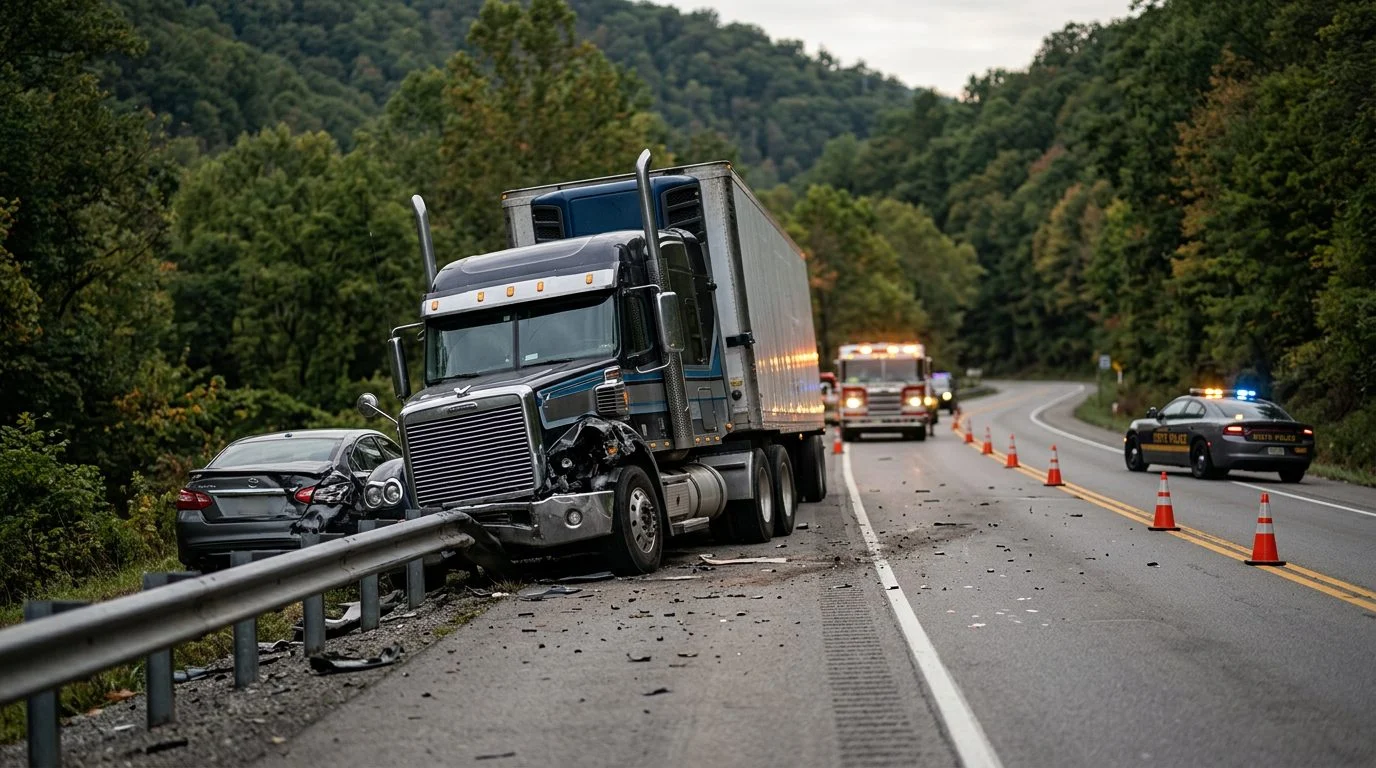
West Virginia Fatal Truck Crash Claims
When a Tractor-Trailer Crash Takes a Loved One
You do not have to face the questions alone.
Published November 7, 2026
Losing someone in a tractor-trailer crash brings grief, police contact, and paperwork all at once. This guide covers the fatal tractor-trailer crash family claim West Virginia families ask about most. In short, a family claim is a civil lawsuit over the losses caused by a death. It is separate from any criminal case against the driver. Below, you’ll find who may bring the claim, who may be responsible, which records matter, and how the process generally moves.
What a family claim after a fatal tractor-trailer crash covers
A family claim after a fatal truck crash is a civil lawsuit for losses caused by a death. It asks a court or jury to decide who is responsible and what the losses are worth. A criminal case asks a different question: whether someone broke the law. Under W. Va. Code § 55-7-5, when a wrongful act causes a death, the person or company that would have been liable had the injured person lived may be liable for damages.
Families often face this while police investigate, the medical examiner’s work is pending, and funeral decisions are due. Many people research these claims for a parent, child, or spouse who has died. You don’t need to have all the answers before you start asking questions.
If a tractor-trailer crash took someone your family loved, you may have options, and you don't have to sort through them alone. Talk it through with Big Bubba — the first case review is free, confidential, and carries no obligation.

Who may bring the claim in West Virginia
A wrongful death claim is generally brought by the personal representative of the deceased person’s estate. A personal representative is the person a court appoints to act for the estate. W. Va. Code § 55-7-6 requires the action to be brought in that person’s name. The appointment may have been made in West Virginia or in another state. Because appointment is a court step, ask early whether one has been named or is needed.
The statute also addresses who shares in the damages. It names the surviving spouse and children, including adopted children and stepchildren. It also names brothers, sisters, parents, and any persons financially dependent on the decedent at the time of death, or others who would otherwise be equitably entitled to share in such distribution. The court or jury can direct how damages are divided. Who qualifies depends on the family’s circumstances.
Who may be responsible when a tractor-trailer is involved
Several parties may be responsible in a truck crash. These can include the driver, the motor carrier, the truck’s owner or lessor, and companies that loaded cargo or maintained the truck. W. Va. Code § 55-7-32 defines an employer defendant to include the vehicle owner, the driver’s employer, and any entity with legal control over the truck or operator. Whether a particular company is responsible may depend on the facts.
Some claims focus on a company’s own choices.
Under W. Va. Code § 55-7-13c, each defendant’s share is generally based on its percentage of fault. Under West Virginia’s comparative fault statute, W. Va. Code § 55-7-13c, an injured person’s own share of fault generally reduces their recovery in proportion, and it bars recovery entirely if their fault is greater than the combined fault of all others responsible. Some insurers may dispute a claim or the fault they assign to each party.
Evidence that is often relevant after a fatal truck crash
Several kinds of records are often relevant after a fatal truck crash. Start with the police crash report, witness names, and any scene diagrams. Then look at the trucking records. Federal rules require a motor carrier subject to the requirements of this part to require each driver it uses to record the driver’s duty status for each 24-hour period, with some exceptions, such as private motor carriers of passengers (nonbusiness). 49 C.F.R. § 395.8 requires each 24-hour record to show total miles driven, the truck’s identification, and the motor carrier’s name. Under 49 C.F.R. § 395.8(e)(2), no driver or motor carrier may disable, deactivate, jam, or otherwise tamper with an electronic logging device so that it does not accurately record and retain required data.
After a crash involving a commercial motor vehicle operating on a public road in commerce, 49 C.F.R. § 382.303 requires the employer to test each surviving driver for alcohol and controlled substances as soon as practicable when the crash involved a fatality, or when the driver received a citation and someone was injured and treated away from the scene or a vehicle was disabled and towed away, though exceptions may apply. If an alcohol test is not given within two hours, the employer must keep a record of the reasons.
Preservation matters. 49 C.F.R. § 379.7 allows records to be preserved by any technology that accurately reflects all of the information in the record and remains accessible in a form that can be accurately reproduced later for reference. A written request asking the carrier to keep logs, dispatch messages, maintenance files, and truck data can help. Families should send one early, not after the investigation ends.
Medical examiner findings and toxicology results may also matter. Ask how to obtain them as soon as possible.
What families may be able to pursue
The wrongful death statute lists the kinds of damages a jury may award. W. Va. Code § 55-7-6 mentions sorrow, mental anguish, and solace, including companionship, guidance, and advice. It also covers reasonably expected loss of income, services, care, and assistance. Care and hospital costs tied to the injury, and reasonable funeral expenses, are included too.
Some losses are easier to document. Income records, bills, and receipts support economic losses. Non-economic losses, such as lost companionship, are usually described through the testimony of family members and others who knew the person.
If the person was injured before dying, a separate claim may apply. W. Va. Code § 55-7-8 allows a separate claim for damages between the injury and the death, joined in the same proceeding, where not otherwise provided for in sections five and six of this article. There is only one recovery for each element of damages.
No one can predict the value of a claim before the facts are known. The evidence, the parties involved, and the family’s losses all shape the claim.
Deadlines and why early action matters
West Virginia generally allows two years from the date of death to bring a wrongful death action. W. Va. Code § 55-7-6 sets that period. The statute says the period is subject to another provision of state law, so exceptions may apply. Every fatal tractor-trailer crash family claim West Virginia families consider has this deadline, so track it from the start.
Waiting can cost evidence. Records can be lost, and memories fade. A criminal case, if one is brought, runs on its own track. The West Virginia DMV impaired driving information describes state penalties for impaired driving. A criminal outcome may not decide the civil claim.
Write down dates, names, the route, and what you remember while it is fresh.
Not sure what your next step is?
Talk it through with Big Bubba — the first case review is free, confidential, and carries no obligation.
How the process typically moves
The process usually starts with a free case review. It then moves through investigation, negotiation, and, if needed, a lawsuit.
- Free case review. You describe what happened, share the paperwork you have, and ask questions.
- Investigation. Records are requested and preserved, insurers are identified, and medical and death records are reviewed.
- Claim and negotiation. The claim is presented to the responsible parties and their insurers.
- Lawsuit, if needed. If a fair resolution is not reached, a case may be filed in the proper West Virginia court and move through discovery and motions.
Each stage can take a different amount of time, depending on the facts and the number of parties. The family decides whether to accept any settlement. The firm explains options along the way.
How the firm works with families on these claims
The firm handles car accidents, truck accidents, commercial vehicle accidents, catastrophic injuries, traumatic brain and spinal cord injuries, and wrongful death claims. We serve families across West Virginia.
The firm has support staff, including assistants and office staff, who help families keep track of records and deadlines. Each step is explained in plain language. Families learn what has been done and what is still pending.
Every family’s situation is different. The firm reviews the facts with you before explaining your options.
Questions families ask before reaching out
Families asking about a fatal tractor-trailer crash family claim West Virginia often start with these questions.
Can we bring a claim if the truck driver was charged with a crime?
A criminal charge and a civil claim are separate. A charge may be relevant to the civil claim.
Do we need the police report before we start?
No single document decides a claim. Families can start the review while the crash report is still pending.
What if we don’t know which company owned the truck?
The crash report, the truck’s markings, and registration information may help identify the carrier.
Can a child or parent start the claim?
Generally, the personal representative of the estate brings the claim. West Virginia law names the family members who may share in damages.
If a tractor-trailer crash took someone your family loved, you don’t have to sort through the claim alone. Request a free case review and tell the firm what happened.