
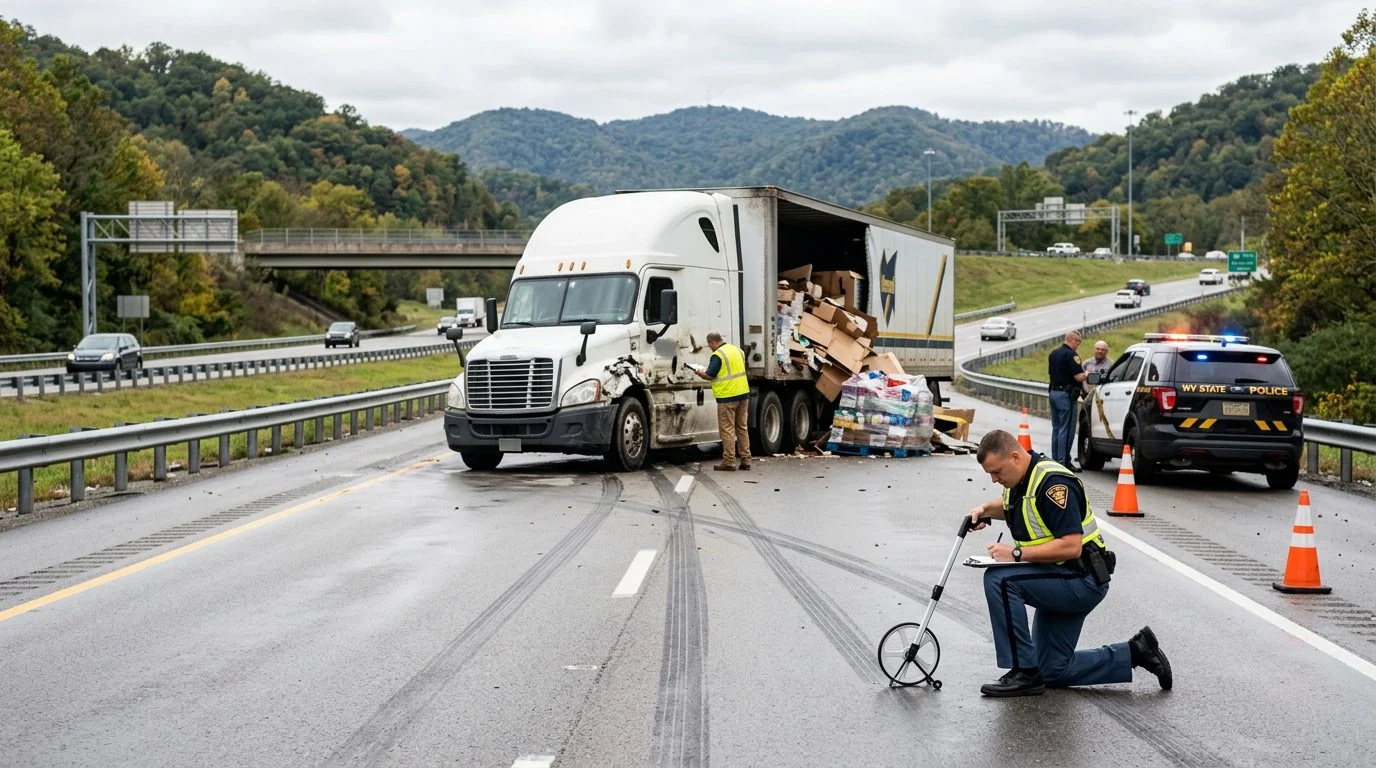
Truck Accidents | West Virginia
Getting a Truck Accident Police Report in West Virginia
A calm, step-by-step guide to the paperwork that follows a serious truck crash, and how to take the next step with help.
Published November 27, 2026
Waiting for a crash report after a truck wreck is stressful, especially if you’re still recovering. You may not know which agency has the report or how to ask for it.
To get a truck accident police report in West Virginia, find the agency that investigated, gather the crash details, submit a request, and check the report when it arrives. Each step is below, in order.
What a Truck Accident Police Report Is
A truck accident police report is the written record an investigating officer completes after a crash. People often call it a crash report, and in most cases the two names mean the same document.
State law sets what a crash report must show. Under W. Va. Code § 17c-4-9, the report must disclose the cause of the crash, the conditions at the time, and the people and vehicles involved.
In practice, a report usually lists the date, time, and location. It also lists the drivers and vehicles, insurance details, a diagram, and the officer’s written account. Those pieces help show what happened.
Remember that the report reflects what the officer saw and was told. It can contain errors or leave things out. Treat it as one piece of evidence, not the final word on the crash.
A commercial truck crash may also produce records from more than one source. The police report is only one of them.
If you're waiting on a truck crash report and aren't sure what it means for you, we're glad to talk it through in a free case review. Talk it through with Big Bubba — the first case review is free, confidential, and carries no obligation.

Why the Report Matters in a West Virginia Injury Claim
The police report can matter in a claim, but it rarely decides a claim alone. The state’s fault rule shows why.
West Virginia generally uses a modified comparative fault rule. Under W. Va. Code § 55-7-13c, your own fault does not bar recovery unless it is greater than the combined fault of everyone else responsible for the damages. If your fault is less, recovery is reduced in proportion to your share.
That is why fault matters so much. If another driver was at fault, the report may be one of several records used to support the claim. It may show how the crash happened, which vehicles were involved, and what the officer observed. How much weight it carries depends on the facts.
Some insurers may dispute a claim, even when a report exists. Other evidence, such as photos, witness accounts, and medical records, is often needed.
West Virginia generally allows two years to file a personal injury claim, and exceptions may apply. See W. Va. Code § 55-2-12. Waiting on a report should not push that deadline out of view.
Step 1: Find Out Which Agency Investigated the Crash
Start by identifying the agency that responded, because the request goes to that agency. The responding agency depends on where the crash happened. State Police often handle highways and rural areas. A county sheriff’s office often covers unincorporated county roads. A city police department usually covers city streets.
Who does it: You, or a family member helping you.
What you need: Any exchange paperwork, a roadside card, or the officer’s business card. Look for the agency name and a report or case number.
What comes next: Once you know the agency, you can make the request in Step 3. If the agency is unclear, call the local law enforcement office and ask whether it responded to the crash on that date and at that location.
Under W. Va. Code § 17c-4-7, for a crash resulting in bodily injury to, or death of, any person or total property damage to an apparent extent of $1,000 or more, the investigating officer must prepare the report within 24 hours after finishing the investigation. If the investigation takes more than 10 days, a preliminary report is due on the 10th day. Ask whether a final report is ready, since the timing can differ from case to case.
Step 2: Gather the Details You Need Before You Ask
Gather the crash details first. They help the agency match your request to the right report. Agencies usually look for a date, a time, and a location.
Who does it: You, or the person requesting on your behalf.
What you need: The crash date and approximate time. Add the exact location or nearest intersection, the names of the people involved, and the report or case number if you have it. Also note the truck company name, the unit or DOT number, and any trailer or cargo markings you saw.
What comes next: A written request, and possibly proof of who you are and how you’re connected to the crash.
Insurance details matter too. Under W. Va. Code § 17c-4-7, within 24 hours of a crash the investigating officer must provide owner, operator, and insurance information upon request for all the involved parties to each of the other involved parties, and to each party’s respective insurance agents. That information is due at no cost, whether or not the report is finished. The West Virginia Division of Motor Vehicles explains the state’s auto insurance requirements and proof of coverage, which helps you read what you receive.
Agencies may ask you to show a connection to the crash. That could mean you were a driver, a passenger, a vehicle owner, or the representative of an injured person or an estate. Rules vary by agency, so ask before you submit.
Keep a dated note of who you contacted, when, and what they said.
Step 3: Submit Your Request to the Agency
Submit the request the way the agency accepts it. Agencies may take requests in person, by mail, or through an online option. Ask which methods apply.
Who does it: You or your representative.
What you need: A written request with the crash details from Step 2, your name and contact information, and proof of your connection to the crash if the agency asks for it. Ask about any required form, identification, and copy requirements.
What comes next: The agency decides when and whether to release the report. Release can depend on the status of the investigation.
If the crash was fatal, the person who may bring a claim is the personal representative. Under W. Va. Code § 55-7-6, a wrongful death action is brought in the name of the duly appointed personal representative. If you hold that role, have proof ready, since an agency may ask for it.
Step 4: Check the Report When You Receive It
Read the whole report before you file it away. Small errors can matter later.
Who does it: You, or your attorney if you have one.
What you need: The notes you made in Step 2 and the original copy.
What comes next: If something is wrong, ask the agency how to request a correction or a supplement. The process depends on the agency.
Check names, addresses, vehicle descriptions, plate numbers, and insurance details against what you know. Review the diagram and narrative closely. An error in the order of events or the location can affect how the crash is read later. Keep the original, and write down the report number for later discussions.
Not sure what your next step is?
Talk it through with Big Bubba — the first case review is free, confidential, and carries no obligation.
Records Beyond the Police Report
A truck crash can create records the police report does not contain. The trucking company often holds the most detailed files.
Federal rules require motor carriers to keep certain driver records. Under 49 CFR 395.8, a carrier must keep driver records of duty status for at least six months from receipt. Under 49 CFR 390.31, legible copies that accurately reflect required records may be kept in place of originals. 49 C.F.R. § 390.31 reads: “Except as otherwise provided, copies that are legible and accurately reflect the information required to be contained in the record or document may be maintained in lieu of originals.”
Other records can include inspection and maintenance histories, cargo paperwork, dispatch communications, and electronic logging device data. These are often obtained through the claim process rather than from the police.
Your own records are separate and may matter too. Photos you took, witness names and contact details, and medical records all belong in your file. Write down what you remember while it’s fresh.

Common Steps After a Serious Crash
Waiting for a truck crash report while you recover is hard. It’s normal to worry about what comes next. If you or someone you love was seriously hurt, or a family member died, early records matter.
Wrongful death claims have their own timing. Under W. Va. Code § 55-7-6, a wrongful death action generally must start within two years after the death, and exceptions may apply.
Questions about the report, what it means for fault, and which records to request next are easier to work through early. For the broader picture, read our guide to truck accident claims in West Virginia.
If you’re waiting on a truck crash report and wondering what it means for your claim, request a free case review with the firm. We serve injury victims across West Virginia, and we handle truck accident claims.
Common questions
Is a crash report the same as a police report?
Usually, yes. People use both names for the written record an officer completes after a crash.
Who can get a copy?
The agency decides. It may ask you to show your connection to the crash.
How long do I have to file a claim?
West Virginia generally allows two years for personal injury claims, and exceptions may apply.