
Truck Accidents | West Virginia
When Cargo Falls, Who May Be Responsible?
Loads that shift or break loose can turn an ordinary drive into a serious crash. Here is how responsibility is commonly sorted out, and how the firm can help you look at your situation.
Published November 25, 2026
A truck accident caused by cargo that breaks loose can hurt people in seconds. If you’re asking who could be held responsible, you’re likely trying to make sense of something you never expected. Several parties may be responsible: the driver, the trucking company, the loader, and sometimes a broker or equipment provider. Which one applies turns on who controlled the load and how it was secured. Federal cargo securement rules and West Virginia fault law shape those answers, and this page walks through both.
What Happens When Cargo Shifts or Falls From a Truck
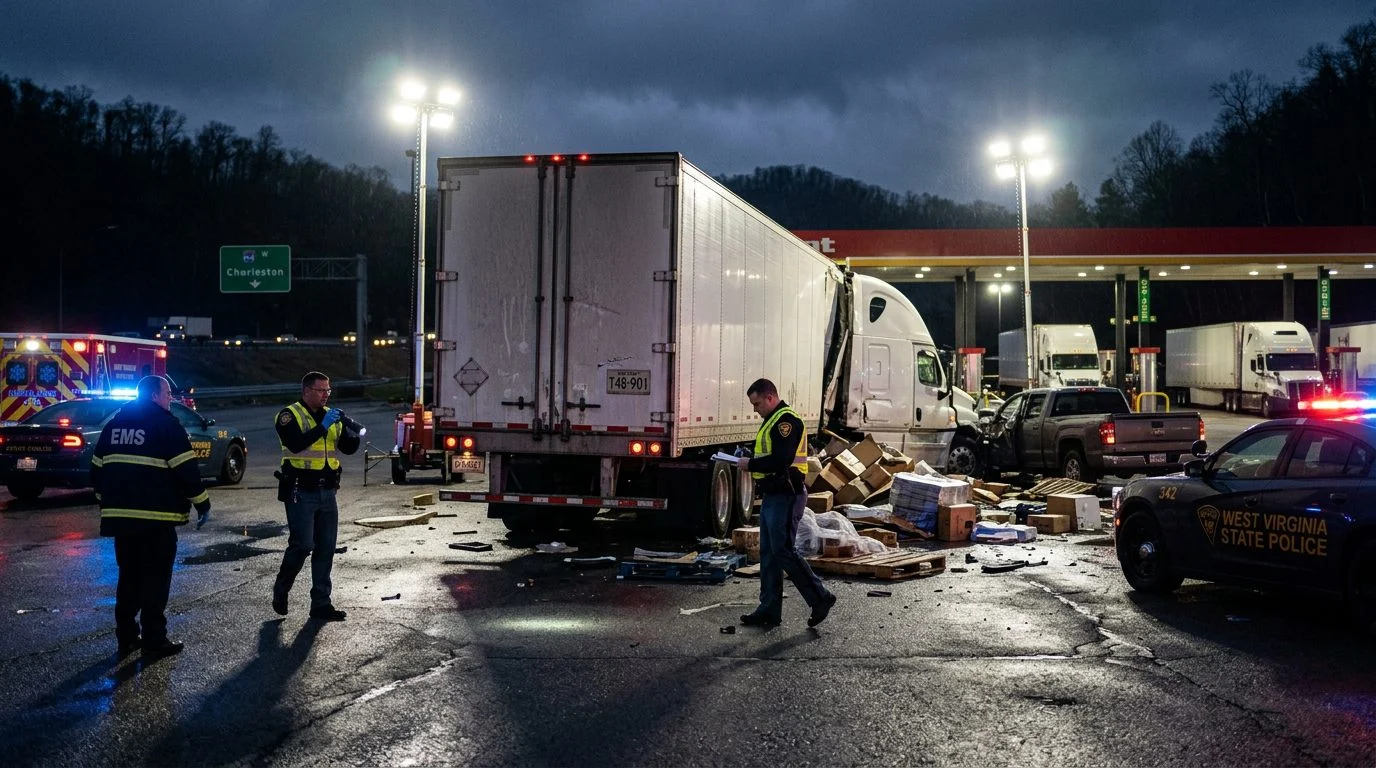
A cargo-shift crash happens when freight moves, breaks loose, or falls onto the road during transport. The load may land on a highway, strike a passing car, or spill across lanes. A truck may also lose control after a load shifts, which can send it into other lanes.
Possible causes include freight that wasn’t tied down firmly enough, pallets that slid, and straps, doors, or latches that failed. These are common possibilities, not findings. Every crash needs its own review before anyone can say what happened.
Injuries from these crashes can be serious. Drivers behind a falling load may be hit by debris, and people walking near the road may be struck. Injuries may include traumatic brain injury and spinal cord injury. How severe an injury is, and how long recovery takes, depends on medical evaluation and the facts of each case.
If a falling load hurt you or someone you love, you don't have to sort out the questions alone. Reach out for a free case review. Talk it through with Big Bubba — the first case review is free, confidential, and carries no obligation.

Federal Cargo Securement Rules and Why They Matter
Federal rules spell out how cargo must be secured on commercial trucks. Under 49 C.F.R. § 393.100, a commercial motor vehicle carrying cargo on public roads must secure that cargo. The goal is to keep it from leaking, spilling, blowing or falling off the vehicle. The same section also requires cargo to be secured against shifting that harms the vehicle’s stability or maneuverability.
Other sections add detail. Under 49 C.F.R. § 393.106, cargo must be firmly immobilized or secured by structures of adequate strength, dunnage, shoring bars, tiedowns, or a combination of these, except commodities in bulk that lack structure or fixed shape and are transported in a tank, hopper, box, or similar device that forms part of the structure of a commercial motor vehicle. Under 49 C.F.R. § 393.104, tiedowns must be in proper working order when used, with no damaged or weakened parts, such as cracks or cuts, that will adversely affect their performance for cargo securement purposes.
These rules cover trucks, truck tractors, semitrailers, full trailers, and pole trailers. The FMCSA cargo securement rules page describes federal requirements for commercial vehicles in interstate commerce. The West Virginia Division of Motor Vehicles also warns that unsecured cargo can cause serious or catastrophic crashes.
A violation may be relevant to fault. W. Va. Code § 55-7-9 reads: “Any person injured by the violation of any statute may recover from the offender such damages as he may sustain by reason of the violation, although a penalty or forfeiture for such violation be thereby imposed, unless the same be expressly mentioned to be in lieu of such damages.”
Can the Truck Driver Be Held Responsible?
A truck driver may be held responsible in some cases, but the answer turns on what the driver knew and did. Federal rules place duties on drivers. Under 49 C.F.R. § 392.9, a driver may not operate a commercial motor vehicle unless the cargo is properly distributed and adequately secured.
Under 49 C.F.R. § 392.9, the driver of a truck or truck tractor must inspect the cargo and its securement devices within the first 50 miles after beginning a trip, unless the vehicle is sealed and the driver has been ordered not to open it, or the load makes inspection impracticable. The driver must check again during the trip. For drivers of trucks and truck tractors, reexamination is required whenever the driver changes duty status, after the commercial motor vehicle has been driven 3 hours, or after 150 miles, whichever occurs first, unless the driver of a sealed commercial motor vehicle has been ordered not to open it to inspect its cargo, or the vehicle is loaded so that inspection of its cargo is impracticable.
Questions that may matter include:
- Did the driver check the load at the first stop and at later checkpoints?
- Did the driver notice shifting, unusual noises, or other warning signs, and respond to them?
- Was the driver’s speed unsafe for the load being carried?
A driver may have had little control over how freight was loaded. In that case, the loader or carrier may carry more of the question. If another driver was at fault, responsibility may extend to that driver.
Can the Trucking Company or Employer Be Held Responsible?
A trucking company may be held responsible for how its drivers handle a load. That depends on its relationship with the driver and the facts of the crash. Under 49 C.F.R. § 390.11, a motor carrier must require its drivers to follow the federal driver duties. That makes company policies on load checks, driver training, and equipment upkeep relevant.
West Virginia has a separate statute for employers in commercial vehicle cases. W. Va. Code § 55-7-32 can limit the noneconomic damages recoverable against an employer defendant in some crashes involving a commercial motor vehicle that requires a commercial driver’s license, for causes of action arising after July 1, 2024. That limit is subject to conditions, including an insurance requirement and exceptions tied to certain driver conduct.
Similar questions may matter when a carrier hired or supervised a driver.
The legal basis for an employer claim can vary, and each crash shapes the analysis. For more on this topic, read our guide to employer liability for truck drivers.
Shippers, Loaders, Brokers, and Other Parties
A shipper, loading company, or freight broker may share responsibility when a load was improperly secured. The party that loaded the trailer may control how freight is stacked, blocked, and strapped. If that work was careless, the loader may be relevant to fault.
A freight broker arranges transport but usually doesn’t load or drive the truck. A broker’s role may differ from a carrier’s. Other questions about the broker’s role still apply.
Contracts, loading records, and who had physical control of the cargo may shape which party is considered responsible. Equipment providers may also be relevant. A maintenance company or a parts maker could share fault if a defect contributed to the failure. Federal rules bar securement devices with cracks or cuts that weaken them.
West Virginia allocates fault by percentage among everyone who contributed to the harm. That includes people who are not parties to the case. See W. Va. Code § 55-7-13a.
Evidence That May Help Show Who Was Responsible
Photos, the crash report, and the load paperwork may help show who controlled the cargo. Each type of record answers a different question.
Scene photos and photos of the load can show how the cargo was tied, blocked, or stacked. The crash report may record the officer’s observations and the parties involved. Witness names and contact details may matter later. Dash camera footage, if it exists, may show the cargo moving before the crash.
Load documents may matter too. Bills of lading, loading records, and inspection records may show who packed and arranged the freight. Driver logs may show when a driver changed duty status, which can connect to the reexamination timing in 49 C.F.R. § 392.9.
Some records are held by the carrier or by other companies. Written requests and early notice may help make sure those records are kept. Which evidence matters most turns on the facts of the crash.
Not sure what your next step is?
Talk it through with Big Bubba — the first case review is free, confidential, and carries no obligation.
Wrongful Death and Family Questions After a Falling-Load Crash
When a falling load causes a death, the family may be able to bring a wrongful death claim in West Virginia. Under W. Va. Code § 55-7-6, the claim is brought by the personal representative of the deceased person’s estate.
The statute lists the kinds of damages a jury may include. These cover sorrow, mental anguish, and solace, reasonably expected loss of income and services, expenses for the decedent’s care and hospital treatment, and reasonable funeral expenses. The court or jury may also direct how damages are shared among survivors.
Timing is a key issue. Under the same statute, a wrongful death action generally must be started within two years after the death, and exceptions may apply. West Virginia generally allows two years for personal injury claims under W. Va. Code § 55-2-12, and exceptions may apply there too.
Fault rules matter as well. Under W. Va. Code § 55-7-13c, a plaintiff’s own fault bars recovery only if it is greater than the combined fault of all other persons responsible. Otherwise, recovery is reduced in proportion to the plaintiff’s share of fault.
Losing someone is hard enough without also learning legal deadlines on your own. Raising timing questions early can help a family plan.
When a Falling Load Affects You or a Loved One
If a falling load hurt you or someone you love, the questions in this article can feel overwhelming. You may be reading this after a frightening crash, while caring for an injured family member, or while sorting through conflicting reports.
Answering who may be responsible usually takes the crash details and the load records. Those can be hard to gather alone. We handle truck accident and wrongful death claims across West Virginia, including commercial vehicle crashes and cases involving catastrophic injuries. We serve injury victims throughout the state.
If you want to walk through what happened, you can reach out for a free case review. It’s confidential, and there’s no obligation to continue.