
Truck accidents | West Virginia
Truck Accident Evidence: What to Protect in the First 90 Days
Commercial trucks leave behind more records than most crashes. Here is how to keep track of them while your memory is fresh.
Published November 21, 2026
If you were hurt in a truck crash, or you are helping someone who was, the first weeks can feel like a blur. This page maps the truck accident evidence that may exist, who holds it, and what can be lost if no one asks for it.
Truck crash evidence sits in two main places: the scene and the vehicles, and the trucking company’s files. Some of that evidence may be overwritten or discarded in the normal course of business. That is why timing matters.
Why the First 90 Days Matter for Truck Crash Evidence
Early action matters because some truck crash evidence may be lost if no one asks for it in writing. A car crash often leaves evidence on the road and in two vehicles. A truck crash adds another layer.
The trucking company, its driver, and sometimes outside vendors keep records about the trip, the truck, and the driver. Those records do not always stay on file. Some are kept on short schedules under federal rules.
This page is a general timeline, not a prediction. What matters in any one crash may depend on who was at fault, the injuries, and which records exist. Think of it as a map of what to check and when.
For a wider look at how these claims work, read our guide to truck accident claims in West Virginia. We handle truck accident claims and commercial vehicle cases across the state.
If you are sorting through a truck crash for someone you love, you do not have to sort through it alone, so reach out and ask for a free case review. Talk it through with Big Bubba — the first case review is free, confidential, and carries no obligation.

Days 0 to 7: What Evidence Exists at the Scene and Who Holds It
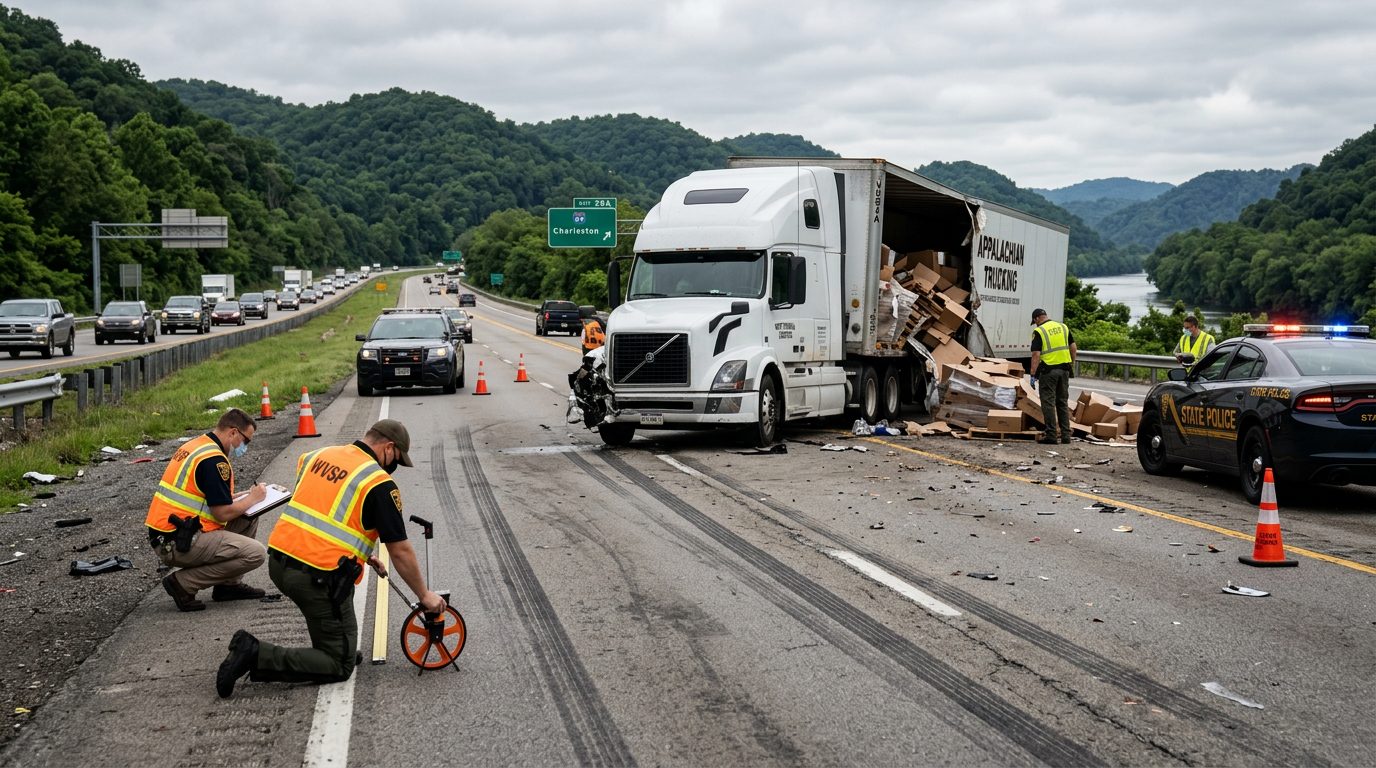
In the first week, the scene and the vehicles hold the most direct evidence. That evidence can change or disappear quickly.
Useful scene evidence includes:
- Photos of where the vehicles came to rest
- Skid marks, debris, and road and weather conditions
- The truck’s markings, including the carrier name, the USDOT number on the cab, and the trailer number
- Names and phone numbers of witnesses and other drivers
West Virginia requires a driver in a crash involving injury or $1,000 or more in property damage to report it right away. The report goes to the local police, the county sheriff, or the State Police, depending on where the crash happened. See crash notice requirements. The driver must also give notice of the crash immediately by the quickest means of communication. Under W. Va. Code § 17c-4-3, a driver involved in a crash, if physically able to do so, must give the other party his or her name, a valid telephone number, the year, make, model and last four digits of the vehicle identification number, and proof of security and financial responsibility, including insurance information; see driver duties after a crash. See driver duties after a crash.
Medical records start the day of the crash. Prompt, steady treatment builds the injury record that later evidence is compared against. Gaps in care may later be questioned by an insurer.
Trucks and cars are often towed to a yard or repair shop. Write down the tow company’s name and where each vehicle went. The vehicle’s location can decide who gets to inspect it.
Also know this rule. For 20 days after an injury, others may not try to settle your claim or take a statement from you while you are in the hospital or unable to work. The exception is narrow: a person acting for you may take a statement from you, but only when you make an express request for it. See West Virginia’s 20-day settlement limit.
Days 1 to 30: Preservation Letters and the Trucking Company’s Records
A written preservation letter asks the trucking company to keep its records before they are discarded. A lawyer or the injured person can send it. It also creates a written record that the company was asked.
Records that may matter include:
- Electronic logging device (ELD) data, which tracks hours of service
- Dispatch and driver communication logs
- Maintenance and inspection files
- Driver qualification files
- Drug and alcohol testing records
Federal rules limit how carriers handle ELD data. A motor carrier must not alter or erase the original hours-of-service information or the data that feeds it. See the federal ELD record rules.
Retention periods vary by record type. Drug and alcohol collection records must be kept for at least two years. 49 C.F.R. § 382.401 reads: “Records related to the alcohol and controlled substances collection process (except calibration of evidential breath testing devices) shall be maintained for a minimum of 2 years.” Negative test results must be kept for at least one year. See federal records retention rules.
Federal rules also require some carriers to test a driver for alcohol after certain crashes. One example is a crash with injury that needs immediate treatment away from the scene, where the driver receives a citation within 8 hours of the occurrence under State or local law for a moving traffic violation arising from the accident. The test should happen as soon as practicable. If it is not done within two hours, the carrier must record why. After eight hours, the carrier must stop trying. See post-accident testing rules.
Dash camera video may also exist if the truck had one. Many systems record over older footage on a loop. Ask for it in the same letter.
Days 8 to 30: The Crash Report and the Vehicle Inspection
The investigating officer generally must prepare the crash report within 24 hours after finishing the investigation. The report may be written or electronic. See crash report rules.
Within 24 hours of a crash, the officer must share owner, operator, and insurance information on request. That information is provided at no cost, even before the report is finished. If the investigation cannot be finished within 10 days, a preliminary report is filed on the 10th day.
A report usually includes the officer’s observations, a diagram, and any citations. The report may be supplemented later. Read it closely for errors, and note any you find.
Our step-by-step crash report guide explains how to request one.
Vehicles should be inspected before they are repaired, salvaged, or sold. A documented inspection can matter later, especially for the truck’s brakes, tires, and lights. Photos taken during the inspection help too.
Accident reconstruction work often starts in this window. Scene measurements and vehicle data are usually easier to collect now than months later.
Days 30 to 60: Medical Records and the Injury Timeline
Medical records from every provider build the injury timeline from the crash forward. That includes emergency care, imaging, follow-up doctors, and therapy.
Keep every discharge summary, bill, and appointment note. Each one shows what was reported and when. Gaps in treatment, or sudden changes in symptoms, may be looked at closely by insurers and courts.
Some injuries need long-term follow-up. Traumatic brain injury and spinal cord injury may require ongoing testing. Recovery can be uncertain and differs from person to person. Don’t assume a short-term improvement means the injury is over.
A written injury diary helps connect the medical record to daily life. Note pain levels, sleep, missed work, and tasks you can no longer do. Keep the diary in your own records. Do not give it to anyone without thinking about it first.
Some insurers may dispute a claim or ask for records early. Responses to those requests may be relevant later. Keep copies of everything you send and receive.
Days 60 to 90: Witnesses, Statements, and Scene Documentation
Witness memories fade, so statements taken closer to the crash may carry more weight. Ask for names and contact details early, and note when each person was reached.
Scene measurements, photos, and mapping done at this stage may support accident reconstruction. These materials may be relevant to who had the right of way and how the crash happened.
Statements to an insurance company are not the same as talking with a lawyer. Before you answer, ask what is being asked. Take your time, and stick to facts you know. If you don’t know, say so.
Under W. Va. Code § 55-7-11a, during the first twenty days after a personal injury, while the injured person is an inpatient or partially or totally unable to work, no one may negotiate a settlement, seek a release, or obtain a statement for use in a settlement (though a person acting for the injured person may take a statement at the injured person’s express request), and a settlement, release or statement made in violation of that restriction may be disavowed by the injured person at any time within one hundred eighty days after the personal injury by signing a written statement of disavowal and then sending a copy of it to the person who violated the section, in which case it may not be used as evidence in any court or other proceeding about the injury, provided any money paid for the settlement or release has been repaid or returned to the payer by the time the copy is sent. See § 55-7-11a.
Keep a simple log of who was contacted, when, and what was sent. That log is useful in its own right. It shows the sequence of events clearly.
Not sure what your next step is?
Talk it through with Big Bubba — the first case review is free, confidential, and carries no obligation.
Deadlines to Keep in View: The Filing Deadline and Related Timing
West Virginia generally allows two years from an injury to file a personal injury lawsuit, and exceptions may apply. See West Virginia’s two-year limit.
Under W. Va. Code § 55-7-6(d), a wrongful death action must be commenced within two years after the death of the deceased person, subject to section eighteen, article two, chapter fifty-five, and that subsection does not apply to deaths occurring before July 1, 1988. It is brought by the personal representative who has been duly appointed. See wrongful death action rules.
Evidence deadlines can come much earlier than the filing deadline. A short federal records period may end months before a lawsuit deadline. That is why the first 90 days matter.
Families handling a death case can use our wrongful death checklist for spouses to track these steps.
How Long a Truck Accident Claim Can Take
The length of a truck accident claim varies widely from case to case. It can move quickly or take much longer, depending on the injuries and the records.
Most claims move through the same general stages. First comes investigation and evidence gathering. Next comes medical treatment and documentation. Then comes a demand or negotiation. If needed, a lawsuit adds discovery, motions, and possibly a trial.
A claim that settles without a lawsuit may move faster. A lawsuit can take longer because it adds formal exchanges of information and court steps. Neither path can be predicted from the crash date alone.
Parents whose child was hurt may find our guide for parents of an injured child useful.
How long does a truck accident lawsuit take?
A lawsuit usually takes longer than a claim resolved by negotiation. The length depends on the case, the records, and the court schedule.
What should I do first after a truck accident?
Write down the carrier name, the USDOT number, the crash report number, and every provider’s name. Then ask for the trucking company’s records in writing as soon as you can.

If You Are Reading This for Someone Else
Many people read about truck crash evidence for a parent, spouse, child, or friend. That person may be in the hospital, in rehab, or unable to make decisions alone.
If that is your situation, start a single file. Put in the dates, the carrier name, the crash report number, and the providers’ names. Those details are easy to lose during a hard few weeks.
We serve injury victims across West Virginia, including Charleston and Morgantown. If you are sorting through a truck crash for someone you love, you do not have to do it alone. Reach out to us and ask for a free case review of your situation.