
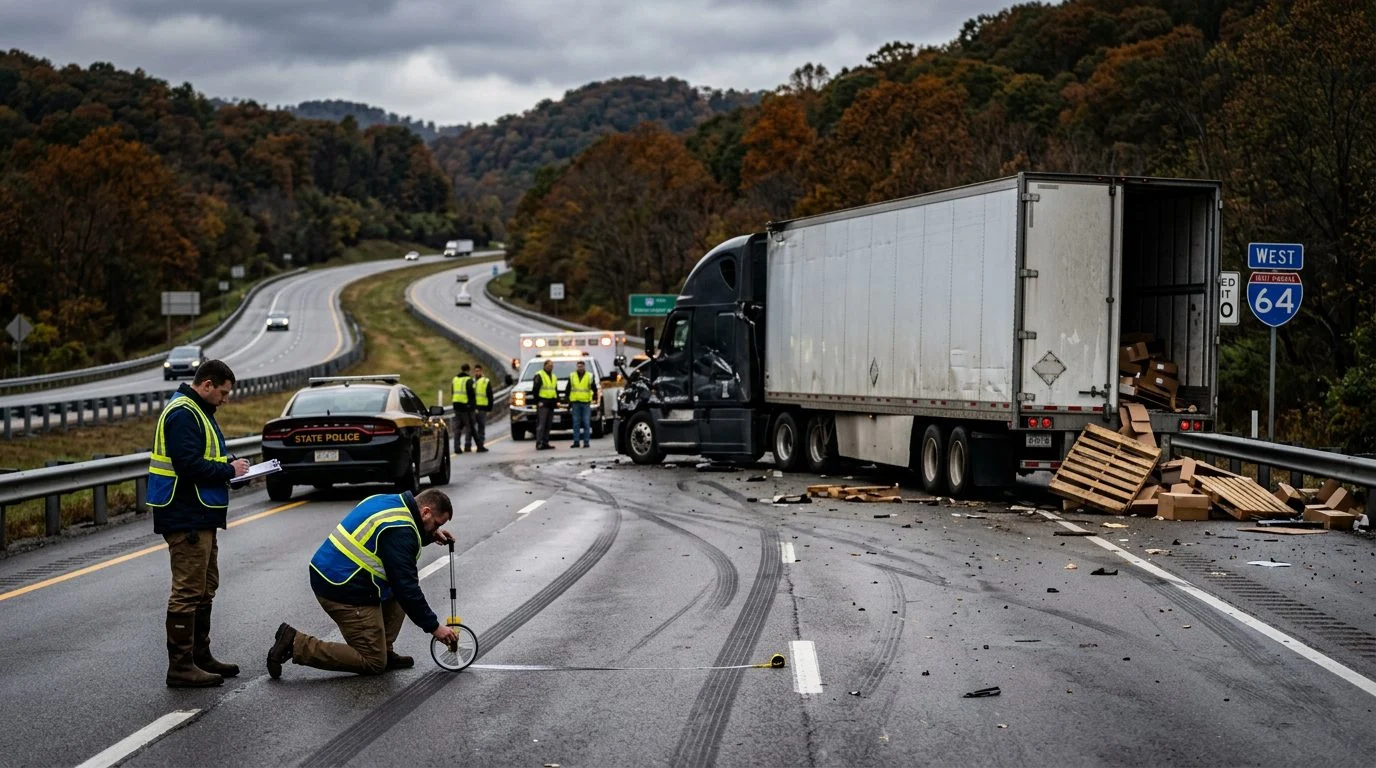
Truck Accidents in West Virginia
Truck Accident Free Case Review Checklist
Use this list to gather what you have while the details are still fresh, and mark what is missing. You do not need everything before you reach out.
Published November 11, 2026
A commercial truck crash can leave you hurt, shaken, and unsure what to do next.
After a truck crash, a useful first step is to write down what you know now and set aside the papers you already have. This is general information, not advice about your claim, and every crash depends on its own facts.
Who This Truck Accident Checklist Is For
This checklist is for people hurt in a crash involving a commercial truck, and for families of people killed in one, in West Virginia.
Truck cases often involve more records than car crashes. The police, your medical providers, and the trucking company may each hold a different piece of the story. Memories fade, and some records are kept for only a limited time.
Work through each section. Answer each yes-or-no test, and write “unknown” where you are not sure. You don’t need every item before you reach out.
We serve injury victims and families across West Virginia. If you’re unsure where to start, contact the firm and ask for a free case review.
If a commercial truck crash left you or someone you love hurt, reach out to the firm and ask for a free case review of the papers you have gathered. Talk it through with Big Bubba — the first case review is free, confidential, and carries no obligation.

Crash Details to Write Down Now
Write down the date, time, location, and what you remember while the details are still fresh.
- Do you know the date, time, and exact location? A street name, mile marker, or nearby landmark helps place the scene. If not, mark it unknown.
- Can you describe the weather, road surface, and lighting? These conditions often appear in crash reports and may matter, depending on the facts.
- Can you state your direction of travel and the truck’s direction? The order of movements is central to how a crash is reconstructed.
- Did you write down what you saw, heard, and felt? Early notes capture details that fade fast. Write down the date you made the notes.
If any answer is no, list the missing details on a separate sheet. Mark them unknown rather than guessing.
Reports, Records, and Paperwork to Gather
Gather every police, insurance, and court paper you already have, and keep the originals in one folder.
- Do you have the crash report number? The responding agency assigns a number that identifies the crash file.
- Do you have a copy of the crash report? The report can list officers, vehicles, and any citations. If you don’t have it, note the agency and date and ask how to request it.
- Do you know the names or unit numbers of the responding officers? Names help locate the file and any later statements.
- Do you have insurance letters, claim numbers, or adjuster names? These help track every claim tied to the crash.
- Do you have tickets or court papers from the crash? These may show what was recorded at the scene.
Make copies of everything, and keep the originals safe.
Photos, Video, and Physical Evidence
Photos and video taken soon after a crash can show positions, damage, and road conditions.
- Do you have photos of the scene, the vehicles, skid marks, or debris? Early photos can show where things came to rest.
- Do you have photos of your injuries taken over time? Bruising, bandages, and braces photographed over weeks can show how injuries changed.
- Do you have dashcam, phone, or nearby business video? Footage may be overwritten quickly. Tell the firm about it even if you’re unsure it still exists.
- Do you still have damaged items, such as a helmet, phone, or clothing? Don’t throw them away before you discuss them. They may be relevant.
- Did you save your phone’s call log or messages from the time of the crash? Timing records may be relevant, depending on the facts.
For each photo or video, write down where it is stored and who took it.
Witnesses and Your Medical Notes
Keep a list of witnesses and every provider who has treated you since the crash.
- Do you have names and phone numbers for anyone who saw the crash or arrived right after? Accounts from witnesses can add to what the police report records.
- Do you know of passengers or drivers in nearby vehicles? They may have seen the truck’s movements before the crash.
- Do you have a list of every doctor, hospital, urgent care, therapist, and pharmacy you have used? A full treatment list helps organize medical records.
- Do you have discharge papers, imaging reports, and treatment plans? These records describe diagnoses and the treatment that was recommended.
- Do you keep a daily journal of pain, sleep, memory, mobility, and daily tasks? A written record can show how an injury affects your life. For more on these injuries, see traumatic brain injury and spinal cord injury overviews from public health sources.
- Do you have bills, prescription receipts, and out-of-pocket records? These show the costs you have incurred.
If records are missing, ask each provider for copies. Bring your treatment list even if the records are incomplete.
The Truck, the Driver, and the Company
Write down the trucking company’s name and the USDOT number on the truck, if you can see them.
- Can you read the company name or USDOT number on the truck? The number identifies the carrier involved.
- Do you have the driver’s name and the employer’s name? The driver and the company may be different entities.
- Do you have the trailer number, plate number, and any cargo details you saw? Cargo can matter if a load shifted or fell.
- Did anyone give you an insurance card, phone number, or adjuster name? These contacts help track who is handling the claim.
- Did you see the driver using a phone or appearing unwell? Observations like these may be relevant, depending on the facts.
Federal rules set time limits for post-accident testing. If a required post-accident alcohol test isn’t given within two hours, the employer must record why, and attempts stop after eight hours. A test is required, for example, after a crash involving a death, or when the truck driver is cited and someone is treated away from the scene or a vehicle is towed (49 C.F.R. § 382.303). Federal rules also require most carriers to keep driver inspection reports, certifications of repairs, and certifications of the driver’s review for three months from the date the written report was prepared (49 C.F.R. § 396.11), except that the rules do not apply to a private motor carrier of passengers (nonbusiness), a driveaway-towaway operation, or any motor carrier operating only one commercial motor vehicle. Because some records are kept briefly, the sooner they are requested, the better.
Some insurers may dispute a claim. Keep copies of every written message from any insurer or company representative.
Not sure what your next step is?
Talk it through with Big Bubba — the first case review is free, confidential, and carries no obligation.
What Happens at Your Free Case Review
A free case review is a first meeting to talk through your situation and the papers you have gathered.
- Before: Sort your papers into folders, mark what is missing, and write down your questions.
- During: Explain the crash in your own words. Walk through your folders, and describe your injuries and how they affect work and daily life.
- After: The firm can explain what it sees in your materials and what steps may follow, depending on the facts.
The free case review is confidential, and there is no obligation to continue after it.
Time limits matter. West Virginia generally allows two years to bring a personal injury action, and exceptions may apply (W. Va. Code § 55-2-12). Under W. Va. Code § 55-7-6, a wrongful death action must be brought in the name of the decedent’s duly appointed personal representative and commenced within two years after the death, subject to the provisions of section eighteen, article two, chapter fifty-five, and the section does not apply to actions for a death occurring before July 1, 1988. Ask the firm about your own deadline.

Questions Readers Ask Before Calling
Bring what you have. You don’t need every item on this list to reach out.
Do I need every item before I call?
No. Bring what you have, mark what is missing, and let the firm help you sort the rest.
Can I bring a family member?
When you call, you can ask the firm how it arranges a free case review.
What if I don’t have a police report yet?
Note the agency name and the date of the crash. Ask the firm how to request the report.
Should I give an insurer a statement right away?
West Virginia limits some settlement talks and statements within twenty days of an injury in certain situations (W. Va. Code § 55-7-11a). Talk with the firm before giving a recorded statement.
Does this checklist mean my claim is strong?
No. The checklist only organizes information. Whether a claim exists depends on the facts and the law.
If a truck crash hurt you or took someone you love, and you are sorting through reports and medical papers, tell the firm what happened. Bring this checklist and contact the firm to ask for a free case review.